
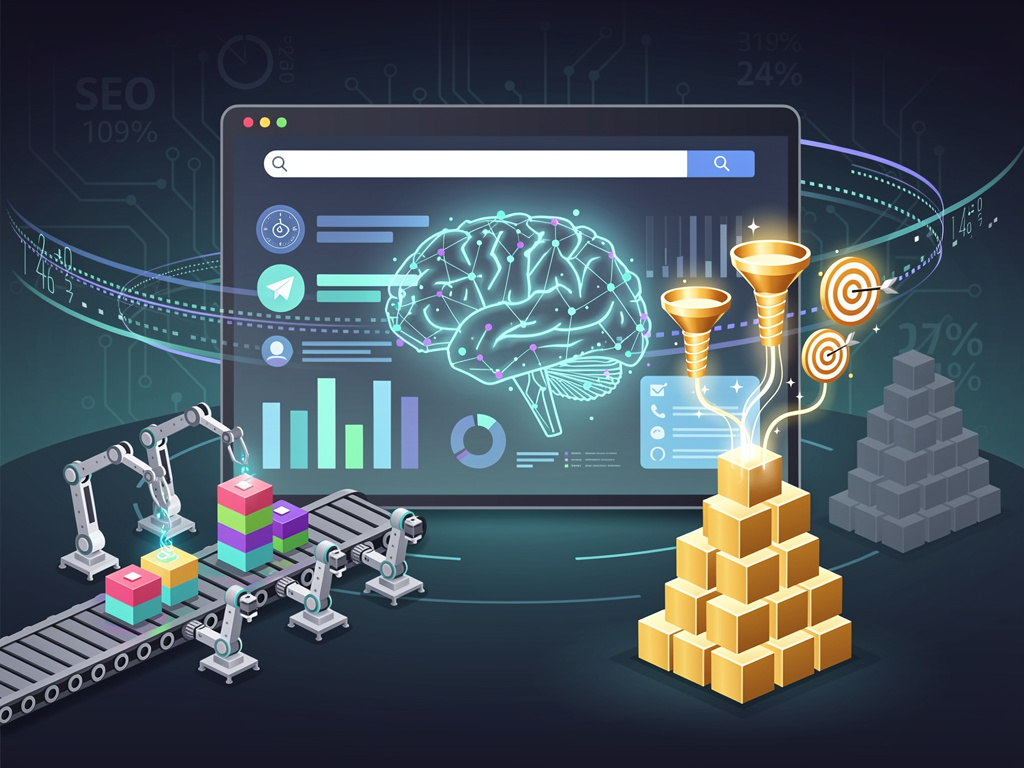
Search results look nothing like they did two decades ago. A top organic spot for “flowers” once drove serious traffic and sales. Today that same position sits buried beneath ads, shopping carousels, local packs, and AI-generated summaries. Yet seasoned optimizers insist their work has never mattered more.
Steve Liu has optimized since before the term SEO existed. In a Search Engine Land article published today, he argues that artificial intelligence will not erase expertise. It will bury shallow tactics instead. Practitioners who grasp user behavior, technical systems, content strategy, and business outcomes stand to gain. Those who treat optimization as title-tag tinkering face obsolescence.
The warnings come from high places. Verizon’s CEO spoke of potential 20-30% U.S. unemployment from AI. Anthropic’s leader predicted half of entry-level white-collar roles could vanish. Ford’s chief echoed similar fears. SEO sits squarely in that category. But history shows the field adapts. Articles declared it dead in 2005 and again in 2009. Traffic kept flowing. The definition simply changed.
Modern SERPs pack far more than blue links. AI Overviews reach two billion users monthly, according to Google data cited in Semrush research. Roughly 60% of searches produce no clicks. When summaries appear, only 8% of users tap traditional results. The old click metric no longer tells the full story. Visibility inside those summaries matters now. So does the quality of traffic that does arrive.
Visitors referred by AI convert at striking rates. They prove 4.4 times more valuable than traditional organic ones, per Semrush’s compilation of 26 AI SEO statistics. They bounce 27% less on retail sites and spend 38% more time exploring pages. Even modest citation rates can deliver outsized revenue. Nearly 70% of companies already report higher returns after folding AI into their SEO and content processes. Speed and scale explain much of the lift. Teams publish faster. Strategists gain breathing room.
Expertise Separates Leaders from Prompt Engineers
AI handles repetitive work with startling speed. It clusters keywords, drafts metadata, spots content gaps, and turns vague recommendations into developer tickets. Yet output quality tracks directly to input sophistication. Generic prompts yield generic results. Experts feed systems rich context from Google Search Console, GA4, competitor data, and business goals. They challenge answers, correct hallucinations, and iterate until findings drive decisions.
Liu describes uploading large datasets and asking precise questions. Which topics does the site clearly own? What competitor keywords sit inside reachable topical neighborhoods? Which landing pages draw impressions but fail to convert? These queries once consumed days. Now they produce strong first drafts in minutes. The human edge lies in validation, synthesis, and translation into action.
Job postings reflect the shift. An analysis of 3,900 listings by Semrush, detailed in their March 2026 study, shows AI mentioned in 31% of senior roles and 22% of others. Familiarity with large language models appears in nearly 10% of senior postings. Median pay for those senior positions hits $130,000, almost double the $71,630 figure for other SEO jobs. The highest reported salary reached $840,000. Companies want visibility strategists who connect traditional rankings, AI citations, and commercial results.
A companion Search Engine Land piece from 2025 lists 12 skills every specialist should master. Strategic thinking tops the list. AI and machine learning literacy follows closely. Professionals need not become data scientists. They must understand how models like BERT or Gemini shape ranking and summarization. Prompt engineering ranks high too. The best operators treat AI as a co-pilot that still requires supervision.
Other demanded abilities include content storytelling, UX fundamentals, advanced analytics, technical depth in server-side rendering and schema, multimodal optimization, brand reputation management, and emotional intelligence. The role has broadened. Senior practitioners function as conductors who align search visibility with larger growth objectives.
And the data keeps arriving. AI search traffic jumped 527% year-over-year in one tracked set of properties. Projections suggest it could overtake traditional search by 2028. Over 88% of AI Overview triggers involve informational queries. More than two-thirds appear on low-competition terms. These patterns favor sites that deliver clear, authoritative answers rather than keyword-stuffed pages.
Business and service websites account for half the links cited by ChatGPT. Users click an average of 1.4 external links per ChatGPT session, more than double Google rates. The intent feels different. People verify, explore, and act. Brands that earn repeated citations gain compounding advantage.
Recent discussions on X reinforce the message. Practitioners note that early success in answer engine optimization rested on prior SEO authority. One agency founder stressed genuine expertise cannot be skipped. Another highlighted Google’s fresh guidance: unique content, strong fundamentals, images, video, and demonstrated experience will drive visibility. Shortcuts won’t survive.
Tools evolve too. Open-source agents promise to automate keyword research, content calendars, and link outreach. Yet users report the strongest outcomes come when humans set direction and review output. The pattern repeats across industries. Filmmakers who master pacing and emotion produce memorable AI-assisted videos. Everyone else generates forgettable clips.
SEO has always mixed technical analysis, creative strategy, and business acumen. AI amplifies each element but cannot replace the synthesis. It cannot intuit unspoken customer needs or weigh trade-offs between short-term traffic and long-term trust. It cannot own outcomes when algorithms change or platforms update policies.
So the experts persist. They prototype page layouts grounded in real user data. They craft distinct title tags, Open Graph descriptions, and structured markup tailored to different surfaces. They translate marketing priorities into precise technical tickets that developers can execute without guesswork. They mine search data for patterns no spreadsheet could reveal in reasonable time.
Executives who once viewed SEO as a cost center now see strategic infrastructure. Those who treat it as infrastructure invest in people who can guide AI, interpret signals across channels, and tie every recommendation to measurable growth. The practitioners who combine domain depth with tool fluency command premiums. Their value rises precisely because automation handles the mundane.
Search will keep changing. Zero-click results may grow. New AI interfaces will emerge. Yet the core task remains. Understand what people seek. Deliver answers they trust. Appear where they look. The professionals equipped to do that at scale, with machines as collaborators rather than replacements, occupy an enviable position. Their expertise has not diminished. The market has finally begun to price it correctly.


 WebProNews is an iEntry Publication