
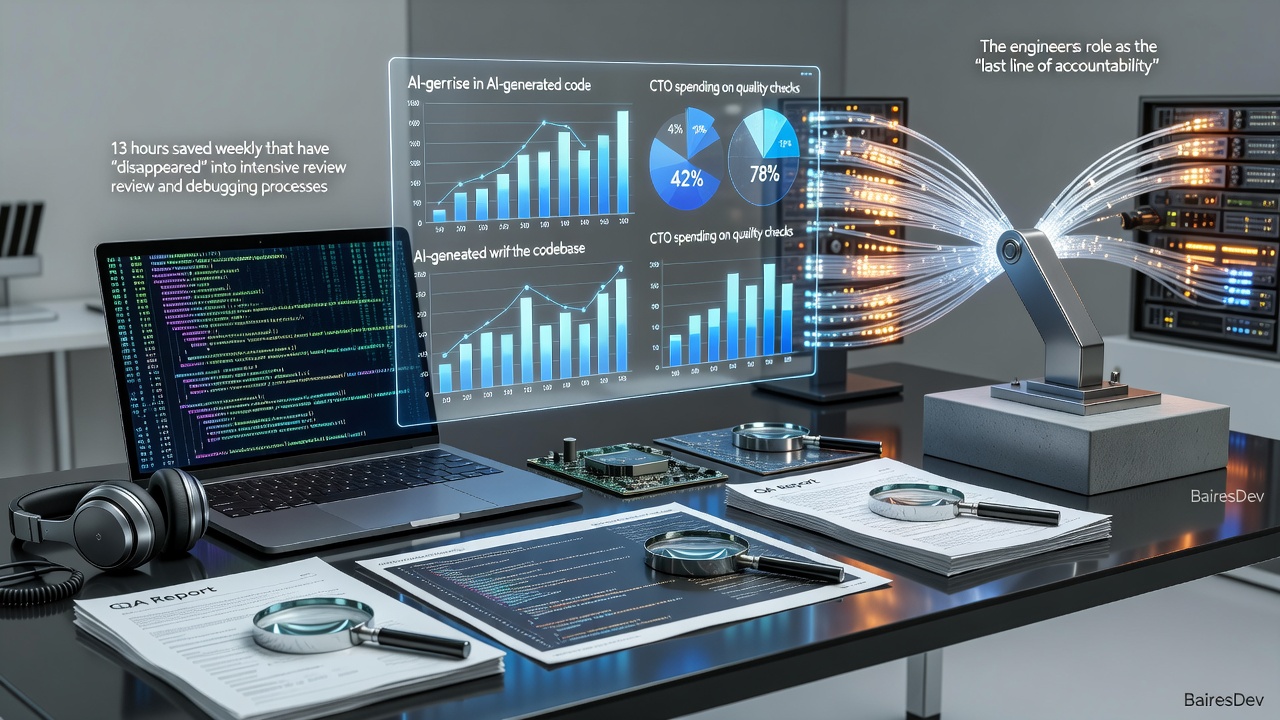

Forty-two percent of software developers now say artificial intelligence writes at least half their code. A year ago, that figure was 12%.
Those numbers come from BairesDev’s Q3 2026 Dev Barometer, fielded in August among 705 developers in more than 60 countries and, for the first time, 41 enterprise CTOs. VentureBeat reported the jump on September 15. The same dataset, carried as a company statement by Markets Insider, shows that only 21% of developers still spend more than half their week writing new code from scratch. The rest of the week has moved. Review. Debugging. Learning the next tool.
AI saves them 13 hours a week on coding, nearly double the seven hours they reported in Q3 2025. The median sits at 10 hours, which means a smaller group of heavy users is lifting the average. Not one of those hours came back as free time.
“Developers nearly doubled the time AI saves them in coding, to 13 hours a week. Not one of those hours came back,” BairesDev CEO Darren Shimkus said in the firm’s Dev Barometer analysis. “Reviewing check-ins. Fixing what the model broke. Learning next quarter’s tool. A year ago we read the first seven hours as capacity, and we got that wrong.”
The typing got cheaper. The thinking didn’t. Sixty-seven percent of developers say they spend more time reviewing AI-generated code than they did a year ago. Fifty-two percent spend more time debugging problems the models introduced. Fifty-nine percent report greater mental effort just to catch subtle bugs in output they didn’t fully write. Developers now put nine hours a week into learning AI tools and new technologies, up from four. Fudzilla noted this week that 72% now use AI for at least a quarter of their code. Code volume rose. The share of the week spent producing it fell. More output is moving through the same people qualified to approve it.
And CTOs are writing checks to match. Seventy-eight percent of the 41 technology chiefs surveyed increased spending on code review, quality assurance, or validation to support AI-generated work. Just 7% of developers say the decision to ship has been handed entirely to AI without their input. Forty-one percent say virtually no AI-generated code reaches production without a specific human look. Fifty-eight percent report greater personal accountability for code they did not fully write. In Q1 2026, 51% already said that accountability sat with them. It is concentrating, not spreading.
Shimkus put the bind in plain language. “In Q3 2025, 12% of developers said AI wrote half their code. Today it’s 42%, and the decision to ship it still sits with one engineer, for far more code than it used to. That’s why 78% of CTOs increased spending on review and validation. Every one of those dollars buys the same thing, which is an accountability layer that is currently one person deep.”
The trust gap is older than this survey. Stack Overflow’s 2025 Developer Survey, with more than 49,000 responses, found 80% of developers using AI tools in their workflows and only 29% trusting their accuracy, down from 40% in earlier years. Sixty-six percent said they were spending more time fixing AI-generated code that was “almost right.” Seventy-five percent said they would still turn to another person when they did not trust an AI answer. Adoption ran ahead of confidence then. It still does.
Agents have since become ordinary equipment. JetBrains’ 2026 Developer Ecosystem Survey of more than 15,000 professional developers found that 90% were using AI coding agents at work at least weekly from May through July, with 68% using them daily. A companion JetBrains Research analysis found that over half now write less than 20% of their code by hand. One in five writes none without AI help. Senior developers are among the first to hand the keyboard over. About a quarter of them generate more than 80% of their code with agents.
But production is not a prototype. Shimkus told VentureBeat he expects personal accountability for code to move toward 100%, even as the share generated by machines keeps rising. The line he hears from enterprise customers is simple: if an engineer cannot explain what AI-generated code does and why it works that way, the organization will not let that engineer check it in. “In a world where we don’t have AI explainability, I need developer explainability,” he said. Prototypes can tolerate more autonomy. Software that serves thousands of companies or millions of consumers, he added, “will not happen without review, at least not anytime soon.”
Developers, for their part, say the work feels better. Eighty-six percent now say AI has made their role more fulfilling, up from 76% a year ago. Satisfaction climbs with use: 58% among those who barely use the tools, 95% among those who lean on them heavily. That fulfillment has a cost attached. Almost half, 46%, say token costs or usage limits changed how they work over the past year, and the most common response was to cut back on their own. Twenty-one percent use AI tools their employer has not approved, most often because the approved options lack features they need.
Pay is starting to follow the new work, though not evenly. Among developers who received raises in 2026 on AI-related grounds, 29% pointed to AI tool fluency and prompting, 20% to system design and architecture, and 15% to human skills such as communication, mentorship, and cross-functional collaboration. Only one in four of the surveyed CTOs said they were actively investing in those human skills. They concentrated budget on AI fluency, data infrastructure, AI quality assurance, and AI security instead. System design, the capability the oversight layer actually runs on, ranked second among developers as a raise driver and sixth among the areas CTOs funded.
That judgment problem is already showing up between generations. In a BairesDev Q2 2026 survey, only 16% of senior developers said junior engineers fully understand the AI-generated code they submit.
The numbers need a caveat. The CTO sample of 41 is much smaller than the developer sample, and the survey comes from a software services company that sells engineering talent. Treat the percentages as a directional read on a fast-moving trade, not a census of every engineering org.
The money around that trade is still swelling. Gartner forecast in May that worldwide AI spending would reach $2.59 trillion in 2026, up 47% from 2025. BairesDev’s data suggests a growing share of that spend inside engineering orgs is now going to review and validation, not adoption alone. Generating another thousand lines is getting cheap. Deciding whether those thousand lines belong in a production system is not.


 WebProNews is an iEntry Publication