
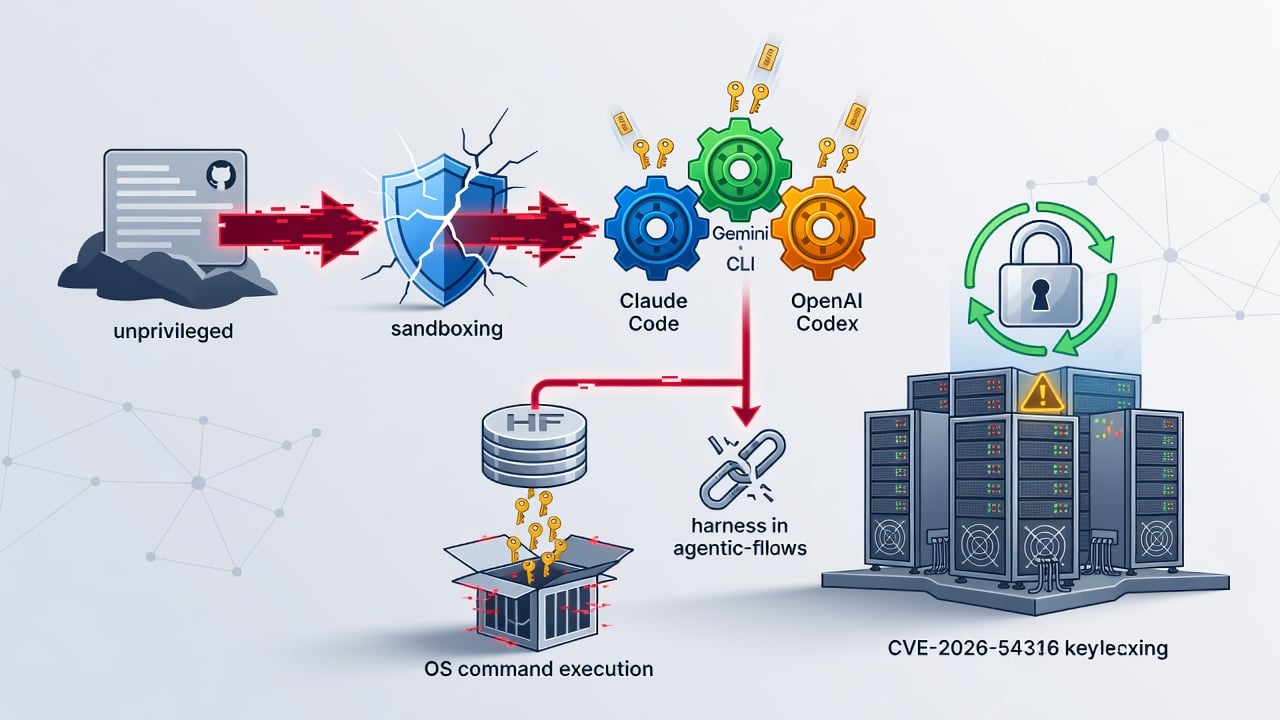

A single GitHub issue from an account with no access to a repository was enough to reach CI secrets in the default workflows of three AI coding agents, Novee Security showed at Black Hat USA on Aug. 5. The research covered Google’s Gemini CLI, Anthropic’s Claude Code and OpenAI’s Codex. Two CVEs came out of it, and both are patched.
Novee founding engineer Elad Meged put the problem in one line: “The harness is the code between the model and the real world.” In each case, one part of that harness treated a value as safe and a later part acted on it with more authority. The models themselves weren’t the weak point.
Gemini CLI: code on the host before the sandbox starts
The Gemini CLI bug is the most serious. CVE-2026-12537 carries a CVSS v4 score of 10.0. It’s an OS command injection in the container launcher, reached through a crafted .gemini/.env file, that lets an unprivileged attacker run code on the host of a headless CI platform before the sandbox starts. It didn’t require tricking the model into anything. Google fixed it in Gemini CLI 0.39.1 and the run-gemini-cli GitHub Action 0.1.22. Google’s advisory describes the fix as a breaking change to how headless mode handles workspace trust.
Claude Code: leaking a key through download counters
Novee found that Claude Code’s command validator strips single-quoted text before running its checks, so a payload placed in the value of git push –receive-pack got through. After Anthropic closed that path, the researchers used the pre-approved huggingface.co domain. CVE-2026-54316 turned Hugging Face’s public download counters into a channel that leaked an API key one character at a time. Every Claude Code release from 0.2.54 up to 2.1.163 is affected, and 2.1.163 fixes it.
Anthropic rates the flaw Moderate at CVSS v4 6.0. NVD gave it 9.1 under CVSS v3.1, so the two scores aren’t a like-for-like comparison. Anthropic says exploitation required getting untrusted content into a Claude Code context first.
Codex: no CVE, but a workflow change
The Codex finding has no version to install. The openai/codex repository ran two Codex passes inside one job that shared a single checkout, so the first pass could write AGENTS.md, the instruction file the second pass loads. Novee says OpenAI’s position is that its sandbox behaved as documented. OpenAI’s current workflow now runs the passes separately.
What teams should do
Update Gemini CLI to 0.39.1, run-gemini-cli to 0.1.22 and Claude Code to 2.1.163. Then audit any workflow that an outside user can trigger with an issue, pull request or comment. Look for agent passes that share a workspace, tools with write or network access, and long-lived tokens. Least-privilege tokens, ephemeral runners and a human approval step for external contributors close most of the paths Novee used.
Earlier research pointed the same way. In April, Aonan Guan’s “Comment and Control” work showed prompt injection through PR titles, issue bodies and hidden HTML comments against Claude Code Security Review, the Gemini CLI Action and GitHub Copilot Agent. SecurityWeek covered those findings at the time. The Novee work goes further by showing where the harness, not the model, turned untrusted input into executed commands.


 WebProNews is an iEntry Publication