
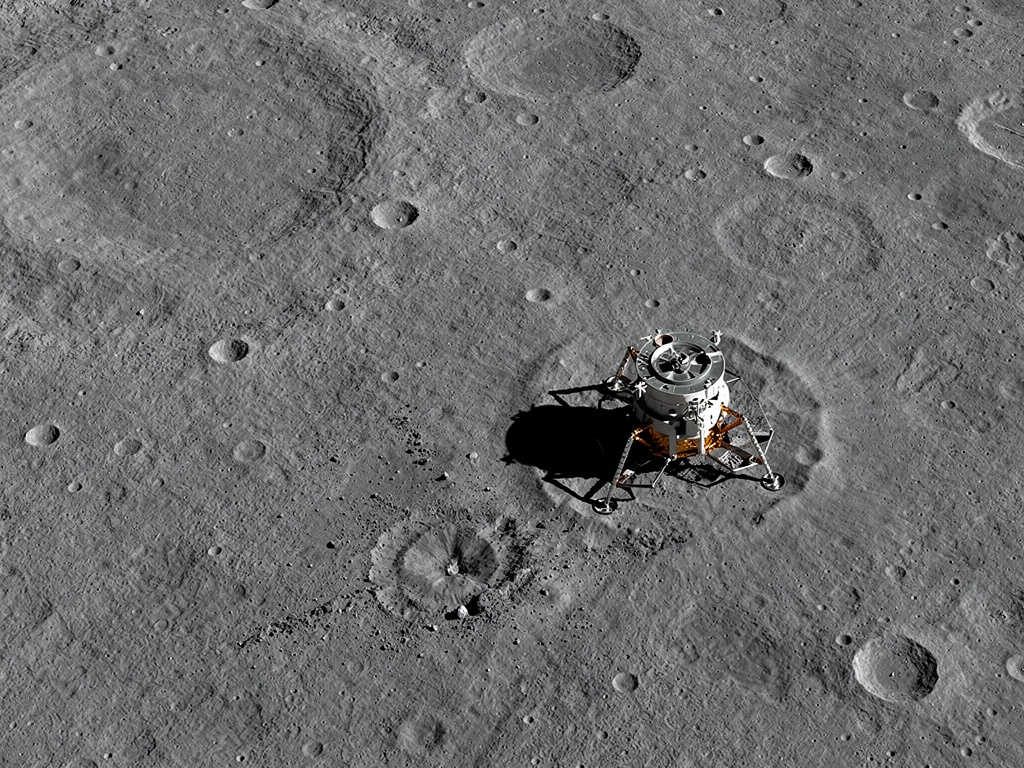
For more than half a century, a piece of Cold War space history has sat silently on the lunar surface, its precise location unknown to the world. Now, a determined group of amateur researchers believes they have finally pinpointed the resting place of Luna 23, a Soviet robotic spacecraft that crash-landed on the Moon in 1974 during a failed attempt to collect and return lunar soil samples to Earth. The discovery, if confirmed, would close one of the longest-standing mysteries of the Space Race era and demonstrate the remarkable power of citizen science in the modern age.
The story was first reported by Slashdot, drawing attention to the painstaking work of space enthusiasts who have been combing through high-resolution imagery captured by NASA’s Lunar Reconnaissance Orbiter (LRO) to identify anomalies on the Moon’s surface. Their work represents a growing trend in which publicly available space data enables ordinary citizens to make extraordinary discoveries that have eluded professional researchers for decades.
The Ill-Fated Mission That Vanished Into Lunar Dust
Luna 23 launched on October 28, 1974, as part of the Soviet Union’s ambitious third-generation lunar exploration program. Its mission was straightforward but technically demanding: land in the Mare Crisium — the “Sea of Crises” — on the Moon’s near side, drill into the regolith, collect a soil sample, and launch it back to Earth in a small return capsule. It was a feat the Soviets had already accomplished with Luna 16 in 1970 and Luna 20 in 1972, making the USSR the only nation besides the United States to return samples from the Moon.
But Luna 23’s descent did not go as planned. Telemetry data indicated that the spacecraft suffered a hard landing, damaging its soil-sampling drill mechanism beyond repair. Soviet ground controllers were able to communicate with the lander for approximately three days after touchdown, confirming it had survived but was unable to fulfill its primary mission. After that, contact was lost, and Luna 23 was effectively abandoned in place. The Soviets would later send Luna 24 to the same general region in 1976, successfully completing the sample return mission that Luna 23 could not. But the exact coordinates of the failed lander remained uncertain, known only within a broad area of Mare Crisium.
Citizen Scientists Turn NASA’s Own Data Into a Treasure Map
The breakthrough came courtesy of NASA’s Lunar Reconnaissance Orbiter Camera (LROC), which has been systematically photographing the Moon’s surface at resolutions as fine as 0.5 meters per pixel since 2009. The LROC image archive is publicly accessible, and over the years it has attracted a dedicated community of amateur lunar researchers who pore over the imagery looking for artifacts of past missions — both American and Soviet.
According to reports, the team of amateur investigators identified what appears to be a small, bright object with characteristics consistent with a Soviet-era lander in the Mare Crisium region. The object casts a shadow whose length and direction are consistent with a spacecraft of Luna 23’s known dimensions. Crucially, the object is located in an area that aligns with the limited positional data the Soviets released about the mission. The researchers cross-referenced the candidate site with known coordinates of Luna 24’s landing location — which is well-documented — and found the spatial relationship between the two sites to be consistent with Soviet-era mission planning documents that indicated the two landers were sent to the same general area.
Why Finding Luna 23 Matters More Than You Might Think
At first glance, locating a 50-year-old failed lander might seem like a niche curiosity. But the discovery carries significance on multiple fronts. For historians of the Space Race, pinpointing Luna 23 helps complete the documentary record of one of humanity’s most consequential technological competitions. The Soviet lunar program was shrouded in secrecy during the Cold War; many missions were only acknowledged publicly after they succeeded, and failures were often buried or minimized. Every piece of physical evidence that can be independently verified adds clarity to a historical record that remains incomplete.
For planetary scientists, the precise location of Luna 23 provides a known reference point on the lunar surface. Mare Crisium is a region of considerable scientific interest — a large, ancient impact basin filled with volcanic basalt. Understanding exactly where Luna 23 landed, and correlating that with the telemetry data from its brief operational period, could yield new insights into the local geology and the conditions the spacecraft encountered during its descent. Additionally, as multiple nations and private companies plan future missions to the Moon, having an accurate catalog of existing hardware on the surface is essential for mission planning and for avoiding interference with heritage sites.
The Growing Power of Open-Source Lunar Archaeology
The apparent discovery of Luna 23 is part of a broader movement that might be called open-source lunar archaeology. In recent years, amateur researchers using LRO data have identified the crash sites of several other lost spacecraft, including the impact locations of various Apollo-era rocket stages and the remains of other Soviet probes. The work is meticulous and often thankless, requiring hundreds of hours of scanning grainy imagery and comparing subtle surface features against known objects.
NASA has actively encouraged this kind of citizen engagement. The agency’s decision to make LROC data freely available online was a deliberate choice to democratize access to lunar science. The result has been a vibrant community of enthusiasts who supplement the work of professional researchers. In some cases, amateurs have beaten the professionals to the punch — identifying features and artifacts that had gone unnoticed in the vast archive of orbital imagery. The Luna 23 find, if validated by professional analysis, would be among the most significant achievements of this community to date.
Verification and the Road Ahead
It is important to note that the identification has not yet been officially confirmed by NASA or any other space agency. The resolution limits of LRO imagery mean that the candidate object, while consistent with a Soviet lander, cannot be unambiguously identified from orbit alone. Professional planetary scientists will need to examine the evidence, and additional LRO passes over the site at different sun angles could help clarify whether the object’s shape and shadow profile definitively match Luna 23’s known configuration.
There is also the tantalizing possibility that a future surface mission could visit the site. Several lunar missions currently in development — including those under NASA’s Commercial Lunar Payload Services (CLPS) program and international efforts by agencies such as the European Space Agency, the Japan Aerospace Exploration Agency, and China’s CNSA — could theoretically be directed to photograph or even examine Luna 23 up close. Such a visit would not only confirm the identification but could also provide valuable engineering data about how spacecraft materials degrade after five decades of exposure to the harsh lunar environment, including micrometeorite bombardment, extreme temperature cycling, and cosmic radiation.
A Cold War Relic in an Era of Renewed Lunar Ambition
The timing of this potential discovery is poignant. The world is in the midst of a renewed push to explore the Moon, with NASA’s Artemis program aiming to return astronauts to the lunar surface, China aggressively pursuing its Chang’e series of robotic missions, and India celebrating the success of Chandrayaan-3. In this context, Luna 23 serves as a powerful reminder of how long humanity has been reaching for the Moon — and how much of that history remains literally lost in the dust.
The Soviet lunar program, despite its many successes, has always been the less-told story of the Space Race. While Apollo astronauts became household names, the engineers and scientists behind Luna, Lunokhod, and Zond missions labored in relative anonymity, their achievements often overshadowed by the manned American program. Finding Luna 23 is, in a sense, an act of historical recovery — a way of honoring the ambition and ingenuity of a program that, for all its setbacks, achieved remarkable things.
If the amateur researchers are right, and a small bright speck in a high-resolution orbital photograph truly is the remains of Luna 23, it will stand as a testament to both the audacity of Cold War-era space exploration and the quiet persistence of modern-day enthusiasts who refuse to let history stay lost. In an age when billionaires compete to build the flashiest rockets, there is something deeply compelling about a handful of dedicated individuals, armed with nothing more than publicly available data and an internet connection, solving a mystery that has endured for half a century.


 WebProNews is an iEntry Publication