
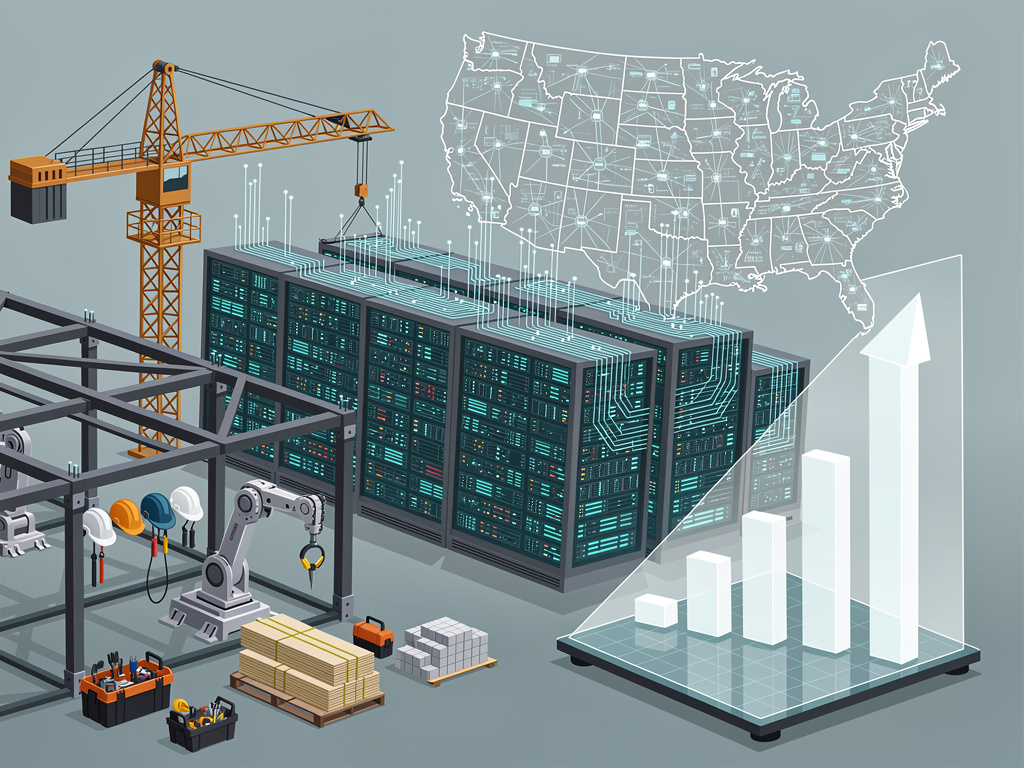
Mark Zuckerberg wants thousands of Americans trained to construct the physical backbone of artificial intelligence. The effort carries a first-year price tag of $115 million. It arrives as his company pours tens of billions into data centers that grow more power-hungry by the quarter.
The initiative, called America’s Workforce Academy, offers free training and pathways to full-time jobs with contractors building Meta’s facilities. Pilot programs launch this year in Louisiana, Ohio, Indiana and Texas. Reuters reported the program supplies generalist skills for data-center technicians. Graduates receive industry credentials and an America’s Workforce Certificate meant to travel across employers.
But the $115 million represents only a sliver of Meta’s larger promise. The social-media giant has pledged more than $600 billion in U.S. infrastructure and jobs by 2028. That figure, shared by Zuckerberg with President Donald Trump last year, covers everything from massive AI clusters to local grid upgrades. Since 2010 Meta data-center projects have supported over 30,000 skilled-trade positions and 5,000 operational roles, according to the company’s own accounting. They have funneled more than $20 billion to American subcontractors.
And yet the training push lands against a backdrop of head-count reductions inside Meta itself. The company recently raised its 2026 capital-expenditure forecast to between $125 billion and $145 billion. That nearly doubles the $72.2 billion spent in 2025. Much of the money buys servers, custom chips and land for facilities that can consume electricity on the scale of small cities.
Zuckerberg has been blunt with employees. During an internal town hall he described two primary cost centers: compute infrastructure and people-oriented expenses. More money for the first leaves less room for the second. Meta began laying off roughly 8,000 workers, about 10 percent of its workforce, in May. Additional cuts could follow. Reuters detailed the CEO’s remarks tying the reductions directly to soaring AI spending.
Short. Direct. The math inside Meta has shifted. Efficiency gains from AI coding tools help, yet the capital demands outpace them. One data-center project in Louisiana, dubbed Hyperion, could eventually reach five gigawatts. Another, Prometheus in Ohio, comes online next year. Zuckerberg posted on Threads that these titan-scale clusters will help pursue what he calls personal superintelligence.
The skilled-labor shortage is real. Construction of AI infrastructure requires electricians, welders, pipefitters, fiber technicians and heavy-equipment operators. Large projects create construction booms that last several years but leave only a modest number of permanent operational jobs. A Meta facility in Texas, for instance, peaks at more than 1,800 construction workers yet settles to around 100 once running.
Meta partnered with the National Urban League, Associated Builders and Contractors, CBRE and others to design the curriculum. Associated Builders and Contractors expects the academy to train thousands. Participants earn credentials from the National Center for Construction Education and Research. The program builds on Meta’s earlier Level-Up fiber-installation effort, which drew 35,000 applications in its first week.
Dina Powell McCormick, Meta’s president and vice-chairman, framed the moment in optimistic terms. “The AI revolution is bringing change but also historic opportunities,” she said. The academy aims to convert some of that change into stable careers.
Wall Street has largely signed off on the strategy. When Meta first guided toward $115 billion to $135 billion in 2026 capital spending, investors focused on revenue growth and efficiency rather than the headline number. Subsequent upward revisions to $125 billion-$145 billion drew some volatility but no widespread revolt. Analysts understand the bet. Whoever secures enough compute capacity first may hold an edge in the race toward more advanced models.
Yet questions linger about long-term returns. Meta carries no major cloud-computing business like its rivals. Every dollar spent on infrastructure must pay off through advertising, engagement on its family of apps, or future AI-driven products. The company’s Llama models remain open-source, a deliberate choice that accelerates adoption but limits direct monetization compared with closed systems.
Recent coverage shows the training idea gaining traction beyond Meta. On June 14, Yahoo Finance noted Alphabet CEO Sundar Pichai committing $50 million to train 300,000 Americans in skilled trades through unions and trade organizations. Google has poured more than $1 billion globally into training since 2022, reaching over 100 million people with digital and AI skills. No single company solves the gap alone. The combined moves signal growing recognition that software ambition collides with hardware reality.
Meta’s own data centers already influence local economies. They have enabled hundreds of millions of dollars in grid upgrades and added 15 gigawatts of energy capacity across the United States. The company designs facilities to use less water than industry norms and targets water-positive status by 2030. It invests in roads, schools and community grants totaling $58 million so far. Those contributions matter in rural parishes and small towns that host the campuses.
Still, the human element proves tricky. Construction jobs rise and fall with each project phase. Permanent roles stay limited. Meta hopes the portable credentials from America’s Workforce Academy give workers mobility across contractors and even industries. Success will show in how many graduates land stable positions once training ends.
Zuckerberg’s vision extends further. He has chased top AI talent with signing bonuses reported as high as $100 million. Internal teams reorganize into AI-focused pods. The company reassigns thousands while trimming others. All of it reflects a conviction that compute capacity must be built aggressively now to handle optimistic scenarios for model scaling.
Critics point to the contrast. Billions flow to hardware and land while payroll shrinks. Supporters counter that the capital intensity of modern AI leaves little choice. Output per engineer has risen, they say, thanks to the very tools Meta develops. The trade-off appears stark only until one considers the alternative: falling behind in a contest where delay compounds quickly.
The academy will not single-handedly close the national shortage of tradespeople. It will, however, place Meta deeper into communities that supply its workforce. And it offers a public demonstration that the company views the physical side of AI as inseparable from the algorithmic one. Bricks, cables and trained hands matter as much as parameters and training runs.
Whether the $115 million yields measurable progress remains to be seen. Early enrollment numbers and placement rates will matter. So will retention once workers reach job sites. For now the program stands as one visible piece of a far larger transformation. Meta is not merely buying GPUs. It is attempting to shape the labor pool that installs, powers and maintains them. That effort, however modest next to $145 billion in annual capital spending, signals how deeply the AI race has reached into the real economy.


 WebProNews is an iEntry Publication