
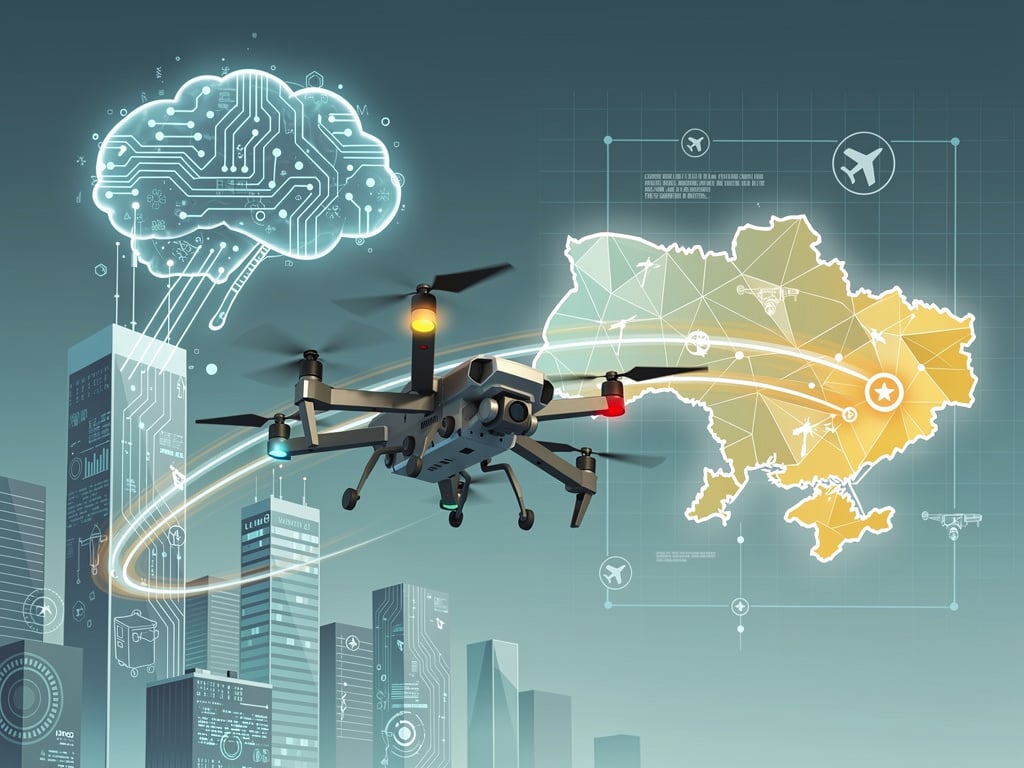
Volodymyr Zelenskyy didn’t mince words. On a recent Sunday appearance on CBS News’ “Face the Nation,” the Ukrainian president laid out a direct proposal to American technology executives. American firms possess advanced artificial intelligence systems. Ukraine possesses unmatched combat data from four years of drone-heavy fighting against Russia. Combine them. Act now.
“American technological companies have a lot of different interesting AI technologies that we don’t have. And we have a lot of things that they don’t have because of our experience on the battlefield,” Zelenskyy said. “I think this cooperation can be huge and the most powerful in the world.”
Zelenskyy Calls for Immediate Deals
He followed with a sharper demand. “We need to negotiate already. Not to speak about it. Just to take steps and to do it as quick as possible.” The message carried urgency. Months of incremental gains on the front have shown what targeted strikes achieve when paired with smarter software.
Ukraine has produced results on a limited budget. Its forces rely on swarms of inexpensive drones. These systems strike Russian supply trucks carrying ammunition, fuel and food along occupied roads. Recent videos analyzed by BBC Verify reveal the pattern. Hornet drones, fitted with AI-targeting trained on thousands of hours of footage of Russian vehicles, identify targets even at long range or under jamming. Nick Brown, a weapons expert at Janes, told BBC that operators can release hundreds of these munitions toward a general area more than 100 miles away. The AI then locks on.
Production numbers tell part of the story. Ukraine manufactured and assembled more than 1.5 million first-person-view drones in 2024. Total drone output exceeded 2 million that year. Plans called for up to 4.5 million FPV units in 2025. The Ministry of Defence reported receipt of more than 3 million strike drones during 2025, according to reporting in the Center for European Policy Analysis. Private Ukrainian firms raised over $105 million from venture investors in 2025 alone.
But the real advantage sits in the data. Every mission generates footage. Every Russian adaptation teaches new lessons. Command posts must stay mobile. They must bury themselves underground. Units cannot linger in one location. These observations come from direct experience. Silicon Valley laboratories lack equivalent real-world testing at this scale.
Anduril stands as one company already attuned to the opportunity. Palmer Luckey, who sold Oculus to Facebook in 2014, leads the firm. It has raised billions to build autonomous weapons platforms. Ukraine offers a live environment to evaluate them. A state program called Test in Ukraine, launched last year, drew applications from hundreds of foreign companies eager to trial drones, counter-drone gear, AI tools, electronic warfare systems, naval drones and ground robots. Business Insider first detailed Zelenskyy’s latest overture to these players.
Recent strikes illustrate the shift. In early May, Zelenskyy noted that mid-range attacks beyond 20 kilometers had doubled since March and quadrupled since February. Some systems now reach 300 kilometers behind front lines. They hit logistics depots, command posts and air defenses. The Hornet model, backed by former Google leadership and aided by Starlink links, receives particular Russian attention, per analysis from the Atlantic Council.
Autonomy marks the next threshold. Certain drones now classify and engage vehicles without constant human input during the final approach. Jamming that once blinded remote operators loses some effect. Forbes described the new rhythm: machines spotting targets faster and striking deeper. Forbes reported operators adapting quickly to Russian countermeasures.
Yet risks remain. Experts caution that Russia will develop its own autonomous systems. Adaptation happens fast in electronic warfare. Ukrainian officials have already exported counter-drone knowledge. The United States deployed Ukraine’s Sky Map platform at Prince Sultan Air Base in Saudi Arabia after Iranian-linked attacks, according to Reuters. American forces trained alongside Ukrainian specialists to detect and intercept threats.
Zelenskyy has carried the same offer to other partners. In Britain, he offered drone expertise to Middle East allies facing Iranian systems. In speeches, he highlighted more than 22,000 robot and drone missions in a recent three-month period. Each mission spared a human life. CNN captured his assessment that the technology saves soldiers in the most exposed positions.
Private investment follows the demonstrated success. Brave1, Ukraine’s defense technology cluster, staged a showcase in Silicon Valley in March. Founders pitched systems ranging from explosive sea drones to AI analytics. Attendees included venture capitalists and diplomats. The event signaled a pivot: battlefield iteration in weeks rather than years. A CNBC report on defense startups noted firms such as Tiberius Aerospace licensing Ukrainian intellectual property for manufacture in Britain and elsewhere.
The partnership model Zelenskyy proposes differs from traditional arms sales. Ukraine supplies verified tactics, vast training datasets and immediate feedback loops. American firms supply scaled manufacturing, superior sensors and advanced algorithms. The combination could accelerate both sides’ capabilities. It could also influence NATO planning and export markets across Europe and the Gulf.
Questions linger about execution. Regulatory hurdles, technology transfer rules and political alignment between Washington and Kyiv matter. Still, the data flows daily from Ukrainian fronts. Russian losses exceed 1,000 troops per day in some assessments, tied in part to precise drone strikes. The longer the conflict runs, the richer Ukraine’s dataset grows.
Zelenskyy’s pitch lands at a moment when U.S. defense leaders seek fresh approaches to autonomous systems. Legacy contractors move slowly. Silicon Valley moves fast but often lacks operational context. Ukraine bridges that gap. Its forces have turned consumer-grade components into weapons that alter supply lines, harass rear areas and challenge air defenses.
Cooperation already exists in pockets. Test programs continue. Data sharing occurs. Zelenskyy wants formal, accelerated agreements. Stop discussing. Begin building. The next wave of systems may emerge from this exact exchange. Battle-tested AI. Proven in the harshest conditions. Ready for wider use.
Developments continue. Recent BBC reporting shows Ukrainian AI drones expanding their reach against convoys once considered protected. Forbes tracks the surge in mid-range strikes. Each new success adds weight to Zelenskyy’s argument. The experience exists. The technology gap is real. The time to close it, he insists, is now.


 WebProNews is an iEntry Publication