
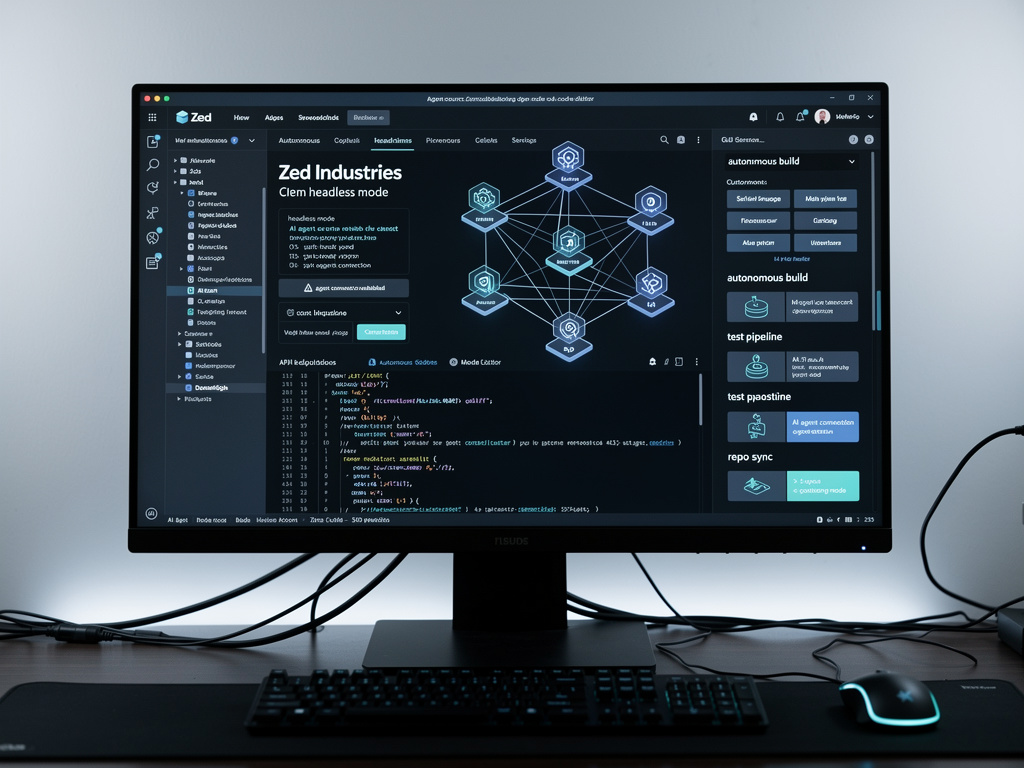
In a move that signals the accelerating convergence of code editors and artificial intelligence, Zed Industries has merged a significant pull request introducing a “headless” mode to its open-source code editor — a feature designed to let AI agents operate the editor programmatically without a graphical user interface. The change, quietly merged into the project’s main branch, represents one of the most ambitious attempts yet by a code editor to natively accommodate autonomous AI coding agents as first-class users.
The pull request, #46758 on GitHub, titled “Add headless platform,” was authored by Zed co-founder Nathan Sobo and introduces a new platform abstraction that allows Zed to run without rendering any windows or handling user input through a traditional GUI. Instead, the editor can be driven entirely through its protocol layer, enabling AI agents and automated systems to open projects, edit files, run terminal commands, and interact with language servers — all without a human sitting at the keyboard.
A New Kind of Editor: Built for Machines, Not Just Developers
The technical implementation is substantial. According to the pull request’s code changes, the headless platform introduces a new HeadlessPlatform struct that implements Zed’s existing platform trait but stubs out or no-ops all visual rendering, window management, and input handling. This allows the full power of Zed’s editing engine — including its Tree-sitter-based syntax parsing, Language Server Protocol (LSP) integration, and multi-buffer editing capabilities — to run in a server-like process that can be controlled remotely.
Nathan Sobo’s approach is architecturally elegant: rather than building a separate tool or forking the editor, the headless mode reuses the same core codebase that powers the desktop application. This means AI agents interacting with Zed in headless mode get access to the same language intelligence, diagnostics, code actions, and project understanding that human developers rely on daily. The design choice ensures feature parity and reduces the maintenance burden of supporting two divergent codebases.
Why Headless Matters: The Rise of AI Coding Agents
The timing of this feature is no accident. The software development industry is experiencing a rapid proliferation of AI coding agents — autonomous systems that can write, debug, refactor, and test code with minimal human intervention. Tools like Anthropic’s Claude Code, OpenAI’s Codex agent, and open-source projects like SWE-Agent and Aider have demonstrated that large language models can perform complex, multi-step coding tasks when given proper tooling and environment access.
However, most of these agents today interact with codebases through relatively primitive interfaces: reading and writing raw files, running shell commands, and parsing text output. They lack the rich semantic understanding that a modern code editor provides through language servers, which offer features like go-to-definition, find-all-references, type checking, and intelligent code completion. By running Zed in headless mode, an AI agent could theoretically leverage all of these capabilities, making its code modifications far more informed and less error-prone.
Zed’s Strategic Position in the AI-Native Editor Race
Zed has been positioning itself aggressively at the intersection of traditional code editing and AI-assisted development. The editor, written in Rust for performance, already includes built-in AI features such as an inline assistant that can generate and transform code using various LLM providers. The company has also been developing what it calls “AI agent” capabilities directly within the editor, allowing users to delegate complex coding tasks to AI models that can operate across multiple files and terminal sessions.
The headless platform takes this a step further by decoupling the AI agent workflow from the desktop application entirely. This opens up several powerful use cases: CI/CD pipelines could use Zed’s language intelligence to perform automated code reviews or refactoring; cloud-based AI agents could spin up headless Zed instances to work on coding tasks asynchronously; and teams could deploy always-on AI coding assistants that maintain persistent project context through Zed’s project management system.
Inside the Technical Architecture
Examining the code changes in the pull request on GitHub, several implementation details stand out. The HeadlessPlatform handles the absence of a display server gracefully, returning sensible defaults for display-related queries and implementing no-op versions of methods that would normally interact with the operating system’s windowing system. The platform still maintains a functional event loop, which is critical for Zed’s async runtime that powers everything from LSP communication to file system watching.
The changes also touch Zed’s GPUI framework — its custom GPU-accelerated UI toolkit — to properly abstract away rendering concerns at the platform level. This separation of concerns suggests that the Zed team has been planning for headless operation for some time, as the platform trait system was already designed with enough abstraction to accommodate a non-visual backend. The pull request modifies files across the platform layer, the workspace module, and the application initialization code, indicating a thorough integration rather than a superficial bolt-on.
Competitive Dynamics: VS Code, Cursor, and the Battle for AI Developer Tools
The move puts Zed in a distinctive competitive position relative to other editors vying for developer mindshare. Microsoft’s Visual Studio Code, which dominates the editor market with roughly 70% usage among developers according to recent Stack Overflow surveys, has its own AI integrations through GitHub Copilot and the recently announced Copilot agent mode. Cursor, the AI-focused VS Code fork, has gained significant traction by deeply integrating LLM capabilities into the editing experience. Windsurf, another AI-native editor, has similarly been pushing the boundaries of agent-assisted development.
But none of these competitors have publicly shipped a headless mode specifically designed for autonomous agent operation. VS Code does have a remote server architecture that enables headless-like scenarios through its Remote Development extensions, but this was designed primarily for human developers working on remote machines, not for AI agents operating independently. Zed’s explicit focus on making the editor a tool that AI agents can wield natively could differentiate it in a crowded and increasingly competitive market.
The Broader Implications for Software Development Workflows
Industry observers have noted that the trajectory of AI coding tools is moving from “copilot” — where AI assists a human developer — to “autopilot,” where AI agents handle entire development tasks autonomously. This shift demands new infrastructure. Just as web development eventually required headless browsers for testing and automation (tools like Puppeteer and Playwright), AI-driven software development may require headless editors that provide the full semantic richness of an IDE without the overhead of a graphical interface.
Zed’s headless platform could become a foundational building block for this new paradigm. Imagine a workflow where a product manager files a ticket, an AI agent picks it up, spins up a headless Zed instance with the relevant project loaded, uses language server intelligence to understand the codebase, implements the change across multiple files, runs tests through the integrated terminal, and submits a pull request — all without a human developer touching the keyboard. While such fully autonomous workflows remain aspirational for most real-world codebases, the infrastructure Zed is building makes them technically feasible.
Open Source Dynamics and Community Response
As an open-source project licensed under a combination of the GPL and Apache licenses, Zed’s headless platform is available for anyone to build upon. This could catalyze a new ecosystem of AI agent frameworks that leverage Zed as their underlying editor engine. The pull request has already attracted attention from the developer community, with discussions around potential use cases and integration patterns emerging on GitHub and developer forums.
The Zed team’s decision to build this capability in the open, rather than as a proprietary cloud service, aligns with a broader trend in AI developer tools toward transparency and extensibility. It also positions Zed as a potential standard runtime for AI coding agents, much as Node.js became the standard runtime for server-side JavaScript — not because it was the only option, but because it was purpose-built for the use case and freely available.
What Comes Next for Zed and AI-Native Development
The merge of the headless platform is likely just the beginning. For the feature to reach its full potential, Zed will need to develop a robust API or protocol layer that AI agents can use to interact with the headless editor efficiently. This might include structured commands for navigating code, applying edits, querying diagnostics, and managing project state — going beyond the raw text manipulation that most AI coding agents rely on today.
Nathan Sobo and the Zed team have been vocal about their vision for AI-native development, and the headless platform represents a concrete, technically sophisticated step toward realizing that vision. Whether it becomes the standard infrastructure for AI coding agents or simply one option among many will depend on execution, ecosystem adoption, and the pace at which autonomous AI coding matures. But with this pull request, Zed has staked out a clear and ambitious position: the future of code editors isn’t just about serving human developers — it’s about serving the AI agents that will increasingly work alongside them.


 WebProNews is an iEntry Publication