
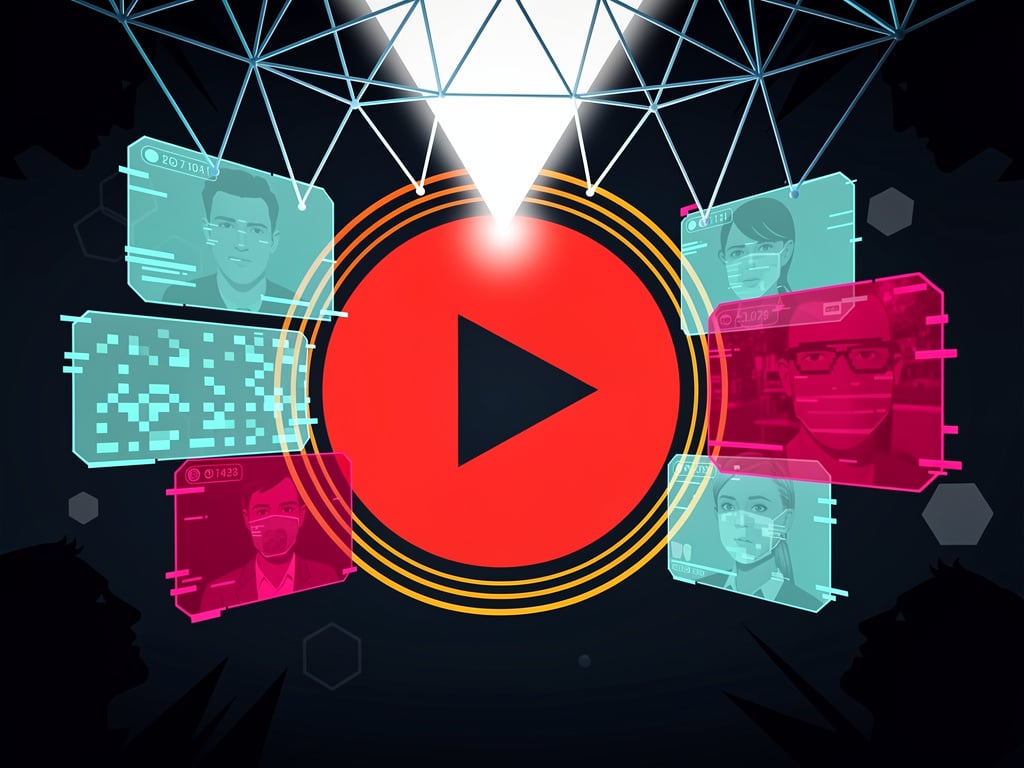
YouTube is rolling out AI-powered deepfake detection tools specifically designed to identify synthetic media depicting politicians, government officials, and journalists. The move signals Google’s most aggressive step yet in combating AI-generated political misinformation ahead of election cycles worldwide.
This isn’t a small feature update. It’s a direct response to the explosion of convincing AI-generated video content that has flooded platforms over the past eighteen months, from fabricated speeches by heads of state to doctored clips of journalists appearing to endorse candidates or policies they’ve never supported.
According to TechCrunch’s reporting, YouTube’s new system uses a combination of detection models trained to spot visual and audio artifacts in synthetic media. The platform will apply enhanced scrutiny to content featuring public figures in government and media roles, flagging suspected deepfakes for human review and applying labels or removing content that violates its policies. The tools are being deployed globally, though YouTube has prioritized regions with upcoming elections.
The timing matters. A lot.
We’re entering a period where dozens of countries are holding national elections, and the sophistication of generative AI tools has outpaced most platforms’ ability to police them. OpenAI’s Sora, Runway’s Gen-3, and a growing list of open-source video generators have made it trivially easy to produce realistic footage of real people saying things they never said. And the detection side has been playing catch-up.
YouTube’s approach focuses on what the company calls “high-consequence public figures” — a category that includes elected officials, candidates for office, senior government appointees, and working journalists. The platform will use its existing Content ID infrastructure alongside new classifiers specifically tuned to detect manipulated media featuring these individuals. When the system flags a video, it triggers an expedited review process. Content confirmed as synthetic and misleading will be removed. Content that’s synthetic but clearly labeled as satire or parody may stay up with an informational panel attached.
So what does this actually look like in practice? YouTube says creators who upload AI-generated content depicting public figures will face stricter disclosure requirements. Failure to disclose could result in content removal, strikes against a channel, or in repeated cases, channel termination. The platform is also expanding its existing requirement that creators label AI-generated content, making disclosure mandatory rather than optional for any video featuring identifiable public figures.
There’s a real question about whether detection technology can keep pace with generation technology. Google DeepMind’s SynthID watermarking system, which embeds imperceptible signals into AI-generated content, is part of YouTube’s toolkit here. But SynthID only works on content created through Google’s own tools. Videos generated by third-party AI systems won’t carry that watermark, forcing YouTube to rely on its detection classifiers — which, by their nature, are probabilistic rather than definitive.
Not perfect. But better than nothing.
Industry reactions have been mixed. Digital rights organizations like the Electronic Frontier Foundation have raised concerns about potential over-censorship, particularly around political speech that uses AI-generated imagery for legitimate commentary or satire. “The line between a deepfake designed to deceive and a clearly satirical AI-generated video isn’t always obvious to an algorithm,” an EFF spokesperson noted in a statement reported by TechCrunch.
On the other side, election integrity groups have broadly welcomed the move. The Partnership on AI, a consortium that includes Google, Microsoft, and several academic institutions, called YouTube’s announcement “a meaningful step forward in platform accountability around synthetic media.”
YouTube isn’t operating in a vacuum here. Meta has its own deepfake policies, though enforcement has been inconsistent. TikTok requires AI-generated content to be labeled but has struggled with compliance. X, formerly Twitter, has taken a more laissez-faire approach under Elon Musk’s ownership, with minimal proactive detection and a reliance on Community Notes for context. The contrast is stark. YouTube’s new tools represent the most resource-intensive commitment any major platform has made to detecting political deepfakes specifically.
But the technical challenges are enormous. Detection models trained on current-generation AI outputs will need constant updating as generation models improve. And adversarial techniques — methods specifically designed to fool detectors — are already a thriving area of research in both academic and underground communities. YouTube has committed to quarterly updates to its detection models, but whether that cadence is fast enough remains to be seen.
There’s also the international dimension. Deepfake regulations vary wildly across jurisdictions. The EU’s AI Act includes provisions around synthetic media disclosure. The United States has a patchwork of state-level laws but no comprehensive federal framework. YouTube’s global deployment means the platform is effectively setting its own standard, one that may or may not align with local legal requirements in every market it serves.
For creators and media professionals, the practical implications are straightforward. If you’re producing content that features politicians, government officials, or journalists, and any portion of that content is AI-generated or AI-modified, you need to disclose it. Full stop. YouTube’s enforcement mechanisms are getting teeth, and the penalty structure now includes expedited strikes that can take down channels faster than before.
For the broader tech industry, YouTube’s move raises the bar. Other platforms will face increasing pressure — from regulators, advertisers, and users — to implement comparable systems. Whether they will is another question entirely.
As someone who’s been watching AI tools evolve since the early GPT days, I’ll say this: detection will never be a complete solution. It’s one layer in what needs to be a multi-layered approach involving media literacy, legal frameworks, and platform accountability. YouTube knows this. Their bet is that imperfect detection deployed at scale is better than waiting for a perfect system that may never arrive. And on that point, they’re probably right.


 WebProNews is an iEntry Publication