
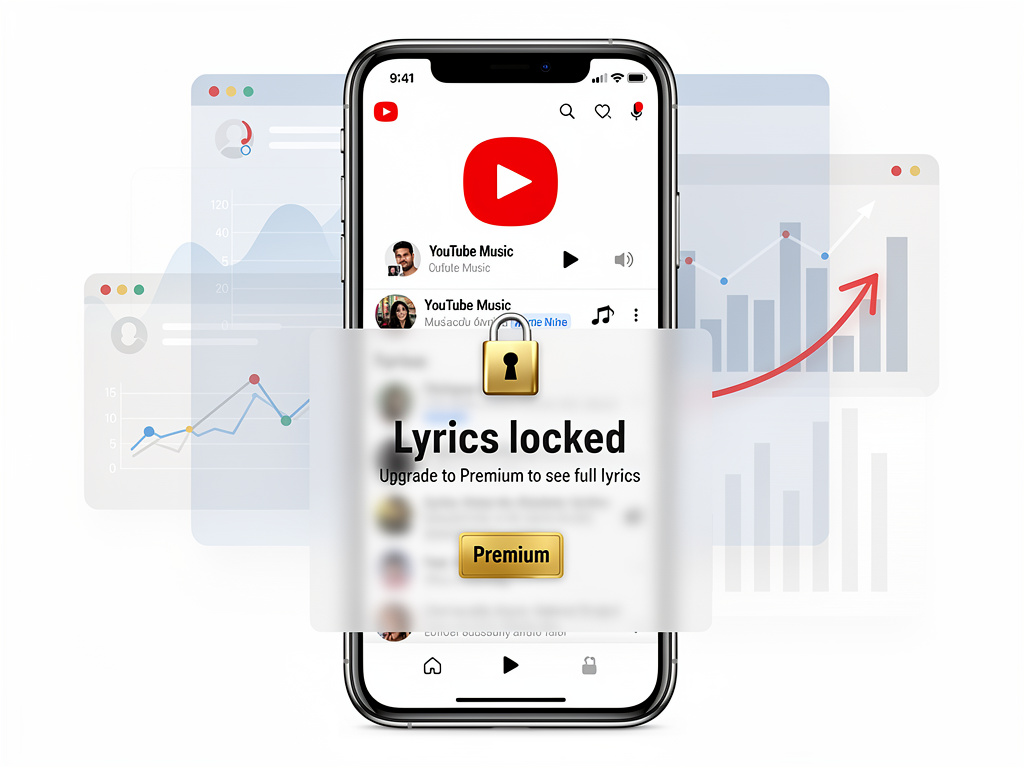
For years, YouTube Music offered one of the more generous free tiers among major streaming platforms, giving users access to a vast catalog of songs, music videos, and even full lyrics — all without paying a dime. That era appears to be ending. Google’s music streaming service has begun restricting access to song lyrics for users on its free, ad-supported tier, marking a significant shift in strategy that signals the company’s growing determination to convert casual listeners into paying subscribers.
The change, first reported by Engadget, means that free-tier YouTube Music users will now see only a partial preview of song lyrics rather than the full text. When attempting to view complete lyrics, users are met with a prompt encouraging them to upgrade to YouTube Music Premium or YouTube Premium. The move effectively transforms a feature that was once universally available into a gated incentive, joining a growing list of capabilities that Google reserves exclusively for its paying customer base.
A Calculated Move in the Subscription Wars
The decision to limit lyrics access is not happening in a vacuum. YouTube Music has been steadily tightening the screws on its free tier over the past several years, incrementally removing features and adding restrictions designed to make the ad-supported experience less appealing. Background playback, offline downloads, and ad-free listening have long been exclusive to Premium subscribers. Lyrics, however, had remained one of the last meaningful features available to all users regardless of payment status. Its removal from the free tier represents perhaps the most visible and emotionally resonant restriction yet, given how central lyrics are to the music listening experience for millions of users.
Google’s strategy mirrors a broader trend across the streaming industry, where platforms are increasingly differentiating between free and paid experiences with sharper distinctions. Spotify, Apple Music, and Amazon Music have all experimented with tiered access models in recent years, though each has drawn the lines differently. Spotify, for instance, offers full lyrics to all users — including those on its free tier — making YouTube Music’s decision a notable departure from what many consumers have come to expect as a baseline feature. The contrast could become a talking point as users evaluate which service offers the best value, particularly among younger demographics who rely heavily on lyrics for discovery and engagement.
The Economics Behind Locking Down Lyrics
From a business perspective, the rationale is straightforward. YouTube Music, which Google launched in 2018 as a successor to Google Play Music, has been in a relentless pursuit of subscriber growth. The platform surpassed 100 million subscribers (including YouTube Premium and YouTube Music Premium combined) in early 2024, a milestone that placed it firmly in competition with Spotify’s roughly 240 million premium subscribers. But growth has not come easily. YouTube Music has had to contend with the perception that its free tier is “good enough” for many users, reducing the urgency to upgrade. By chipping away at the free experience, Google is effectively raising the cost of not subscribing — not through higher prices, but through diminished utility.
Lyrics, in particular, represent a low-cost, high-value feature from the platform’s perspective. The licensing arrangements for displaying lyrics are separate from those governing music playback, and companies like LyricFind and Musixmatch serve as intermediaries between platforms and rights holders. While the exact financial terms are proprietary, lyrics licensing is generally considered far less expensive than music streaming rights. This means that the decision to restrict lyrics is less about cutting costs and more about creating a psychological wedge — a small but meaningful inconvenience that nudges free users toward the $10.99-per-month Premium subscription.
User Backlash and the Risk of Alienation
The reaction from YouTube Music’s user community has been swift and largely negative. Across social media platforms including X (formerly Twitter) and Reddit, free-tier users have expressed frustration at what they perceive as an increasingly hostile attitude toward non-paying customers. Some users have pointed out that lyrics are freely available on dozens of websites and third-party apps, making the restriction feel more punitive than practical. “You can literally Google any song lyrics in two seconds,” one user wrote on X, capturing a sentiment shared by many. “This doesn’t make me want to subscribe — it makes me want to switch.”
The backlash underscores a delicate balancing act that every freemium platform must navigate. The free tier serves a critical function as a customer acquisition funnel: users discover the service, develop habits around it, and eventually — ideally — convert to paying subscribers. But if the free experience becomes too degraded, users may simply leave rather than upgrade. Google has historically shown a willingness to absorb short-term user dissatisfaction in pursuit of long-term revenue goals, as evidenced by its aggressive ad load increases on YouTube proper. Whether that same tolerance for friction will serve YouTube Music well in a fiercely competitive market remains to be seen.
How Competitors Stack Up on Lyrics Access
The lyrics restriction also invites direct comparison with YouTube Music’s primary competitors. Spotify introduced real-time synced lyrics — powered by Musixmatch — to all users, including free-tier listeners, back in 2021. The feature has since become one of Spotify’s most popular, with the company frequently highlighting lyrics engagement in its earnings calls and Wrapped campaigns. Apple Music, which does not offer a free tier, includes fully synced lyrics as a standard feature for all subscribers. Amazon Music provides lyrics access across its various tiers as well, though the depth of the feature varies by subscription level.
By contrast, YouTube Music’s decision to gate lyrics behind a paywall places it at a competitive disadvantage on a feature-by-feature comparison, at least for cost-conscious consumers. However, Google may be betting that YouTube Music’s unique advantages — its unparalleled catalog of live performances, covers, remixes, and user-uploaded content — are sufficient to retain users even as individual features are restricted. No other major streaming platform can match YouTube’s depth of video content, and for many users, that library alone justifies staying on the platform regardless of lyrics access.
The Broader Trend of Freemium Erosion
YouTube Music’s lyrics restriction is part of a much larger pattern playing out across the technology industry. The era of generous free tiers — once a hallmark of Silicon Valley’s growth-at-all-costs mentality — is giving way to a more disciplined approach focused on monetization and profitability. From Netflix’s crackdown on password sharing to X’s decision to limit the number of posts non-subscribers can view, tech companies are increasingly signaling that free access has limits. The implicit message is clear: if you value the product, you need to pay for it.
For Google specifically, the push to monetize YouTube and YouTube Music more aggressively aligns with Alphabet’s broader corporate strategy under CEO Sundar Pichai. The company has been under pressure from investors to demonstrate that its non-search businesses can generate meaningful, sustainable revenue. YouTube’s advertising business has been a bright spot, but subscription revenue represents a more predictable and higher-margin income stream. Every feature that can be moved behind the paywall — lyrics included — contributes to that goal.
What This Means for the Future of Music Streaming
Looking ahead, the lyrics restriction may be just the beginning of a more aggressive gating strategy from YouTube Music. Industry analysts have speculated that features like personalized playlists, high-quality audio, and even certain algorithmic recommendations could eventually be tiered more aggressively. The platform has already introduced features like podcast integration and collaborative playlists that are designed to increase engagement and stickiness among Premium subscribers.
For consumers, the message is increasingly unambiguous: the golden age of getting something for nothing in music streaming is winding down. As platforms mature and investor expectations shift from user growth to revenue per user, the features that once served as enticements to join are being repurposed as reasons to pay. YouTube Music’s lyrics gambit is a small but telling chapter in that larger story — one that will continue to unfold as the streaming industry enters its next phase of evolution. Whether users respond by opening their wallets or by opening a new browser tab to find their lyrics elsewhere will ultimately determine whether Google’s bet pays off.


 WebProNews is an iEntry Publication