
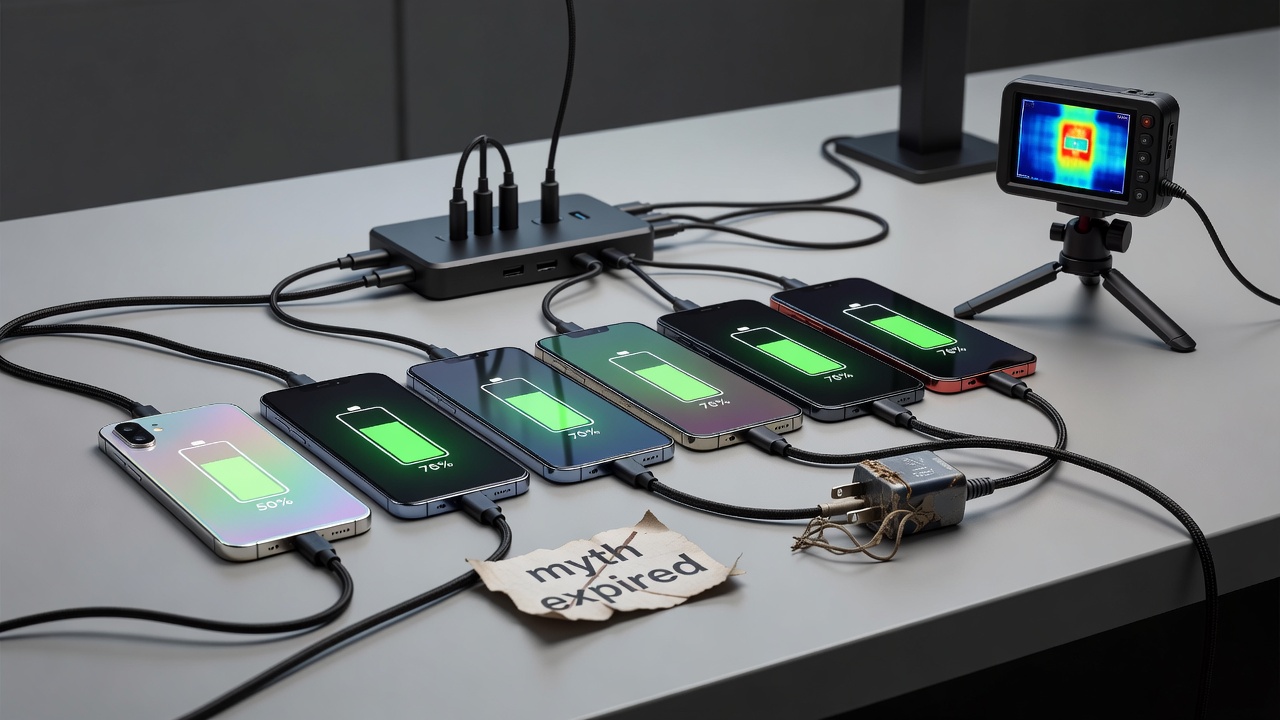
The old rule felt ironclad. Plug in your phone before bed. Wake to 100%. Start the day fully powered. Yet CNET’s latest testing tells a different story. Phones released in the past three years often gain 50% to 76% charge in just 30 minutes. Morning top-ups work fine. No all-night session required.
And the data backs it. Since 2023, CNET Labs has run standardized 30-minute charging tests on 115 phones using the included cable and a wall adapter matching the device’s top speed. Results show clear gains. The Samsung Galaxy S26 Ultra reached 76% from empty. Its predecessors, the S24 Ultra and S23 Ultra, managed only 45%. The jump traces to faster 60-watt support versus 45 watts on earlier models. (CNET, June 29, 2026)
Similar patterns appear across brands. Apple’s iPhone 17 Pro added 74% in the test. The iPhone 16 Pro hit 57%. The iPhone 15 Pro reached 62%. Google’s Pixel 10A gained 57% compared with 38% for the 2023 Pixel 7A. Even budget options improved. The 2025 Moto G Stylus 5G hit 74% from empty. Its 2024 version managed 38%.
These numbers matter. They challenge the overnight habit many still follow out of habit or fear. But fear of what exactly?
Battery chemistry explains the worry. Lithium-ion cells age fastest at extremes. Full 100% for hours creates voltage stress. Heat makes it worse. Trickle charging kicks in after the battery hits full. The phone draws small bursts of power for background tasks. The charger tops it off. Each cycle adds tiny wear. Over years the effects accumulate.
Yet modern phones refuse to let that wear run wild. Software steps in. Apple’s Optimized Battery Charging, on by default since iOS 13, learns your schedule. It holds the phone at 80% overnight and finishes the last 20% shortly before your alarm. iPhone 15 and later models let users cap charging at 80% permanently through Settings > Battery > Charging. (PCMag, April 23, 2026)
Samsung’s Battery Protect feature caps at 85%. Google offers Adaptive Charging. These tools reduce time spent at peak voltage. They turn the overnight ritual from risky to responsible. “Keeping your phone plugged in overnight or on your desk all day will not destroy its battery,” wrote Nelson Aguilar for CNET. “That is a leftover myth from a different era of tech.” (CNET, June 28, 2026)
The shift reflects broader industry changes. Phone makers stopped bundling chargers years ago to cut costs and waste. Users now buy their own. Many grab whatever sits nearby. Yet matching the adapter to the phone’s supported speed unlocks those fast 30-minute gains. Anker’s 45W charger with display or Apple’s Dynamic Power Adapter work for multiple devices. Research the model’s exact wattage first. The payoff shows in the lab data.
Heat remains the real enemy. Batteries perform best between roughly 62 and 72 degrees Fahrenheit. Direct sun, a hot car, or a pillow blocks airflow and spikes temperatures. Wireless charging adds more warmth than wired. Fast charging while gaming or streaming pushes harder still. Remove the case during long sessions. Place the phone on a hard surface. Simple moves that matter more than the exact percentage when you plug in.
Real-world user reports echo the nuance. On X, recent posts mix caution with experience. One user noted modern phones stop charging at 100% and switch to trickle mode, calling overnight charging safe. Another insisted constant 100% overnight caused noticeable overnight drain on an iOS beta. The split reflects what lab tests show: safeguards help, but habits and conditions still influence long-term capacity.
Older advice lingers because it once made sense. Nickel-cadmium batteries suffered memory effects. Early lithium-ion cells risked damage from overcharging without smart circuitry. Those days passed. Protective chips now cut power at full. The Note 7 battery fires of 2016 highlighted defects, not normal overnight use. Today’s flagships handle the process without drama.
Capacity still fades. Apple rates its batteries to retain at least 80% after 500 or more cycles depending on model. Real-world replacement often happens around two to three years when users notice shorter runtime. EU rules will require user-replaceable batteries in smartphones by 2027, potentially easing future swaps. Until then, slowing the fade beats chasing perfection.
Practical steps emerge from the testing and features. Turn on optimized charging. Avoid extremes of 0% and 100% when possible though the phone can handle occasional full cycles. Charge in short daytime bursts if convenient. Keep temperatures moderate. Use quality cables and adapters. These adjustments extend useful life without constant monitoring.
Some experts push harder. They recommend 20% to 80% as the sweet spot to minimize stress. Frequent shallow charges suit lithium-ion chemistry better than deep discharges. Others say the built-in safeguards make overnight charging acceptable for most. The CNET lab results tilt the scale. With phones hitting 70% or more in half an hour, the morning routine suffices for many users.
Industry data reinforces the progress. Charging speeds have climbed steadily since 2023 across premium and midrange segments. Sub-$600 models now support 45 watts or higher where earlier versions topped out at 25 watts or less. Software refinements keep pace. The combination means less need to surrender your phone to the charger each night.
That freedom carries quiet benefits. No more hunting for cables at bedtime. Less worry about forgotten charges during travel. StandBy mode on recent iPhones turns the locked device into a clock or photo frame while plugged in. Sleep trackers that run overnight still work. Convenience persists. The data simply removes the obligation.
Batteries remain consumable. No trick stops aging entirely. Yet the combination of faster charging, smarter software, and better understanding of heat and voltage stress gives owners more control than before. The overnight charge, once mandatory, now stands as one option among many. For those who forget it entirely some nights, the phone and its battery will likely be just fine.


 WebProNews is an iEntry Publication