
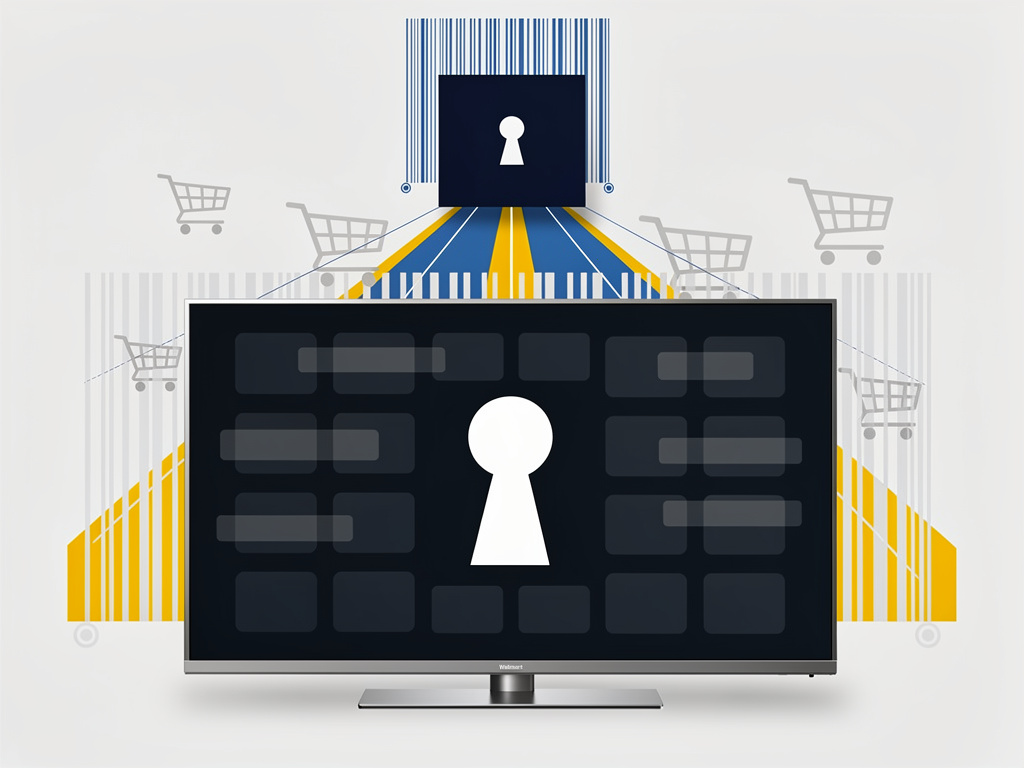
Buy a Vizio television in 2026, plug it in, and try to use its smart features. You’ll hit a wall — specifically, a Walmart account login screen. No account, no apps. No streaming. No voice search. Just a big, dumb screen attached to a very smart data-collection apparatus you can’t fully access.
This is the new reality for Vizio customers, and it arrived without fanfare. As first reported by Ars Technica, newly purchased Vizio TVs now require users to create or sign into a Walmart account before they can use the SmartCast operating system’s connected features. The requirement applies to sets sold after Walmart completed its $2.3 billion acquisition of Vizio in December 2024 — a deal that was always more about advertising and consumer data than about selling hardware.
The mandate doesn’t affect older Vizio sets already in homes. Not yet, at least.
But for anyone walking out of a store with a fresh Vizio box, the terms have changed. And those terms tell you everything about where the television industry is headed: the TV itself is no longer the product. You are.
Walmart’s acquisition of Vizio was finalized in early December 2024 after clearing regulatory review. The deal’s logic was transparent from the start. Walmart didn’t need a hardware division. It needed what Vizio had built underneath its affordable TV lineup — a sophisticated advertising platform called SmartCast that tracked viewing habits across roughly 18 million active accounts. That platform let Vizio sell targeted ads on its home screen, within its free streaming channels, and across third-party apps. It was a high-margin business grafted onto a low-margin product, and Walmart saw an opportunity to connect that data pipeline directly to its own retail advertising machine, Walmart Connect.
At the time of the acquisition announcement in February 2024, Walmart’s executive vice president Seth Dallaire said the deal would allow the company to deliver “an extraordinary experience” for customers and help advertisers reach audiences “in a measurable way.” Translation: Walmart wanted to close the loop between what you watch and what you buy. A Vizio TV linked to a Walmart account creates exactly that connection — viewing data married to purchase history, browsing behavior, and demographic information already sitting in Walmart’s databases.
Now the account requirement makes that marriage mandatory.
The mechanics are straightforward but heavy-handed. When a user sets up a new Vizio TV, the SmartCast interface prompts them to either log in with an existing Walmart account or create one. Without completing this step, the TV’s smart features — its app store, built-in streaming services, voice assistant functionality, and content recommendations — remain locked. The television still functions as a display. You can plug in a Roku stick, an Apple TV, or a gaming console and use it just fine. But the operating system you ostensibly paid for when you bought the set? Gated.
This isn’t entirely without precedent. Samsung, LG, and other TV manufacturers have long nudged users to create accounts during setup. But “nudged” is the operative word. Those companies typically allow users to skip account creation and still access most smart TV functions, even if certain personalized features are limited. Walmart’s approach with Vizio is more aggressive — a hard gate rather than a soft suggestion.
The Data Equation Behind the Login Screen
The financial incentives driving this decision are substantial. Connected TV advertising has become one of the fastest-growing segments in digital marketing. According to estimates from the Interactive Advertising Bureau, CTV ad spending in the United States surpassed $30 billion in 2025, and the number continues to climb as linear television viewership declines. For a retailer like Walmart — which already operates the second-largest retail media network in the country behind Amazon — the ability to serve ads informed by both shopping data and TV viewing data represents an enormously valuable proposition for brand advertisers.
Every Walmart account linked to a Vizio TV is a data point. Every data point makes the advertising inventory more targetable. Every more-targetable impression commands a higher price.
So the account wall isn’t a bug. It’s the business model.
Privacy advocates have raised alarms. The concern isn’t simply that Walmart collects data — most tech companies do — but that the collection is a precondition for using a product someone has already purchased outright. There’s an important distinction between a free service that monetizes user data (like Gmail or Facebook) and a physical product that costs hundreds of dollars and then demands personal information before it fully works. Consumers paid for the TV. They didn’t sign up for a data-sharing arrangement with the nation’s largest retailer.
Walmart’s privacy policy for Vizio devices, updated after the acquisition closed, states that the company may collect information about content viewed, apps used, search queries, and device identifiers. This data can be shared with advertising partners and used to personalize marketing across Walmart’s properties. The policy is legal. Whether it’s ethical is a different question — one that consumer rights organizations have been asking with increasing urgency as smart TVs have evolved from entertainment devices into surveillance instruments.
Vizio itself has a complicated history on this front. In 2017, the Federal Trade Commission fined the company $2.2 million for collecting viewing data from 11 million TVs without users’ informed consent. The company was tracking what people watched on a second-by-second basis and selling that data to third parties. Under the settlement, Vizio was required to get explicit consent before collecting viewing data. Now, under Walmart’s ownership, that consent mechanism has been folded into the Walmart account creation process — a long terms-of-service agreement that few people read.
The broader television industry has been moving in this direction for years. Roku, which powers more smart TVs in the United States than any other platform, generates the majority of its revenue from advertising and data licensing rather than hardware sales. Its TVs are sold at or near cost; the profit comes after the sale, from the user’s attention and information. Amazon’s Fire TV platform operates similarly, feeding data back into Amazon’s advertising and retail operations. Samsung’s Tizen platform now displays ads on its home screen by default. Even LG’s webOS has introduced ad-supported content channels prominently into its interface.
What Walmart has done with Vizio is simply more explicit about the transaction. Or more coercive, depending on your perspective.
There’s also a competitive dimension. Walmart is locked in a fierce battle with Amazon for retail media dominance. Amazon’s advantage has been its ability to connect product searches, purchase data, and Prime Video viewing behavior into a single advertising profile. Walmart lacked that video component. Vizio gives it one. But the value only materializes if users actually link their Walmart identities to their TV usage, which explains why the company isn’t making it optional.
For consumers who object, the options are limited. They can use the Vizio TV as a “dumb” display and rely on external streaming devices — effectively paying for smart TV features they can’t access. They can create a throwaway Walmart account with minimal personal information, though this limits but doesn’t eliminate data collection tied to the device itself. Or they can buy a different brand entirely.
That last option may be what Walmart is counting on people not doing. Vizio has long competed on price, offering large-screen TVs at some of the lowest price points in the market. A 65-inch Vizio V-Series can be found for under $400. For budget-conscious shoppers — exactly the demographic Walmart serves — switching to a Samsung or Sony to avoid an account requirement means spending significantly more. The calculus is clear: convenience and affordability will win out over privacy concerns for most buyers.
And Walmart knows its customers.
Industry analysts have noted that the account requirement could affect Vizio’s market share if competitors capitalize on the backlash. But the backlash, so far, has been confined largely to tech-savvy forums and publications. The average consumer buying a $350 TV at Walmart probably already has a Walmart account. They may not even register the login step as unusual in an era when every device, app, and service demands credentials.
That normalization is perhaps the most significant aspect of this story. A decade ago, a television that required you to create a retail account before it worked would have been considered absurd. Today it barely registers. The expectation of privacy in the living room has eroded so gradually that each new incursion feels incremental rather than alarming.
But the cumulative effect is substantial. A Walmart-linked Vizio TV knows what you watch, when you watch it, and for how long. Walmart knows what you buy, where you shop, and what you search for. Combine those datasets and you get one of the most detailed consumer profiles in American retail — all generated from a piece of furniture sitting in your living room.
Walmart hasn’t disclosed how many new Vizio TVs have been activated with Walmart accounts since the requirement took effect, nor has it shared specifics about how the linked data is being used within Walmart Connect’s advertising platform. The company declined to comment beyond pointing to its existing privacy disclosures, according to Ars Technica.
The silence is telling. Walmart doesn’t need to justify the policy because, legally, it doesn’t have to. The terms are disclosed. The data collection is outlined in the privacy policy. The consumer agrees by clicking “accept” during setup. The system works exactly as designed — for Walmart.
For everyone else, it’s a reminder that the cheapest TV in the store might end up being the most expensive one you own. You just pay in a different currency.


 WebProNews is an iEntry Publication