
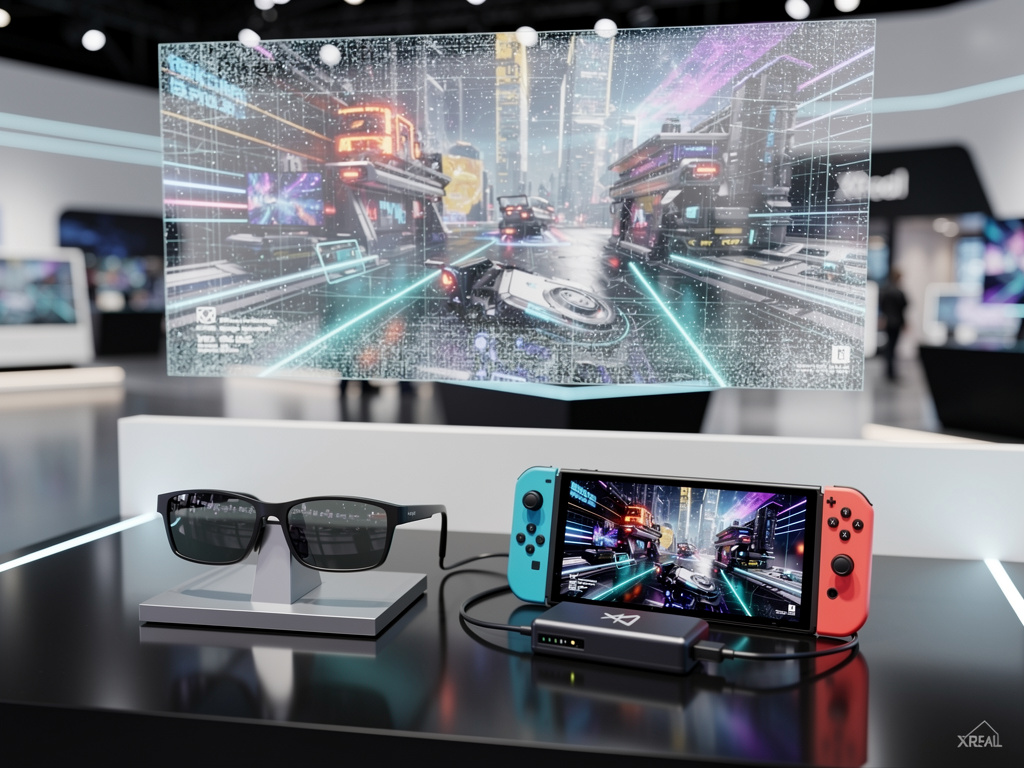
Through the Looking Glass: Xreal’s CES 2026 Breakthrough Unites AR and Nintendo Switch Worlds
At the bustling halls of CES 2026 in Las Vegas, Xreal unveiled a game-changing integration that bridges augmented reality eyewear with Nintendo’s latest console, marking a pivotal moment for portable gaming enthusiasts. The announcement centers on the Xreal Neo, a new accessory that finally enables seamless compatibility between Xreal’s AR glasses and the Nintendo Switch 2. This development addresses long-standing frustrations among gamers who have yearned for an immersive, hands-free way to experience their favorite titles on the go.
The Xreal Neo acts as a dedicated adapter, transforming the AR glasses into a virtual big-screen display for the Switch 2. According to reports from Lifehacker, this compatibility has been a highly requested feature, with users previously resorting to cumbersome workarounds. Now, players can dock their Switch 2 and project games onto a massive virtual canvas, effectively turning any environment into a personal theater. Industry insiders note that this move aligns with broader trends in mixed-reality entertainment, where hardware makers are racing to blend digital overlays with real-world interactions.
Beyond compatibility, Xreal introduced enhancements to its entry-level lineup, including the Xreal 1S glasses, which boast improved resolution and a novel 2D-to-3D conversion feature. This allows users to upscale flat content into stereoscopic visuals, adding depth to games and videos without native 3D support. Early hands-on impressions suggest this could redefine how consumers engage with media, particularly in mobile scenarios where traditional screens fall short.
Pushing Boundaries in AR Hardware Evolution
Xreal’s updates at CES 2026 extend to refining the user experience with better ergonomics and affordability. The Xreal 1S, priced at $449, increases display resolution from 1080p to 1200p per eye, as detailed in coverage from The Verge. This bump enhances clarity for prolonged sessions, crucial for gamers diving into extended playthroughs of titles like The Legend of Zelda or Super Mario. Moreover, the glasses now include built-in stereo speakers and adjustable nose pads, addressing comfort issues that plagued earlier models.
Complementing these glasses is a new Switch dock designed specifically for Xreal’s ecosystem. CNET highlights how this accessory simplifies connections, eliminating the awkward cable management that users faced before. By plugging the Switch 2 into the dock and linking it to the glasses via USB-C, gamers can enjoy low-latency streaming with minimal setup. This integration not only boosts portability but also opens doors for augmented overlays, such as real-time stats or environmental enhancements during gameplay.
On the software side, Xreal has leveraged partnerships to expand functionality. Posts on X from tech enthusiasts, including those discussing Google’s Project Aura collaboration with Xreal, indicate growing interest in AR platforms that support full Android apps. While not directly tied to the Switch integration, this ecosystem could eventually allow for hybrid experiences where Nintendo games interact with AR elements, like virtual companions or overlaid maps in open-world adventures.
Market Implications for Gaming and Wearables
The timing of Xreal’s reveal coincides with Nintendo’s push into next-generation hardware. The Switch 2, rumored to feature enhanced graphics and backward compatibility, stands to benefit immensely from AR extensions. Analysts point out that this could help Nintendo compete with rivals like Sony and Microsoft, who have invested heavily in VR headsets. By partnering indirectly through third-party accessories like Xreal’s, Nintendo maintains its focus on accessible, family-friendly gaming while tapping into cutting-edge tech.
Pricing plays a key role in Xreal’s strategy, with the 1S model undercutting previous iterations while offering superior specs. Gizmodo emphasizes that this combination of lower cost and higher performance makes AR more approachable for mainstream audiences. For instance, the glasses’ 500 nits brightness ensures usability in various lighting conditions, from dim airplane cabins to sunny outdoor settings, broadening appeal beyond niche tech hobbyists.
Furthermore, the 2D-to-3D conversion isn’t just a gimmick; it uses advanced algorithms to add depth perception, potentially revitalizing older Switch games. Imagine playing classic 2D platformers with a newfound sense of dimension, or watching movies with pop-out effects. This feature, as noted in Engadget, represents a polish over the original Xreal One, refining the personal cinema aspect that positions these glasses as alternatives to bulky TVs or monitors.
Technical Deep Dive into Compatibility Challenges
Delving deeper into the engineering behind the Neo adapter, it resolves key technical hurdles that previously hindered AR-Switch pairings. The Switch 2’s output, optimized for handheld or docked TV use, required specific signal processing to work with AR displays. Xreal’s solution involves a compact hub that handles video passthrough and power management, ensuring stable frame rates without draining the console’s battery excessively.
Industry experts, drawing from web searches and recent news, highlight how this adapter supports up to 120Hz refresh rates, minimizing motion sickness—a common complaint in AR gaming. Posts on X from users like those sharing hands-on experiences at CES underscore the excitement, with many praising the seamless integration for titles demanding quick reflexes, such as Splatoon or Mario Kart.
Xreal’s broader vision includes expanding to other devices, but the Switch focus at CES 2026 steals the spotlight. By enabling AR glasses to act as a private, expansive screen, it caters to travelers and commuters who want immersion without disturbing others. This aligns with Nintendo’s ethos of fun, accessible play, potentially boosting Switch 2 sales as consumers seek complementary accessories.
Competitive Dynamics and Future Prospects
In the competitive arena of wearables, Xreal’s moves position it against giants like Apple and Meta. While Apple’s Vision Pro targets high-end spatial computing, Xreal opts for lightweight, glasses-style form factors that prioritize comfort over full immersion. The collaboration with Google on Project Aura, as mentioned in X posts from reliable tech journalists, suggests upcoming Android XR integrations that could further enhance Switch compatibility through app ecosystems.
Cost-effectiveness remains a differentiator; at under $500, the Xreal 1S undercuts many competitors while delivering premium features. Tom’s Guide coverage of CES live updates notes the buzz around these announcements, with attendees flocking to demos showcasing Zelda adventures in 3D glory. This enthusiasm reflects a shift toward hybrid devices that blur lines between gaming consoles and smart eyewear.
Looking ahead, potential software updates could introduce AR-exclusive modes for Switch games, such as augmented reality puzzles or multiplayer overlays. Nintendo has historically been cautious with VR/AR, but third-party innovations like Xreal’s might encourage official support, fostering a new era of interactive entertainment.
User Experiences and Adoption Hurdles
Early adopters report transformative experiences, with the glasses turning mundane commutes into epic gaming sessions. However, challenges persist, including battery life— the 1S lasts about three hours on a charge—and the need for prescription lens compatibility. Xreal addresses some of these with modular designs, allowing custom inserts.
Sentiment from X posts reveals a mix of hype and skepticism; while many celebrate the dock’s ease, others question long-term durability. Industry insiders advise that widespread adoption hinges on developer support, urging Nintendo to provide APIs for deeper AR integrations.
As CES 2026 unfolds, Xreal’s announcements signal a maturing market where AR enhances rather than replaces traditional gaming. This could lead to innovative hybrids, like glasses that overlay game elements onto real environments, expanding creative possibilities.
Strategic Partnerships and Ecosystem Growth
Xreal’s partnership ecosystem, including ties with Google for Android XR, positions it for growth. Posts on X discussing Project Aura highlight features like a 70-degree field of view and AI-driven interactions, which could complement Switch gaming by enabling floating windows for guides or chats.
The Neo’s compatibility extends beyond gaming to productivity, allowing Switch users to multitask with virtual screens. This versatility appeals to professionals who game on the side, blending work and play seamlessly.
In essence, Xreal’s CES reveal not only solves immediate compatibility issues but paves the way for a more interconnected future in consumer tech.
Innovations in Display Technology
At the core of the 1S improvements is Micro-OLED technology, offering high pixel density for crisp visuals. Compared to earlier models, this reduces screen-door effects, making virtual elements feel more lifelike.
The 3D conversion leverages machine learning to analyze and depth-map 2D content in real-time, a feat that Lifehacker Australia describes as automatic and seamless. For Switch users, this means enhancing library titles without developer intervention.
Battery and thermal management have also seen upgrades, with the dock providing pass-through charging to keep sessions uninterrupted.
Broader Industry Ripple Effects
Xreal’s advancements influence adjacent sectors, like education and training, where AR glasses could simulate environments using Switch-like interfaces. This cross-pollination drives innovation across tech domains.
Competitors may respond with their own integrations, accelerating AR adoption. Nintendo’s silence on official AR plans leaves room for speculation, but Xreal’s initiative could force a strategic rethink.
Ultimately, these developments at CES 2026 underscore a shift toward personalized, immersive experiences that redefine entertainment boundaries.


 WebProNews is an iEntry Publication