
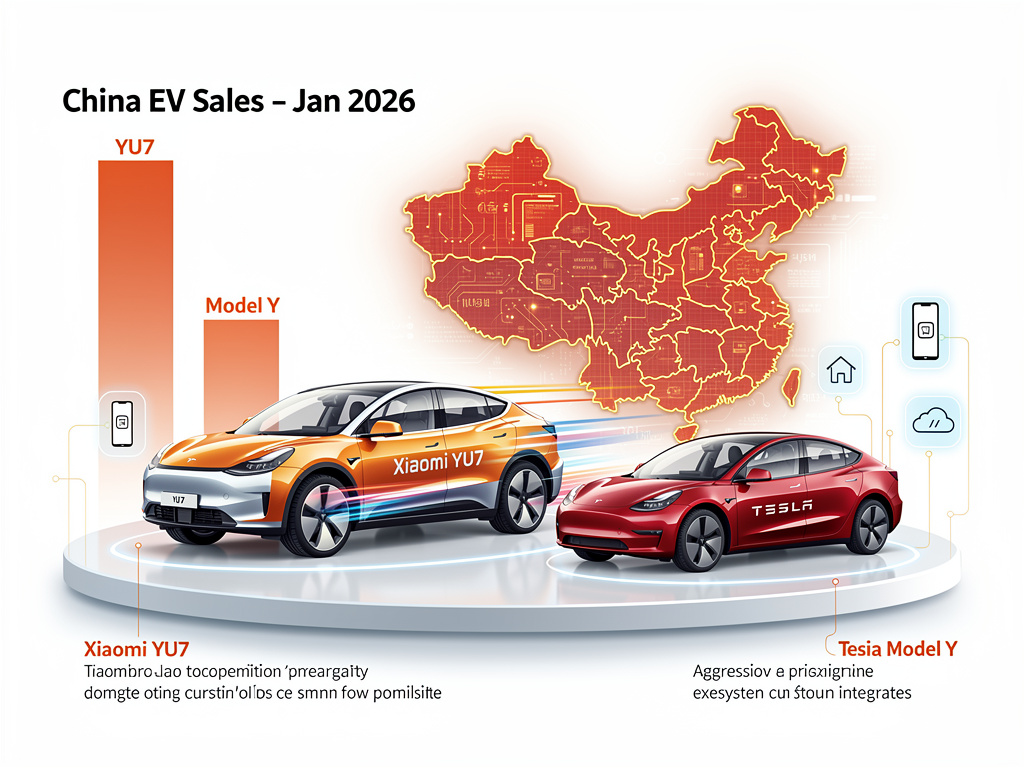
For years, Tesla’s Model Y has been the undisputed king of China’s electric vehicle market, a position that seemed unassailable given the company’s brand cachet, Supercharger network, and Elon Musk’s cult-like following among Chinese tech enthusiasts. That era appears to be over. In January 2026, Xiaomi — the smartphone giant that only entered the auto business in 2024 — outsold Tesla’s flagship SUV by a factor of two to one, a seismic shift that underscores just how rapidly the competitive dynamics of the world’s largest EV market are evolving.
According to CNBC, Xiaomi’s YU7 electric SUV sold approximately 40,000 units in China during January, roughly double the number of Tesla Model Y units delivered in the same period. The figures represent not just a momentary blip but a sustained trend that has been building since Xiaomi launched the YU7 in late 2025 at a price point that dramatically undercut Tesla’s comparable offering.
A Smartphone Playbook Applied to the Auto Industry
Xiaomi’s approach to the automobile market mirrors the strategy that made it one of the world’s largest smartphone makers: offer premium-level specifications at a price that competitors struggle to match, then build an ecosystem that locks consumers into the brand. The YU7, which starts at roughly 219,900 yuan (approximately $30,200), undercuts the Tesla Model Y by nearly 30,000 yuan — a gap of about $4,000 that resonates powerfully with China’s increasingly price-conscious middle class.
The strategy is not merely about being cheap. Xiaomi has leveraged its massive existing user base of smartphone and smart home device owners to create what the company calls a “human-car-home” ecosystem. YU7 owners can seamlessly control their vehicle through Xiaomi’s smartphone interface, integrate it with their home automation systems, and access a suite of services that feel native rather than bolted on. This level of integration is something Tesla has long promised but never fully delivered in the Chinese market, where local software ecosystems dominate daily life.
Tesla’s China Problem Runs Deeper Than Price
Tesla’s struggles in China are not new, but the speed of its decline in relative market share has caught many analysts off guard. The Model Y, which underwent a significant refresh in early 2025, initially saw a sales bump but has since struggled to maintain momentum against a wave of competitively priced domestic alternatives. Beyond Xiaomi, Tesla faces relentless pressure from BYD, Li Auto, NIO, and a host of smaller players that have collectively transformed China into the most competitive EV market on the planet.
Industry analysts point to several factors beyond price that are working against Tesla. Brand perception in China has shifted considerably over the past two years. Where Tesla was once seen as the aspirational choice for upwardly mobile Chinese consumers, domestic brands have successfully repositioned themselves as technologically superior and more attuned to local preferences. Xiaomi, in particular, benefits from an enormous reservoir of brand loyalty among younger Chinese consumers who grew up using its products. As reported by CNBC, Xiaomi’s ability to convert its existing customer base into car buyers has been one of the most remarkable feats of brand extension in recent automotive history.
The YU7’s Technical Credentials Are No Joke
Dismissing Xiaomi’s success as purely price-driven would be a mistake. The YU7 boasts specifications that compete head-to-head with Tesla’s Model Y on virtually every metric. The vehicle features an 800-volt electrical architecture, enabling ultra-fast charging speeds that can add 300 kilometers of range in roughly 15 minutes. Its ADAS (advanced driver-assistance system), developed in-house by Xiaomi’s autonomous driving division, has received strong reviews from Chinese automotive media and is considered by many to be on par with or superior to Tesla’s Full Self-Driving system in Chinese driving conditions.
The SUV’s interior, designed with a minimalist aesthetic that echoes Xiaomi’s consumer electronics DNA, features a 16.1-inch central touchscreen running Xiaomi’s HyperOS automotive platform. The system offers native integration with popular Chinese apps and services — a critical advantage over Tesla’s infotainment system, which has been criticized for its limited compatibility with China’s dominant digital platforms like WeChat and Alipay. Range figures for the YU7 top out at approximately 620 kilometers on the CLTC cycle for the long-range variant, competitive with Tesla’s Model Y Long Range offering.
Production Scale-Up Has Been Remarkably Smooth
One of the most impressive aspects of Xiaomi’s automotive venture has been its ability to ramp production quickly. The company’s manufacturing facility in Beijing, which also produces the SU7 sedan that launched Xiaomi’s auto ambitions in 2024, has demonstrated a level of production efficiency that typically takes legacy automakers years to achieve. Xiaomi CEO Lei Jun has publicly stated that the company aims to deliver over 300,000 vehicles in 2026, a target that seemed ambitious when announced but now appears increasingly achievable given the YU7’s strong reception.
The production ramp stands in contrast to the struggles faced by other Chinese EV startups. NIO, XPeng, and others spent years burning through cash before achieving meaningful scale. Xiaomi’s advantage lies in its existing manufacturing expertise — while building smartphones is obviously different from building cars, the company’s deep understanding of supply chain management, component sourcing, and lean manufacturing has translated surprisingly well to the automotive sector. The company has also benefited from China’s mature EV supply chain, which offers access to world-class battery cells, electric motors, and other components at prices that international competitors cannot match.
Wall Street Is Taking Notice — And Tesla Bears Are Emboldened
The implications for Tesla’s stock, which has been volatile throughout 2025 and into 2026, are significant. Tesla derives a substantial portion of its global deliveries from China, and any sustained erosion of its market position there directly impacts the company’s financial performance. Several Wall Street analysts have revised their China delivery estimates downward in the wake of the January sales data, with some noting that Tesla may need to implement further price cuts — potentially at the expense of margins — to remain competitive.
Xiaomi’s stock, meanwhile, has been on a tear. The company’s shares have more than doubled over the past 12 months as investors have warmed to the idea that its automotive division could become a major profit center. The YU7’s strong sales have validated the bull thesis that Xiaomi can replicate its smartphone success in the auto sector, and the company’s market capitalization now reflects meaningful value attributed to its EV business.
What This Means for the Global EV Order
Xiaomi’s rise in China’s EV market carries implications that extend far beyond the country’s borders. The company has signaled its intention to expand internationally, and if it can replicate even a fraction of its Chinese success in markets like Southeast Asia, the Middle East, and eventually Europe, it could reshape the global competitive order in electric vehicles. European automakers, already struggling to compete with BYD’s aggressive international expansion, now face the prospect of another well-funded, technologically capable Chinese competitor entering their home markets.
For Tesla, the path forward in China likely involves a combination of price adjustments, accelerated introduction of new models, and deeper localization of its software and services. The company’s planned compact vehicle, expected to launch in late 2026 or early 2027, could help it compete more effectively in the high-volume segments where Chinese brands currently dominate. But the window is narrowing. Every month that Xiaomi and its domestic rivals gain ground, Tesla’s task of reclaiming its former position becomes more daunting.
The broader lesson of Xiaomi’s triumph is one that should concern every Western automaker with ambitions in China: in a market where consumers have abundant choice, where domestic brands carry no stigma, and where technological parity has been largely achieved, price and ecosystem integration become the decisive battlegrounds. Xiaomi understood this from day one. Tesla, for all its pioneering brilliance, is still learning.


 WebProNews is an iEntry Publication