
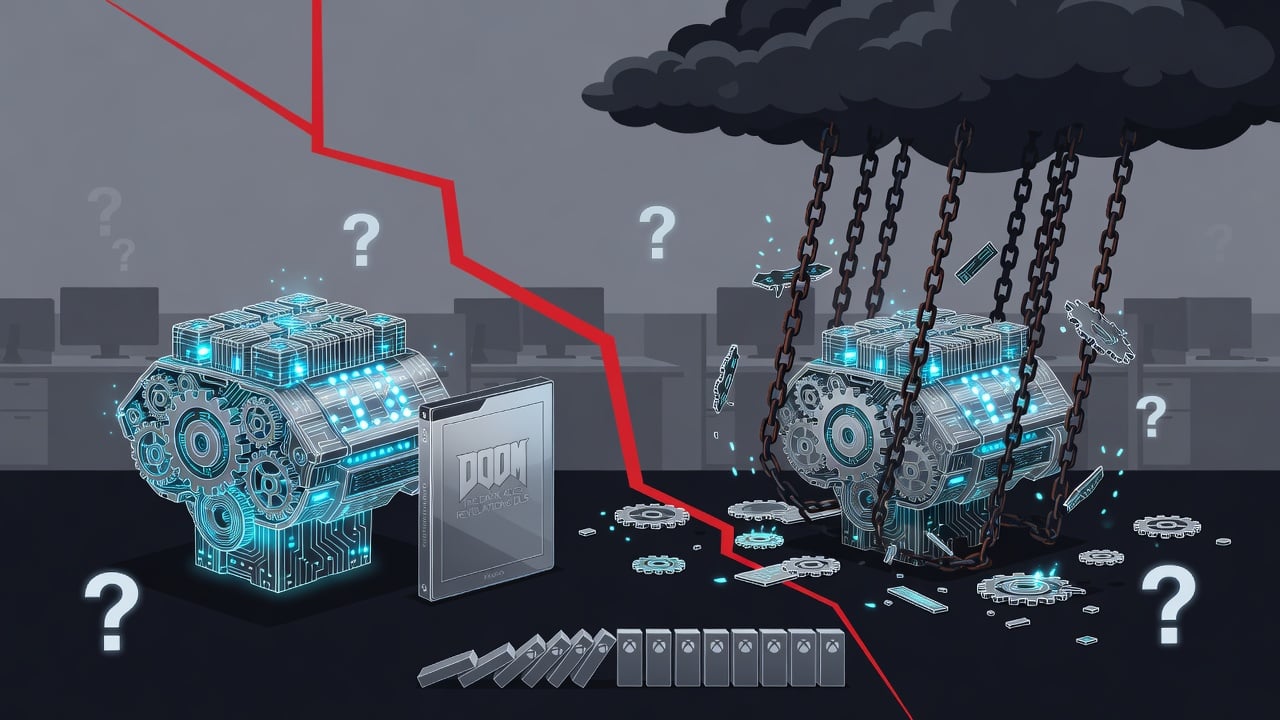
Microsoft’s latest round of job reductions has struck at the heart of one of gaming’s most storied developers. id Software, the studio behind Doom, Quake and the id Tech engine, lost roughly half its workforce this week. The timing could hardly feel more jarring. Doom: The Dark Ages Revelations, the first expansion for last year’s mainline entry, dropped the same day reports of the cuts surfaced.
Around 95 people received notice. That’s according to former Bethesda project lead Jeff Gardiner, who shared the number on X after learning of the changes. For context, the studio had about 185 employees late last year when many signed union cards in response to earlier Xbox reductions. The math lines up with multiple accounts that put the losses near 50 percent.
Scott Miller, founder of Apogee and 3D Realms, offered an even bleaker picture. He wrote on X that the cuts took “most (if not all) coders.” The loss hits the very people responsible for id Tech. That proprietary engine powered the blistering performance and visual fidelity of recent Doom titles. Observers now question whether future Doom or Quake games will rely on it at all.
Michael Maynard, a principal gameplay systems programmer who spent more than two decades at the studio, didn’t hold back in his LinkedIn post. “Yes, I was part of the team (roughly 50% of the company) that was laid off today,” he wrote. He described the decision as Microsoft determining that half the team “was no longer needed.” The veteran added that the move felt like reducing a pioneer of first-person shooters to just another line item in a reorganization.
These departures come as part of a sweeping Xbox reset announced by CEO Asha Sharma. The company plans roughly 3,200 job cuts across its gaming business over the new fiscal year. About 1,600 roles were eliminated immediately. The remainder will phase out in coming months. Studios under ZeniMax Media, which includes id Software, Bethesda and others, must now concentrate on proven franchises such as Doom, Fallout, The Elder Scrolls, Wolfenstein and Quake.
Industry voices warn the damage at id runs deeper than headcount.
John Romero, co-creator of the original Doom, posted his reaction on X. “I’m so sorry for everyone at id Software affected by these layoffs. I know what it feels like to leave id while id goes on. It’s a strange and painful thing.” His words carried the weight of someone who watched the studio evolve across decades. Others echoed concern that institutional knowledge around id Tech could prove impossible to replace quickly.
Reports from multiple outlets paint a consistent scene. Programming and quality assurance departments took especially heavy hits. One anonymous source told Game Developer that the QA team was gutted. That matches details shared across Eurogamer and Ars Technica, both of which published updates in the past day. Jason Schreier of Bloomberg also noted on Bluesky that ZeniMax Online Studios and id Software each lost a significant number of staff.
But id Software isn’t shutting down. Xbox leadership has signaled that the studio will continue to support its flagship series. Yet size matters. A team reduced to perhaps 90 people will struggle to lead ambitious single-player campaigns and multiplayer modes at the same scale as before. Some speculation points to id shifting into a support role for other ZeniMax teams or adopting engines like Unreal for future projects. Such a move would mark a sharp break from the studio’s history of pushing custom technology.
The cuts arrive even as recent Doom games earned praise for tight level design, improved audio, and fast combat. Players on X described enjoying the new Revelations content while feeling bittersweet about the human cost. One post noted the expansion’s strong soundscape and level work, then added that the layoffs made it harder to celebrate. Another highlighted that the modern Doom trilogy succeeded without leaning on culture-war distractions, only to see its creators face corporate belt-tightening.
This isn’t id Software’s first brush with layoffs under Microsoft ownership. The studio unionized last December partly in response to prior waves of job losses across Xbox. That union status raises questions about how protections applied this time, though exact numbers of union members affected remain unclear. What is clear is the scale. Losing half the staff in one stroke, especially technical talent, changes a studio’s capabilities overnight.
Microsoft has framed the reductions as necessary to remove management layers and focus resources on high-impact titles. Yet the timing, coinciding with a major DLC launch, leaves a sour taste. It also fuels broader industry chatter about whether giant publishers can sustain specialized teams that built their reputations on technical excellence and creative risk. Doom helped define the first-person shooter genre in the 1990s. Its modern revival under id Tech showed that formula could still deliver in high-fidelity form.
So the fear is real. Without enough coders to iterate on the engine, future entries might lose the performance edge that set them apart. Quake, Wolfenstein and even potential new projects could follow the same path. And while franchises will live on, the unique culture and technical DNA that made id Software singular may not survive intact.
Observers will watch closely in the months ahead. Will the slimmed-down team deliver another standout Doom release? Or will the studio’s role diminish to support duties while other teams take the lead? For now, the numbers tell a stark story. Nearly 100 people who shipped hit games are suddenly looking for work. The industry they helped define keeps contracting. id Software, for all its legacy, proved no exception.


 WebProNews is an iEntry Publication