
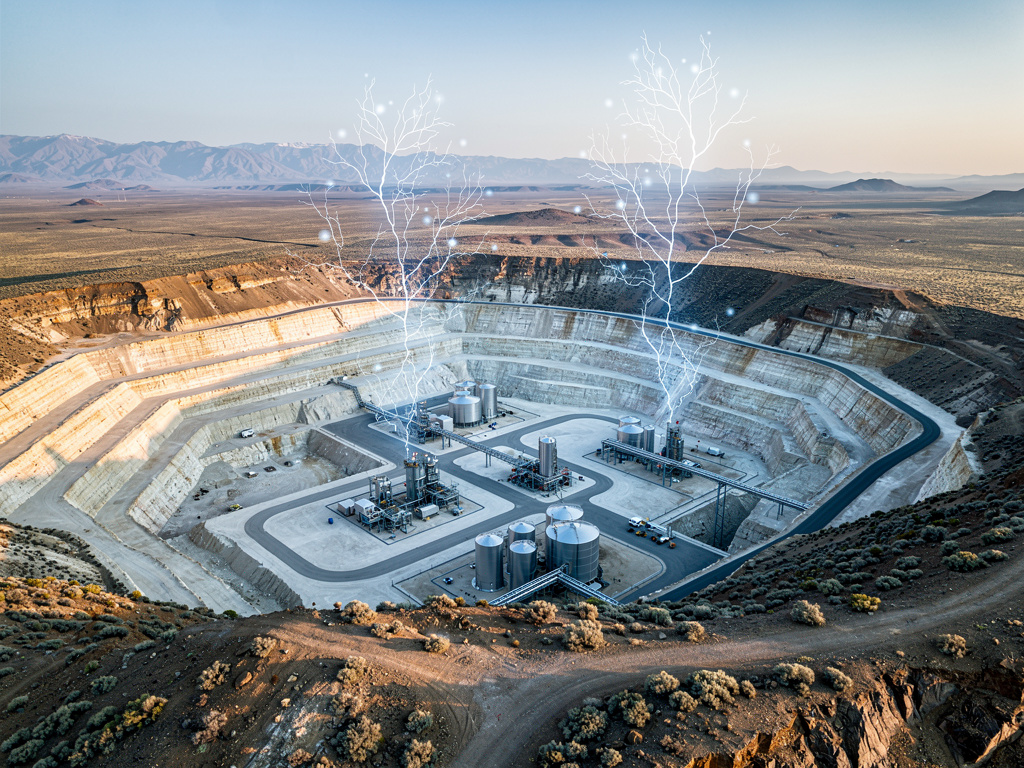
Volcanic Vault: Unearthing America’s $1.5 Trillion Lithium Windfall Amid Supervolcano Perils
In the arid expanse of the Nevada-Oregon border, a geological marvel has emerged as a potential game-changer for the global technology sector. Scientists have uncovered what could be the world’s largest lithium deposit, nestled within the ancient crater of the McDermitt Caldera, an extinct supervolcano. Valued at an astonishing $1.5 trillion, this find promises to supply batteries for electric vehicles, smartphones, and renewable energy storage for decades. Yet, the location presents formidable challenges, blending cutting-edge extraction technology with environmental and seismic risks that could redefine how the industry approaches resource mining.
The discovery stems from recent geological surveys that revealed massive lithium-rich clay deposits in the caldera, formed millions of years ago through volcanic activity. According to reports, the site holds up to 40 million metric tons of lithium, dwarfing reserves in Bolivia’s Salar de Uyuni, previously considered the largest. This revelation comes at a critical juncture as demand for lithium surges with the electric vehicle boom and the push toward sustainable energy. Industry analysts project that global lithium needs could triple by 2030, driven by companies like Tesla and battery manufacturers scrambling for stable supplies amid volatile markets.
For the United States, this deposit represents a strategic opportunity to reduce dependence on foreign sources, particularly China, which dominates lithium processing. Federal initiatives, including subsidies under the Inflation Reduction Act, are already funneling billions into domestic mining projects. However, the supervolcano setting adds layers of complexity, with potential for geothermal instability and ecological disruption that miners must navigate carefully.
Geological Origins and Extraction Hurdles
The McDermitt Caldera, formed about 16 million years ago from a massive eruption, now harbors lithium trapped in smectite and illite clays. Researchers from institutions like the Lithium Americas Corporation have detailed how volcanic processes concentrated the metal here, creating a unique sedimentary basin. A study highlighted in Tom’s Hardware estimates the deposit could yield enough lithium to power billions of devices, potentially stabilizing prices that have fluctuated wildly in recent years.
Extracting this resource won’t be straightforward. Traditional lithium mining often involves evaporating brines or hard-rock excavation, but the clay-based deposits here require innovative acid-leaching techniques. Companies are exploring direct lithium extraction (DLE) methods, which promise higher efficiency and lower water use compared to conventional approaches. Yet, the volcanic terrain poses risks: subsurface heat and potential seismic activity could complicate operations, raising concerns about long-term site stability.
Environmental groups have voiced alarms over the impact on local ecosystems, including water scarcity in the already parched region. Indigenous tribes, such as the Fort McDermitt Paiute and Shoshone, claim cultural significance to the area and have initiated legal challenges against proposed mines. These disputes echo broader tensions in resource extraction, where economic gains clash with heritage preservation.
Tech Industry Ripples and Market Dynamics
The potential influx of U.S.-sourced lithium could reshape supply chains for tech giants. With electric vehicles accounting for over 70% of lithium demand, automakers like Ford and General Motors are eyeing partnerships to secure allocations. A report from Earth.com notes that this deposit alone might cover domestic needs for decades, potentially slashing battery costs by 20-30% through reduced import tariffs and transportation expenses.
Market volatility has plagued lithium in recent years, with prices peaking in 2022 before a sharp decline due to oversupply from Australia and South America. This new find could act as a buffer, providing a steady North American source amid geopolitical uncertainties. Analysts at firms like Benchmark Mineral Intelligence predict that successful development here might pressure Chinese refiners, who control 60% of global capacity, to innovate or face market share erosion.
Beyond EVs, the deposit’s impact extends to consumer electronics and grid storage. Companies developing solid-state batteries, which require high-purity lithium, stand to benefit immensely. For instance, startups in Silicon Valley are already prototyping devices that could double energy density, leveraging abundant supplies to accelerate R&D timelines.
Regulatory and Investment Landscape
Government backing is accelerating progress. The Biden administration has allocated funds through the Department of Energy for pilot projects, aiming to fast-track environmental reviews. However, regulatory hurdles remain, with the Bureau of Land Management scrutinizing permits amid public opposition. A piece in Daily Galaxy underscores the $1.5 trillion valuation, based on current market prices, but warns that extraction costs could inflate due to the site’s unique geology.
Investors are pouring in, with venture capital firms betting on tech-driven mining solutions. Lithium Americas, a key player, has secured deals with General Motors for offtake agreements, signaling confidence in the project’s viability. Stock prices for related companies have surged, reflecting optimism, though experts caution that full-scale production might not commence until the late 2020s.
On social platforms like X, sentiment is mixed. Posts highlight excitement over energy independence, with users speculating on how this could “redraw the global battery map,” while others raise alarms about environmental fallout, drawing parallels to past mining disasters. This public discourse underscores the broader societal debate on balancing innovation with sustainability.
Innovation in Extraction Technologies
To mitigate risks, engineers are adapting geothermal drilling techniques borrowed from oil and gas sectors. These methods could harness the caldera’s residual heat for energy-efficient processing, potentially creating a dual-purpose site for lithium and renewable power generation. Innovations like ion-exchange resins in DLE promise to extract lithium with 90% recovery rates, minimizing waste.
Challenges persist in scaling these technologies. Pilot tests have shown promise, but full implementation requires massive infrastructure, including roads and processing plants in remote areas. Water usage is a flashpoint; the region faces chronic shortages, and mining could exacerbate this, prompting calls for closed-loop systems that recycle 95% of water.
Collaborations between academia and industry are key. Universities like Stanford are modeling volcanic stability to predict risks, ensuring operations don’t trigger geological events. Such foresight is crucial, as any mishap could halt the project and deter future investments in similar sites.
Economic and Global Implications
Economically, the deposit could generate thousands of jobs in Nevada and Oregon, boosting local economies long reliant on agriculture and tourism. Projections suggest annual revenues exceeding $10 billion once operational, contributing to U.S. GDP growth in clean tech sectors. This aligns with broader goals of onshoring critical minerals, reducing vulnerabilities exposed during the pandemic.
Globally, the find might shift power dynamics. Countries like Chile and Australia, current lithium leaders, could see reduced dominance, prompting them to enhance their own efficiencies. In TechRadar, experts discuss how this could “revolutionize the tech industry,” but emphasize the “bad news” of the supervolcano location, which demands unprecedented safety protocols.
For consumers, cheaper lithium translates to affordable EVs and gadgets, accelerating the green transition. Yet, ethical sourcing remains paramount; ensuring fair labor and minimal environmental harm will define the project’s legacy.
Indigenous Perspectives and Ethical Mining
Indigenous communities are at the forefront of opposition, arguing that mining desecrates sacred lands. Legal battles, supported by organizations like the Sierra Club, seek to enforce treaties and environmental laws. Proponents counter with community benefit agreements, offering revenue shares and job training.
This tension highlights the need for inclusive development models. Successful precedents, such as negotiated pacts in Canadian mining, could serve as blueprints. Industry insiders advocate for transparent stakeholder engagement to build trust and avoid protracted delays.
As the project evolves, monitoring frameworks will be essential. Independent audits could verify compliance with sustainability standards, fostering a model for future extractions in sensitive areas.
Future Prospects and Strategic Importance
Looking ahead, the McDermitt deposit could catalyze advancements in battery recycling, complementing new supplies to create a circular economy. With lithium demand forecasted to hit 2.5 million tons annually by 2035, per a GlobeNewswire report, diversification is vital.
Strategically, this bolsters U.S. national security by securing materials for defense tech, from drones to energy systems. Alliances with allies like Canada and the EU could form a Western lithium bloc, countering Eastern monopolies.
Ultimately, the supervolcano’s bounty tests the industry’s ingenuity. Success here could unlock similar deposits worldwide, from Yellowstone to Andean volcanoes, heralding a new era of resource discovery. Failure, however, might reinforce skepticism toward high-risk mining, pushing innovation toward alternatives like sodium-ion batteries. As debates rage, the McDermitt Caldera stands as a symbol of opportunity laced with peril, where volcanic legacies meet modern ambitions.


 WebProNews is an iEntry Publication