
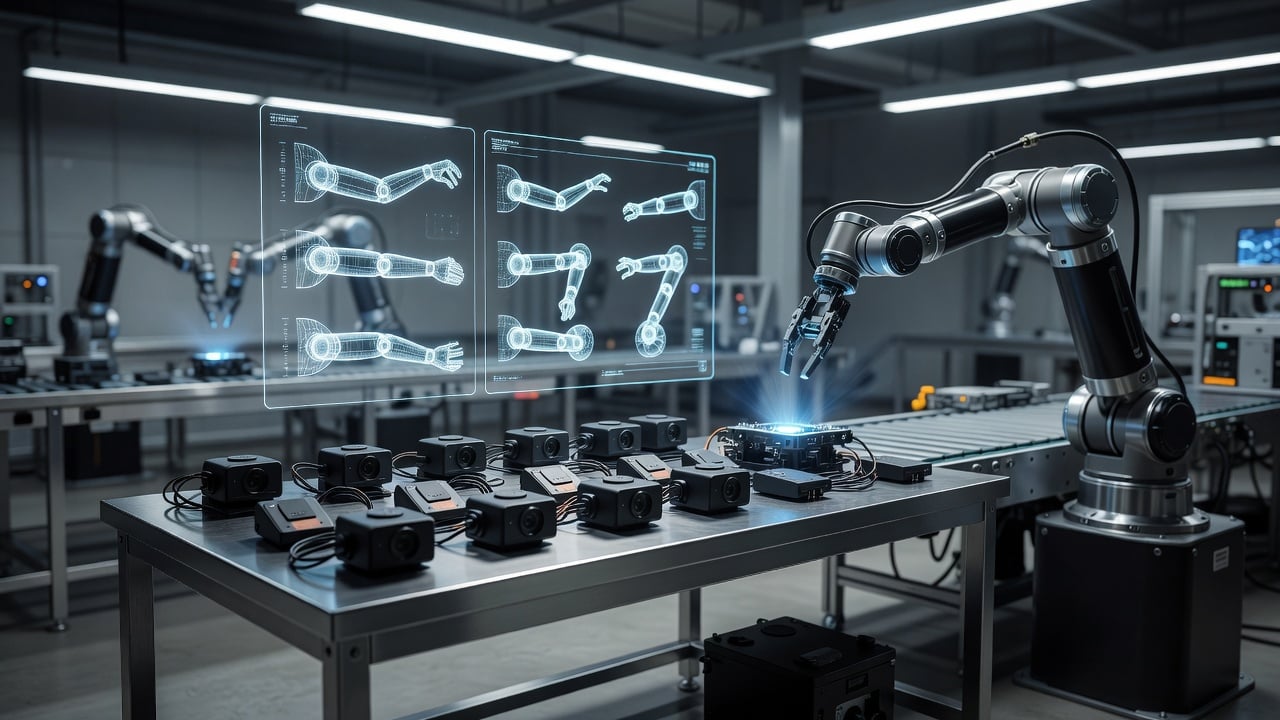
In factories across the globe, a disturbing new practice has taken root. Companies now require their human employees to wear cameras and sensors that feed real-time data directly into the very machines destined to replace them. This arrangement turns workers into unwilling participants in their own elimination from the workforce. The setup feels like a betrayal of basic human dignity, forcing people to train the instruments of their unemployment while still punching the clock each day.
The story broke through reporting by Futurism, which uncovered multiple manufacturing facilities attaching vision systems and motion trackers to line workers. These devices record every movement, every hesitation, every adjustment a person makes while performing tasks. The data then trains robotic systems to copy those exact behaviors with mechanical precision. Workers must sign agreements accepting the surveillance or face termination. Refusal means immediate loss of income in an economy that already offers few alternatives for skilled tradespeople.
This forced collaboration represents something uniquely cruel in the history of labor relations. Previous generations of workers fought against machines that threatened their jobs, often through strikes, sabotage, or political organizing. Those conflicts, however bitter, maintained a clear line between human labor and mechanical replacement. The current approach eliminates that boundary. Companies now demand that employees actively improve the algorithms that will render their positions obsolete. The worker becomes both the teacher and the soon-to-be-unemployed student in a perverse master class on efficiency.
Consider the psychological toll this takes. A machinist with twenty years of experience must demonstrate the subtle techniques that separate acceptable parts from scrap. Each motion captured by the overhead cameras and wearable sensors gets broken down into data points. The system learns how much pressure to apply, when to pause for quality checks, and how to compensate for material variations. Once the robot masters these nuances, management can calculate the exact moment when human oversight becomes unnecessary. The employee has literally handed over the keys to their own replacement.
The power imbalance could hardly be more stark. Workers in these facilities often come from communities where manufacturing jobs represent the best available option for stable income and benefits. Many support families on these wages. When presented with the camera requirement, they face an impossible choice between unemployment today or unemployment six months from now. Some describe the experience as signing their own termination papers. Others report feeling physically ill when strapping on the monitoring equipment each morning, knowing their every action accelerates the timeline toward their dismissal.
Manufacturing executives defend the practice by pointing to competitive pressures and productivity demands. They argue that global markets require constant efficiency improvements to maintain profitability. Yet this explanation rings hollow when examined closely. The same companies that claim they must automate to survive somehow find resources to invest millions in surveillance infrastructure and artificial intelligence development. Those funds could instead support worker retraining programs or transitions to new roles within the company. Instead, the chosen path maximizes short-term gains while discarding human capital with clinical detachment.
The human cost extends beyond immediate job losses. Workers who train their robotic successors often report diminished pride in their craft. What was once a source of identity and expertise becomes a temporary bridge to obsolescence. The knowledge accumulated through years of hands-on experience gets extracted and digitized, then used to eliminate the need for that very expertise. This extraction feels like theft, not collaboration. Companies harvest the irreplaceable value of human judgment and muscle memory while offering nothing in return except the promise of severance packages that rarely match the long-term value of steady employment.
Labor advocates have begun documenting cases where this surveillance leads to immediate workplace deterioration. Employees become self-conscious about their movements, knowing that any inefficiency might accelerate automation timelines. The natural rhythm of work disappears as people try to perform perfectly for the machines watching them. Some workers develop anxiety disorders linked directly to the constant monitoring. Others experience depression when they realize their years of dedication to a company have culminated in helping to engineer their own redundancy.
The practice also raises troubling questions about consent and coercion. Can an agreement be truly voluntary when the alternative is financial ruin? Courts have historically recognized that certain power imbalances render agreements unenforceable. The relationship between a large manufacturer and an individual assembly line worker contains exactly that kind of imbalance. Yet few legal challenges have emerged so far, partly because workers fear retaliation and partly because labor law has not kept pace with technological development.
Some companies have taken the concept even further by creating bonus structures tied to how effectively employees train the replacement systems. Workers can earn additional pay by providing detailed explanations of their techniques or by demonstrating complex problem-solving scenarios for the cameras. This financial incentive creates a market for self-sabotage. Employees find themselves calculating whether the short-term monetary gain justifies hastening their own departure from the workforce. The ethical implications of such arrangements should trouble anyone who values human labor as something more than disposable input.
The broader societal consequences deserve serious attention. When large segments of the working population are systematically removed from production roles without adequate support systems, the resulting economic dislocation affects entire communities. Reduced consumer spending follows job losses. Local businesses suffer. Tax revenues decline. The very markets that automation was supposed to serve begin to shrink. This creates a feedback loop where technological efficiency undermines the economic foundation necessary for continued consumption.
Education and retraining programs have not scaled to meet the challenge. Most displaced workers cannot simply transition into software development or data science roles. The skills gap is real and growing. Meanwhile, the profits from automation flow primarily to corporate shareholders and technology vendors rather than funding comprehensive workforce development initiatives. The result is a society where technological progress and human welfare increasingly diverge.
Workers in these camera-equipped factories describe a pervasive sense of dread that builds throughout each shift. They know the data they generate today will be used to write their job descriptions out of existence tomorrow. This knowledge transforms ordinary workplace tasks into acts of self-erasure. The coffee break conversation shifts from sports and family news to speculation about which station will be automated next. Morale plummets as the inevitable approaches.
Some employees have attempted subtle resistance by deliberately introducing minor variations in their movements or withholding certain techniques from the recording systems. These efforts rarely succeed against sophisticated vision algorithms that can generalize from limited data. The machines prove remarkably adept at filling in gaps and adapting to inconsistencies. What begins as quiet rebellion often ends in resignation as workers realize the technological momentum has become unstoppable.
The psychological impact on older workers is particularly severe. Many entered manufacturing straight from high school and expected to complete their careers in the same facilities. The sudden introduction of monitoring equipment designed to eliminate their positions feels like a violation of an implicit social contract. They gave their youth, their bodies, and their loyalty to companies that now treat them as temporary data sources. The betrayal cuts deep.
Younger employees face different but equally troubling prospects. They watch the automation process with a mixture of resignation and anxiety about their own futures. Some choose to leave manufacturing entirely, seeking careers less vulnerable to technological displacement. This brain drain further weakens the sector even as companies claim they need skilled workers to manage increasingly complex automated systems.
The pattern emerging across multiple industries suggests this approach to automation represents more than isolated corporate decisions. It reflects a fundamental shift in how management views human employees. Workers transition from valued team members to data-generating obstacles standing between current operations and fully automated efficiency. The camera requirement makes this philosophical change explicit and unavoidable.
Legal scholars have begun examining whether existing privacy laws or labor regulations might restrict these practices. The question of whether companies can compel employees to participate in their own replacement touches on basic human rights considerations. If the right to meaningful work holds any significance in modern society, then forcing people to accelerate their own obsolescence would seem to violate that principle.
Unions have started incorporating language about surveillance and automation into contract negotiations. Some have successfully negotiated restrictions on how data from worker monitoring can be used. Others have won commitments for retraining funds tied to automation initiatives. These victories remain limited but point toward potential paths for protecting worker interests in an increasingly automated economy.
The fundamental issue remains the absence of genuine choice for most employees. When your mortgage, healthcare, and children’s education depend on a specific job, agreeing to wear cameras that will eliminate that position hardly qualifies as a free decision. Companies understand this dynamic perfectly well. They structure the arrangements to minimize legal risk while maximizing data collection. The result is a system that appears consensual on paper while functioning as coercion in practice.
As more facilities adopt these methods, the cumulative effect on the workforce grows more concerning. Entire skill sets that once provided stable careers are being systematically digitized and transferred to mechanical systems. The workers who possess those skills become temporary vessels for information transfer rather than long-term assets. This transformation devalues human experience in ways that extend far beyond economic calculations.
The tragedy lies not in technological progress itself but in the callous manner of its implementation. Automation could serve as a tool for reducing dangerous or repetitive work while creating new opportunities for human creativity and problem-solving. Instead, many companies have chosen a path that extracts maximum value from workers during their final months or years of employment. The cameras keep rolling, the data keeps flowing, and the jobs keep disappearing.
Society must confront the reality that treating workers as disposable components in a larger automation scheme carries heavy human and economic costs. The skills, knowledge, and dedication of manufacturing employees represent decades of accumulated wisdom that should be preserved and built upon rather than harvested for robotic replication. Forcing people to participate in their own elimination from the workforce violates basic principles of fairness and respect.
The factories installing these camera systems have made their priorities clear. Human workers exist primarily as data sources for the next generation of machines. This instrumental view of people as temporary means to a mechanical end should alarm anyone who believes that economic systems should serve human needs rather than the reverse. The practice of attaching cameras to workers to accelerate their replacement stands as a stark example of how far some companies are willing to go in pursuit of efficiency at the expense of dignity. The workers strapping on those devices each morning understand the bargain they have been forced to accept. Their compliance does not indicate acceptance. It indicates the absence of viable alternatives in a system that increasingly views human labor as an obstacle to be overcome rather than a foundation to be strengthened.


 WebProNews is an iEntry Publication