
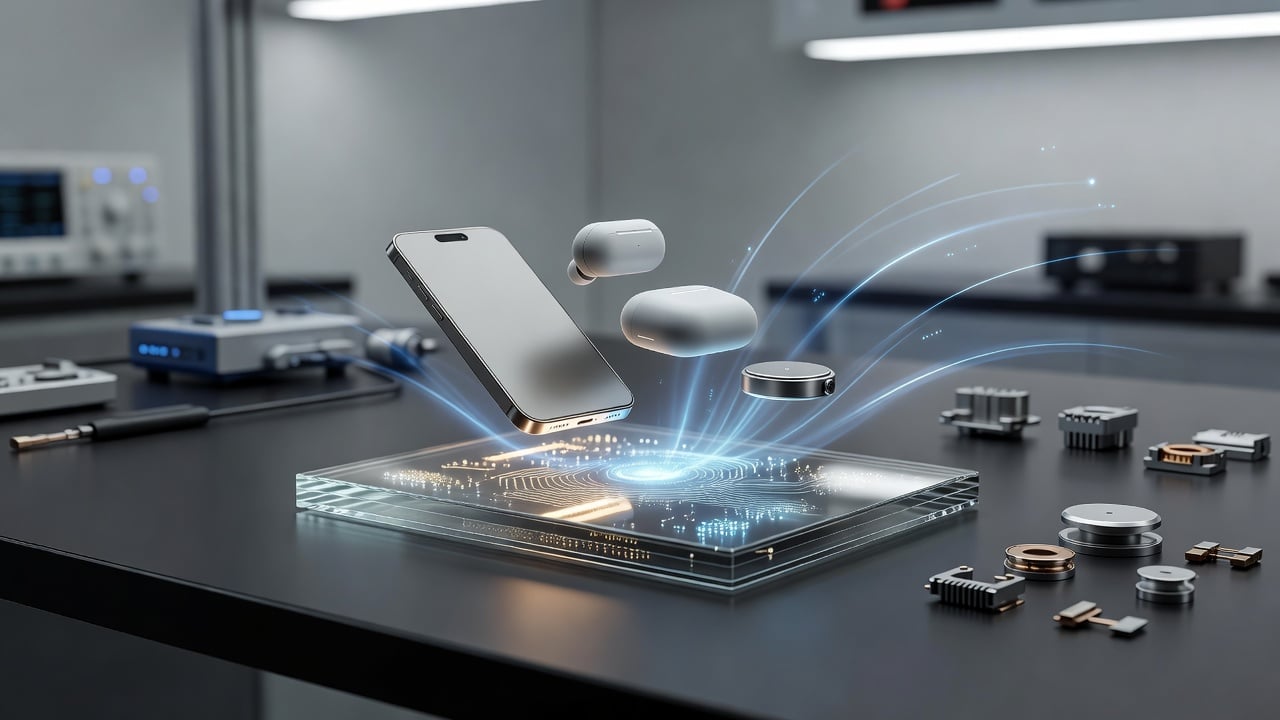
Wireless charging has spent years stuck in a comfortable but limited zone. Fifteen watts felt adequate. Then magnetic alignment arrived with Qi2 and nudged speeds toward 25 watts. Now the industry wants more. A lot more.
At a recent off-cycle meeting of the Wireless Power Consortium held inside Xiaomi’s Beijing headquarters, representatives from Apple, Google, Huawei, OPPO, vivo and more than 20 other companies gathered to hammer out details for a new Qi 50W specification. The hardware design parameters are said to be largely finalized. An official release could come in 2028. Android Authority first surfaced the development in a report published hours ago.
The push comes from Xiaomi. The Chinese manufacturer has contributed key elements of its own low-inductance, low-voltage, high-power architecture to the effort. Low inductance reduces losses in the coil module and opens the door to more flexible product designs inside increasingly complex phones. Low voltage, meanwhile, strikes a balance among safety, efficiency, heat management and circuit complexity. Those choices matter when power levels double.
But the real prize is compatibility. For years Chinese brands have advertised wireless speeds above 50 watts on their flagships. Those numbers only materialized on proprietary chargers sold by the same company. A true open standard changes the equation. One charger. Multiple phone brands. Consistent performance. Safer thermal behavior. Lower overall power loss. The meeting participants appear determined to deliver exactly that.
Current reality looks different. Qi2 25W chargers and compatible phones have only begun to reach shelves. The Wireless Power Consortium itself describes the 25-watt profile as delivering nearly 70 percent more power than the original Qi2 specification. First certified products from Anker, Belkin, Baseus and Ugreen started rolling out in late 2025 with broader availability expected through 2026. AudioXpress reported the initial wave of certified accessories in July 2025.
Samsung has already developed a power-management chip that supports the higher profiles and claims efficiency as high as 98 percent in testing. The company worked directly with the consortium on the Qi 2.2 specification that underpins much of the 25-watt rollout. Yet adoption among Android makers outside a handful of leaders has lagged. Many flagship devices still ship without native magnets and rely on cases or third-party solutions to unlock the full benefit.
Apple’s influence remains unmistakable. The company contributed its MagSafe magnetic technology to the Qi2 standard years ago. Recent regulatory filings in Taiwan revealed MagSafe chargers supporting the newer specification, hinting that iPhone 17 models and their successors could negotiate higher sustained wireless rates. Google has shown parallel interest. Future Pixel devices could adopt the faster standard once hardware matures.
So why wait until 2028? Technical validation takes time. Foreign-object detection must improve at these power levels to prevent overheating or damage from misplaced coins or keys. Communication protocols between charger and phone need refinement. Efficiency curves must stay flat enough that users do not trade battery health for speed. Prototype testing discussed at the Beijing meeting will address those exact concerns.
Yet the momentum feels real. 9to5Google noted on the same day that the standard is “basically” most of the way there. Xiaomi’s leadership in the room suggests the low-inductance approach has gained traction among the group. If the timeline holds, devices launching in 2029 could advertise genuine 50-watt wireless charging on any certified pad.
That outcome would mark a departure from today’s fragmented experience. Drop an iPhone on a Samsung charger, a Pixel on a Xiaomi pad, or a future vivo phone on a Belkin stand. The same 50 watts should flow. Alignment magnets snap everything into place. Thermal sensors and improved power-loss accounting keep temperatures in check. The days of brand-specific wireless bricks may finally recede.
Challenges remain. Heat dissipation inside slim phones limits sustained high-power delivery regardless of the standard. Battery chemistry must tolerate rapid cycling without accelerated wear. Regulatory bodies in different regions will scrutinize safety data. Still, the consortium’s decision to host the meeting at Xiaomi’s facility and include every major player signals serious intent.
Consumers have grown accustomed to 65-watt, 80-watt, even 120-watt wired chargers that refill phones in under 30 minutes. Wireless has trailed. Closing that gap without sacrificing the cable-free convenience users love represents the next logical step. The Qi 50W specification, if delivered on schedule, could achieve exactly that.
And the implications stretch beyond phones. Tablets, laptops, even certain automotive applications could benefit from standardized high-power inductive transfer. The same magnetic alignment that makes a phone click onto a nightstand charger could secure a tablet on a desk or keep a portable display powered in a moving vehicle. The groundwork laid now determines how broad that future becomes.
For now the focus stays on mobile. Apple, Google and Xiaomi each bring different priorities to the table. Apple values tight integration and user experience. Google pushes for broad ecosystem support. Xiaomi drives aggressive performance targets. Their ability to align on one specification will decide whether 50 watts becomes universal or remains a marketing bullet point on a single vendor’s charger.
The 2028 target gives engineers time to perfect the details. It also gives the supply chain time to scale production of the necessary coils, controllers and magnetic arrays. When the first devices ship with native support, the accessory market should already stand ready. That coordination rarely happens by accident. The Beijing meeting suggests it is happening by design.
Wireless charging once felt like a parlor trick. Fifteen watts on a rubberized pad. Now the industry talks seriously about 50 watts delivered safely, efficiently and across brands. The distance traveled is striking. The distance left to cover may prove even more significant.


 WebProNews is an iEntry Publication