
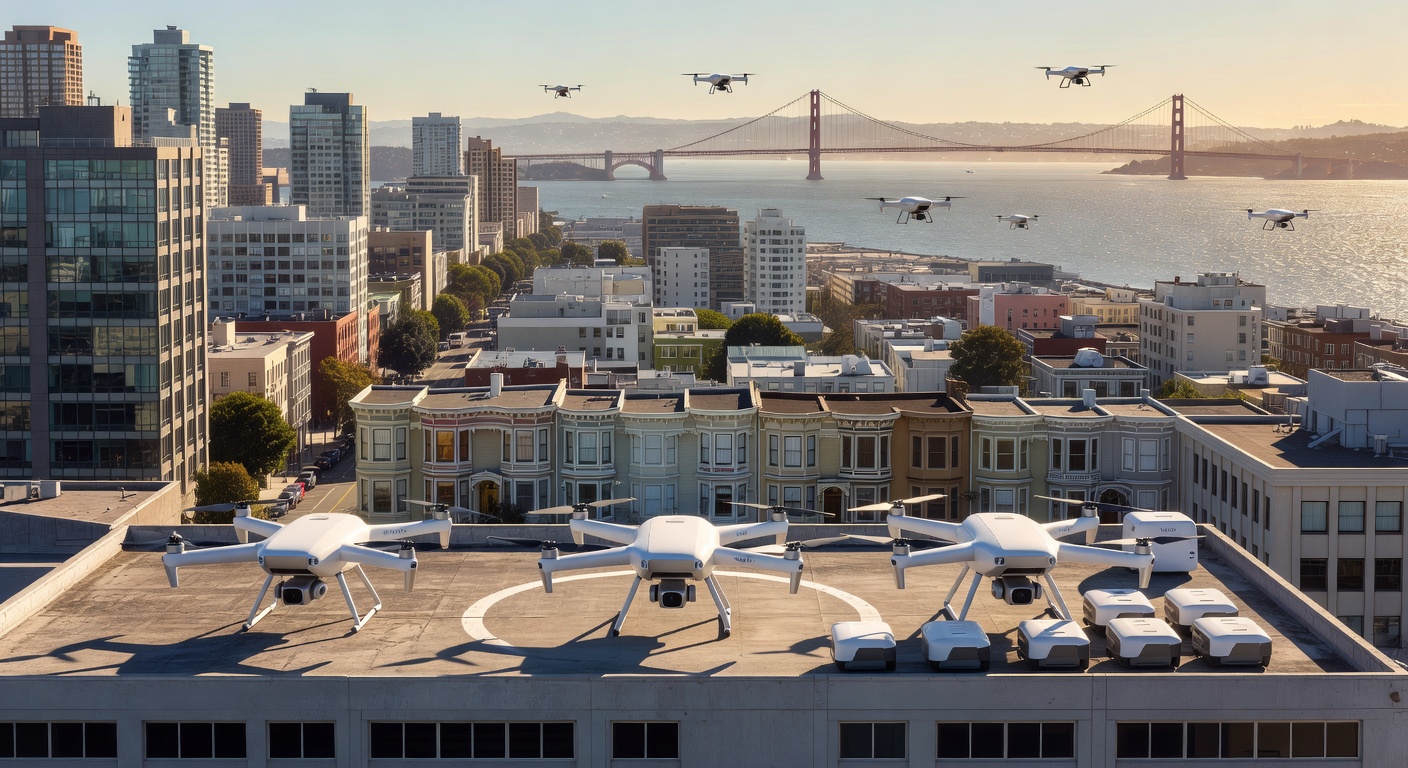
The drones are coming to the Bay Area. Not as a novelty. Not as a pilot program confined to a single suburban cul-de-sac. Alphabet’s Wing Aviation is preparing a full-scale commercial drone delivery operation across parts of the San Francisco Bay Area by 2026, a move that signals the company’s most ambitious urban expansion in the United States to date.
The announcement, first reported by CNET, confirms that Wing will extend its delivery service into a region home to nearly eight million people — a dense, affluent, tech-savvy population that represents perhaps the ideal testing ground for whether drone delivery can actually work at meaningful scale in American cities.
Wing has been building toward this moment for years. The company, which operates as a subsidiary of Alphabet, has run drone delivery services in parts of the Dallas-Fort Worth metroplex and select communities in Virginia. It also operates internationally in Australia and Finland. But the Bay Area is different. It’s denser. More complex airspace. More regulatory scrutiny. And far more consumer demand.
From Suburban Experiment to Urban Ambition
Wing’s trajectory mirrors a broader pattern in the commercial drone industry: start small, prove the model in low-density suburban environments, then push into metro areas where the real economic opportunity lies. The company launched its first U.S. deliveries in Christiansburg, Virginia, back in 2019. That operation was modest — a handful of routes, limited product selection, a population base that barely registered on the national map.
Dallas-Fort Worth came next, and the scale jumped considerably. Wing partnered with retailers and restaurants to deliver everything from Walgreens products to coffee. The service expanded across multiple suburbs, giving Wing its first real dataset on how drone delivery performs across varied residential layouts, weather conditions, and consumer expectations.
Now, the Bay Area.
According to CNET, Wing plans to begin operations in 2026, though the company hasn’t disclosed which specific cities or neighborhoods will be included in the initial rollout. That ambiguity is deliberate. Wing is still navigating local permitting processes, FAA airspace authorizations, and community engagement — all of which can shift timelines and geographies.
What’s clear is that Wing sees the Bay Area as a critical proof point. If drone delivery can function reliably in a region defined by hills, microclimates, dense housing, and some of the most congested roads in the country, the model becomes much harder to dismiss as a niche curiosity.
The logistics math is compelling. Last-mile delivery — the final leg from a distribution point to a customer’s door — accounts for roughly 53% of total shipping costs, according to research from Statista. Drones don’t sit in traffic. They don’t require a driver’s salary, benefits, or bathroom breaks. And they can complete a delivery in minutes rather than hours. Wing’s aircraft, which use a vertical takeoff and landing design with a tether-based lowering system, can carry packages weighing up to around 3.5 pounds.
That weight limit matters. It constrains the product categories that drone delivery can address. But it also covers a surprising amount of daily commerce: medications, small grocery orders, electronics accessories, meals, personal care products. The kinds of things people order when they need them fast and don’t want to drive.
Wing’s competitive position has strengthened in recent months. The company received a Part 135 air carrier certificate from the FAA back in 2019, making it the first drone delivery company to earn that designation. It has since expanded its operating authority and developed proprietary air traffic management software called OpenSky, which is designed to coordinate drone flights in shared airspace — a necessity as operations scale and multiple operators begin flying in overlapping zones.
But Wing isn’t operating in a vacuum. Amazon’s Prime Air, which has been plagued by delays and leadership turnover, is still pursuing drone delivery in select markets. Zipline, the California-based company originally known for medical supply deliveries in Rwanda, has expanded aggressively into U.S. commercial delivery with a platform that serves Walmart customers in parts of Arkansas and other states. And Joby Aviation and Archer Aviation, while focused primarily on air taxis, are pushing the broader regulatory framework for urban air mobility forward in ways that benefit drone delivery operators too.
The Regulatory Puzzle and the Noise Question
Federal regulation remains the single biggest variable in determining how quickly drone delivery scales. The FAA has been working on a comprehensive framework for beyond-visual-line-of-sight (BVLOS) operations — essentially, the rules that would allow drones to fly longer distances without a human operator watching them directly. A final rule on BVLOS, expected to be finalized in 2025 or 2026, would dramatically expand the operational range and economic viability of services like Wing’s.
Without BVLOS authority, every delivery requires either a visual observer on the ground or a waiver from the FAA — both of which add cost and limit scale. Wing has secured multiple waivers for its existing operations, but a permanent rule change would be transformational for the entire industry.
Then there’s noise. This is the issue that doesn’t show up in investor presentations but dominates community meetings. Drones are loud — not jet-engine loud, but loud enough that residents in delivery zones notice. Wing has invested in quieter rotor designs and flight path optimization to minimize noise exposure, but complaints have surfaced in communities where the company already operates. A 2023 report from residents in Logan, Australia, where Wing has been active since 2019, documented persistent frustration with drone noise, particularly during early morning and evening hours.
The Bay Area, with its politically engaged population and strong tradition of local activism, will likely prove an even tougher audience. San Francisco and its surrounding cities have a long history of pushing back against tech companies that move fast without adequate community input — ride-hailing companies, electric scooter operators, and autonomous vehicle testers have all faced significant local resistance.
Wing appears to be aware of this dynamic. The company has emphasized community engagement as a core part of its expansion strategy, though specifics on outreach plans for Bay Area neighborhoods remain sparse.
There’s also the question of airspace complexity. The Bay Area is home to three major commercial airports — SFO, Oakland International, and San Jose International — along with numerous smaller airfields, helicopter routes, and restricted zones. Coordinating drone flights in this environment requires sophisticated deconfliction technology and close cooperation with the FAA and local air traffic control. Wing’s OpenSky platform is designed for exactly this purpose, but the Bay Area will test it like no previous market has.
And the weather. San Francisco’s fog is legendary, but the broader Bay Area also experiences high winds, rain, and temperature inversions that can affect drone performance. Wing’s aircraft are designed to operate in a range of conditions, but weather-related service interruptions are inevitable — and managing customer expectations around reliability will be a key challenge.
The commercial opportunity, though, is enormous. The Bay Area’s median household income exceeds $120,000, and the region’s residents are early adopters by nature. Grocery delivery, meal delivery, and rapid commerce are already deeply embedded in local consumer behavior. DoorDash, Instacart, and Uber Eats all have their headquarters in San Francisco. Adding a drone delivery option to this already delivery-saturated market could either accelerate adoption or face stiff competition from entrenched ground-based services that consumers already trust.
Wing’s business model relies on partnerships with retailers and restaurants rather than building its own inventory or fulfillment infrastructure. This asset-light approach keeps capital expenditure manageable but creates dependency on partners’ willingness to invest in drone-compatible packaging, staging areas, and order management systems. In the Bay Area, where commercial real estate is expensive and retail space is tight, finding suitable launch points for drone operations will be a logistical challenge in itself.
What the Bay Area Bet Tells Us About the Industry
Wing’s expansion into the Bay Area isn’t just a business decision. It’s a statement about where drone delivery sits on the maturity curve. For years, the industry has been stuck in a loop of promising demonstrations followed by slow, incremental rollouts that never quite matched the hype. Amazon promised 30-minute drone deliveries back in 2013 — over a decade ago — and the company is still nowhere near that vision at scale.
Wing’s willingness to enter one of the most complex, expensive, and scrutinized markets in the country suggests the company believes it has solved enough technical and regulatory problems to operate commercially in a demanding environment. That’s a meaningful signal.
It also raises the stakes. A high-profile stumble in the Bay Area — whether from safety incidents, noise backlash, or operational unreliability — could set the entire industry back. The region’s media density and cultural influence mean that any problems will be amplified far beyond local impact.
But success would be equally amplified. If Wing can deliver packages reliably, quietly, and safely across Bay Area neighborhoods, it becomes much easier for the company to expand into other major metro areas. Los Angeles. Chicago. New York. Each presents its own challenges, but a proven Bay Area operation would provide the operational credibility and regulatory precedent needed to accelerate those expansions.
For now, the timeline is 2026. That gives Wing roughly a year to finalize partnerships, secure local approvals, build out infrastructure, and prepare for what will be the most watched drone delivery launch in the United States. The technology is ready, or close to it. The regulations are moving in the right direction. The consumer demand is there.
The question isn’t whether drone delivery will come to the Bay Area. It’s whether the Bay Area will let it stay.


 WebProNews is an iEntry Publication