
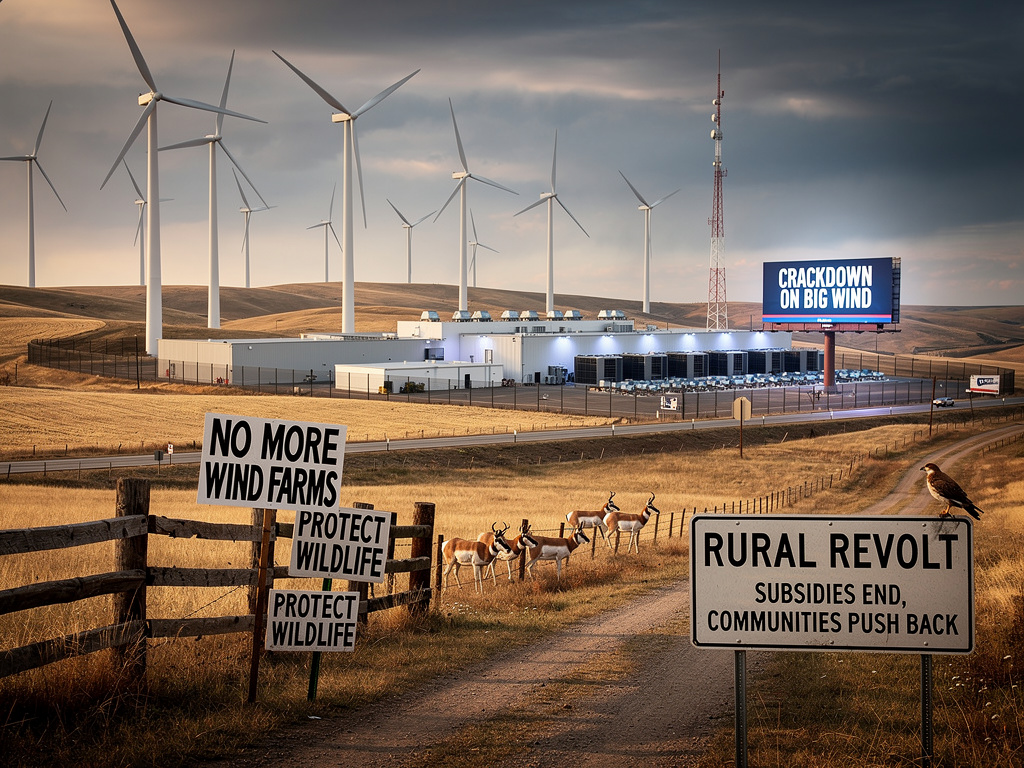
As federal tax credits that propelled the U.S. wind industry for three decades phase out under the Trump administration’s One Big Beautiful Bill Act, developers face a stark new reality in Wyoming and Nebraska. Rural residents, long tolerant of turbine sprawl for economic promises, are mobilizing against projects like Pronghorn H2, Sidewinder, Cedar Springs, and Greeley Wind. Opposition centers on wildlife disruption, plummeting property values, and irreversible industrial conversion of ranchlands, according to testimony at a January 8 Wyoming Board of Land Commissioners meeting in Douglas, where no supporters spoke for Pronghorn H2’s 267 turbines.
Secretary of State Chuck Gray, who voted against the Pronghorn lease in April and plans a February motion to revoke it, told Cowboy State Daily the projects hinged on subsidies now vanishing. “The people of Wyoming were clear at last week’s meeting in Douglas that we are against these projects,” Gray said. His stance highlights a rift: Gray approved NextEra’s smaller Cedar Springs project in Converse County in 2023, covering 2,400 acres for 36-54 megawatts, but draws the line at larger Focus Clean Energy proposals in Converse and Niobrara counties.
Nebraska’s Grassroots Uprising
In Nebraska’s Greeley County, farmer Bill Spelic, 68, who relocated from Denver in 2019, discovered NextEra’s Greeley Wind project—up to 41 turbines generating 115 megawatts—had quietly won initial approval in 2021. Spelic and his son rallied communities in Scotia, Spalding, Wolbach, and Greeley, growing town halls from 15 to over 100 attendees. “We even had people that came in and said, ‘Oh I’m for wind turbines,'” Spelic recalled to Cowboy State Daily. “Well, as more of these meetings went on, we had people that were changing their minds.”
By August 2023, commissioners approved the project but imposed 42 regulations, including $12 million upfront for decommissioning and $5 million for road repairs—totaling $17 million before construction. As of mid-January 2026, NextEra hasn’t deposited funds, and work remains stalled amid Trump’s anti-wind push, Spelic said. NextEra’s site projects 250 construction jobs, $27 million in landowner payments, and $19 million in taxes over 30 years, but locals prioritize bird habitats in the Sandhills region.
Economics Without the Crutch
U.S. Energy Secretary Chris Wright underscored the shift in December, telling Cowboy State Daily: “We cleaned out a ton of subsidies, over a half a trillion of energy subsidies… 33 years running—that seems like enough.” Turbine orders plunged 50% in early 2025, per American Clean Power Association and Wood Mackenzie, though 46 gigawatts of capacity is forecast through 2029 despite regulatory fog.
Yet electricity demand surges from AI data centers strain grids. Rocky Mountain Power’s Tom Carter told Wyoming lawmakers in May 2025 of 10 gigawatts in requests—tenfold the state’s current load—built over a century. A single data center rivals northeastern Wyoming’s usage, per AARP Wyoming’s Sam Shumway. Wind advocates like American Clean Power’s Bo Downen argue renewables deploy fastest: “In a time where we need more energy immediately, they are the fastest to deploy with project timelines under a year or two.”
Wyoming’s Mounting Grievances
At the Douglas hearing, opponents decried cumulative impacts. Wendy Volk testified: “From Cheyenne up to Douglas and Glenrock and from Cheyenne to Rawlins, there is more than 200 miles of proposed wind turbines, haul roads, substations, transmission lines.” Anne Brande, via her nonprofit, warned of over 4,000 turbines spanning 3,000 square miles: “I think we are not taking into account the full cost of permitting.” Pronghorn’s lease was vacated by Converse County Judge Scott Peasley on December 5; Attorney General Keith Kautz appealed to the Wyoming Supreme Court.
Landowners with leases face income uncertainty, while opponents gain organizing time. Spelic credited Nebraska success to early town halls: “If we wouldn’t have gone to the commissioners’ meetings right when they said that the planning and zoning had passed this, it would have gone through.” Businesses stayed neutral to avoid backlash, complicating efforts.
Trump’s Broader Onslaught
President Trump has vilified wind as “junk” and “losers,” per USA Today, vowing to halt new farms in a New York Times report. Courts have rebuffed some moves: A federal judge allowed Ørsted’s Revolution Wind to resume, as noted by NPR and Politico, rejecting national security claims. Still, gCaptain reports Trump’s campaign chills investment.
Wyoming Governor Mark Gordon and Secretary Gray clashed over development at a January 12 meeting, per WyoFile, with residents decrying the Industrial Siting Council’s lax oversight. Posts on X from @ChuckGrayWY echo Gray’s resolve to end leases, while @cowboystatedaily highlights rural sentiment against “Green New Deal” impositions.
Industry’s Adaptation Playbook
Wind now relies on state policies, corporate PPAs, and cost drops. Downen told Cowboy State Daily: “Wind and solar are competing in a post-subsidy environment, with development driven by significant cost declines and market demand.” States rich in renewables see falling prices, he added. NextEra touts Greeley as agriculture-compatible, but Spelic’s concessions show community leverage.
Focus Clean Energy and NextEra declined comment on timelines, but legacy projects retain credits. Wyoming’s top officials promise reckoning with 4,000+ turbines, per WyoFile. Nebraska’s model—upfront bonds, strict regs—may spread, forcing developers to prove viability sans subsidies amid data-center booms and Trump’s rhetoric.
Heartland’s Last Stand
Rifts deepen: Landowners seek diversification; neighbors recite prayers against turbines, as in Greeley. Volk’s warning resonates: “Once agricultural land is converted to industrial use, it is effectively lost forever.” With appeals pending and Trump in office, 2026 tests wind’s resilience—balancing hyperscale demands against rural pushback reshaping energy’s frontier.


 WebProNews is an iEntry Publication