
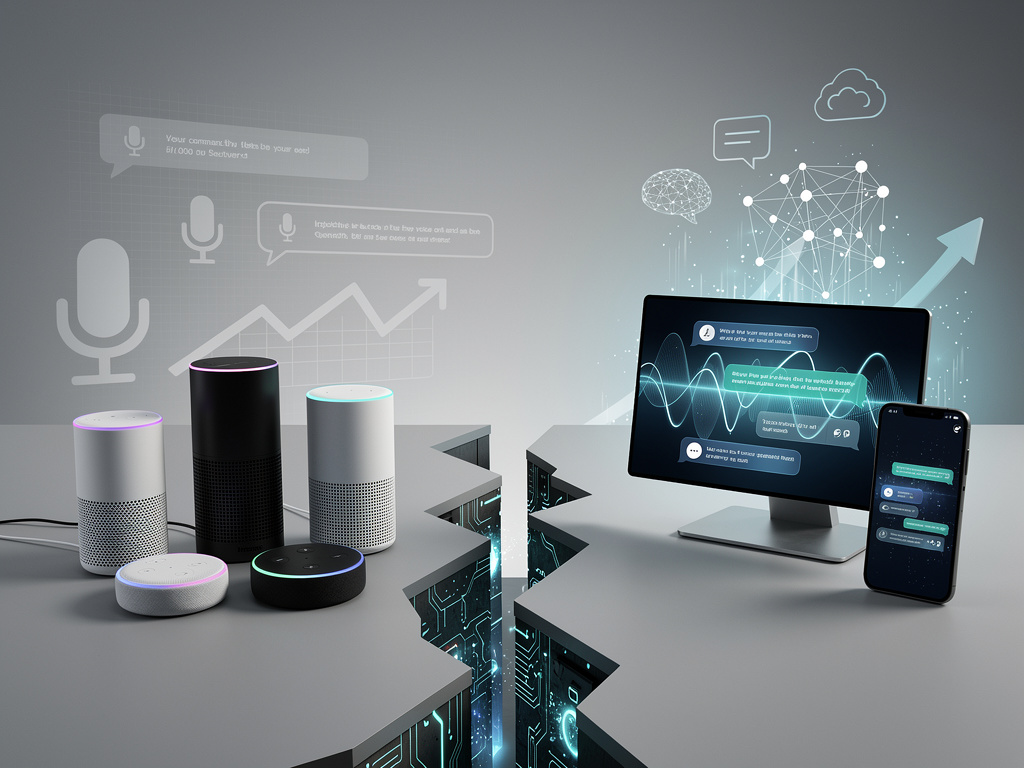
For all the billions of dollars poured into artificial intelligence over the past decade, a curious paradox persists: the AI systems you can talk to remain dramatically less capable than the ones you can type to. While text-based chatbots like ChatGPT, Claude, and Gemini have leapt forward in reasoning, nuance, and utility, their voice-powered cousins — Siri, Alexa, and Google Assistant — continue to stumble over basic requests, misunderstand context, and frustrate users with robotic limitations. The divide is not merely a matter of polish. It reflects deep architectural, economic, and strategic fault lines that the technology industry has yet to resolve.
As The Information recently reported in a detailed examination of the problem, voice assistants remain “dumb compared to text chatbots,” a blunt assessment that captures the growing impatience among both consumers and industry insiders. The gap has become especially glaring as large language models (LLMs) have transformed what users expect from AI. People who routinely use ChatGPT to draft legal memos, debug code, or plan complex travel itineraries find themselves shouting at Alexa just to set a timer correctly. The disconnect is no longer a minor inconvenience — it is becoming a credibility problem for the companies that built their smart-home and mobile strategies around voice.
The Architectural Roots of Voice AI’s Limitations
The fundamental challenge is that voice assistants were not originally built on the same foundation as modern chatbots. Siri launched in 2011, Alexa in 2014, and Google Assistant in 2016 — all before the transformer architecture that underpins today’s LLMs had been invented. These systems were designed around intent-classification frameworks: a user speaks, the system converts speech to text, classifies the intent (“set alarm,” “play music,” “what’s the weather”), and routes the request to a narrow handler. This architecture works well for a finite set of commands but collapses when users attempt open-ended, multi-turn, or contextually rich conversations.
Text-based chatbots, by contrast, are built natively on large language models that process language holistically. They do not need to classify intent into a predefined bucket; they generate responses token by token, drawing on vast training data to handle ambiguity, follow-up questions, and novel requests. The result is a system that feels genuinely conversational rather than transactional. As The Information’s reporting highlights, the companies behind legacy voice assistants have struggled to graft LLM capabilities onto aging infrastructure without breaking the reliable but limited features that users depend on daily.
Why Big Tech Has Been Slow to Close the Gap
Apple, Amazon, and Google have all acknowledged the problem in various ways, but their responses have been halting. Apple announced plans to integrate more advanced AI into Siri through its Apple Intelligence initiative, but the rollout has been slow and the improvements incremental. Amazon has been working on a next-generation Alexa powered by a large language model — internally codenamed “Remarkable Alexa” — but the project has faced repeated delays and internal skepticism about whether consumers will pay a subscription fee for a smarter assistant. Google has perhaps moved fastest, integrating Gemini into its assistant products, but even there, the transition has been uneven, with some features regressing during the switchover.
The economic incentives further complicate matters. Voice assistants were originally conceived as loss leaders — gateways to ecosystems of smart speakers, streaming subscriptions, and e-commerce purchases. Amazon famously sold Echo devices at or below cost, betting that Alexa would drive shopping on its platform. But the anticipated commerce revolution never fully materialized. Users overwhelmingly use voice assistants for simple utilities: timers, alarms, weather, and music. The business case for investing billions more in making these assistants as smart as ChatGPT is far from obvious, especially when the text-based chatbot companies themselves are still searching for sustainable revenue models.
The Latency Problem and the Physics of Speech
Beyond business strategy, there are genuine technical obstacles that make voice AI harder than text AI. Latency is chief among them. When a user types a query into ChatGPT, a response that takes two or three seconds to begin generating feels acceptable — the user is already in a reading posture, and the text streams in progressively. But in a voice interaction, even a one-second pause feels awkward and unnatural. Human conversation operates on turn-taking rhythms measured in hundreds of milliseconds. Any AI system that aspires to feel conversational must process speech input, run inference through a large model, and synthesize a spoken response all within a window that feels instantaneous. This is an enormously demanding computational pipeline.
The speech-to-text and text-to-speech layers add their own sources of error. Accents, background noise, overlapping speakers, and the sheer variability of human vocal production mean that the input a voice model receives is inherently noisier than typed text. Misrecognitions cascade: if the system mishears a key word, the entire downstream response can go off the rails. Text chatbots sidestep this problem entirely because the user provides clean, unambiguous input. Some researchers are now exploring “speech-to-speech” models that bypass the text intermediary altogether, processing audio waveforms directly, but these approaches are still in early stages and introduce their own challenges around controllability and safety.
OpenAI and the New Entrants Raising the Bar
The competitive dynamics are shifting, however, in ways that may finally force the incumbents’ hands. OpenAI’s Advanced Voice Mode for ChatGPT, which began rolling out in 2024, demonstrated that a voice interface powered by a frontier LLM could deliver a qualitatively different experience — one that handles interruptions, maintains context across long conversations, and even modulates tone and pacing. The response from users was enthusiastic, and it immediately raised the question of why the voice assistants embedded in billions of phones and smart speakers couldn’t do the same.
Google’s Gemini Live and other multimodal AI efforts represent a similar push. These systems treat voice not as a separate, inferior modality but as one of several input and output channels for a unified, powerful model. The implication is profound: the future of voice AI may not belong to the dedicated assistant platforms that dominated the last decade but to the general-purpose AI companies that happen to add voice as a feature. If OpenAI or Anthropic can deliver a voice experience that is both smarter and more natural than Siri or Alexa, the strategic moats that Apple and Amazon have built around their ecosystems could erode faster than expected.
Privacy, Trust, and the Stakes of Always-Listening AI
There is also a dimension of the problem that is less technical and more social. Voice assistants, by their nature, require always-on microphones in intimate spaces — bedrooms, kitchens, cars. The privacy implications of connecting these microphones to powerful cloud-based AI models are significant and not lost on consumers. Surveys consistently show that a meaningful segment of the population distrusts smart speakers and voice-enabled devices precisely because of concerns about surveillance and data collection. Making voice assistants smarter by connecting them to LLMs that process and potentially store richer conversational data could exacerbate these concerns, creating a tension between capability and trust that companies must navigate carefully.
Regulation is beginning to catch up as well. The European Union’s AI Act and various U.S. state-level privacy laws impose new requirements on how voice data is collected, processed, and retained. Companies that want to deploy LLM-powered voice assistants at scale will need to invest not just in model quality but in privacy-preserving architectures — on-device processing, differential privacy techniques, and transparent data governance — that satisfy both regulators and users. This adds cost and complexity to an already difficult engineering challenge.
What the Next Two Years Will Determine
Industry insiders broadly agree that the current state of affairs is unsustainable. The gap between what users experience in a ChatGPT conversation and what they experience asking Siri for directions is too large and too visible to persist indefinitely. The question is not whether voice assistants will get smarter but how quickly, at what cost, and under whose control. Will Apple, Amazon, and Google successfully modernize their platforms, or will they cede the voice interface to the AI-native companies that have already demonstrated superior conversational intelligence?
The next 18 to 24 months will be decisive. Apple’s deeper integration of large language models into Siri, Amazon’s bet on a subscription-tier Alexa, and Google’s Gemini-powered assistant overhaul will all face market verdicts. Meanwhile, OpenAI, Anthropic, and a growing cohort of startups will continue pushing the boundaries of what a voice-enabled AI can do. For consumers, the promise is tantalizing: an AI that you can talk to as naturally and productively as you can type to. For the industry, the stakes are existential. The companies that crack the voice-AI problem will own the most intuitive and pervasive computing interface ever built. Those that don’t may find their billion-dollar assistant platforms reduced to glorified kitchen timers.


 WebProNews is an iEntry Publication