
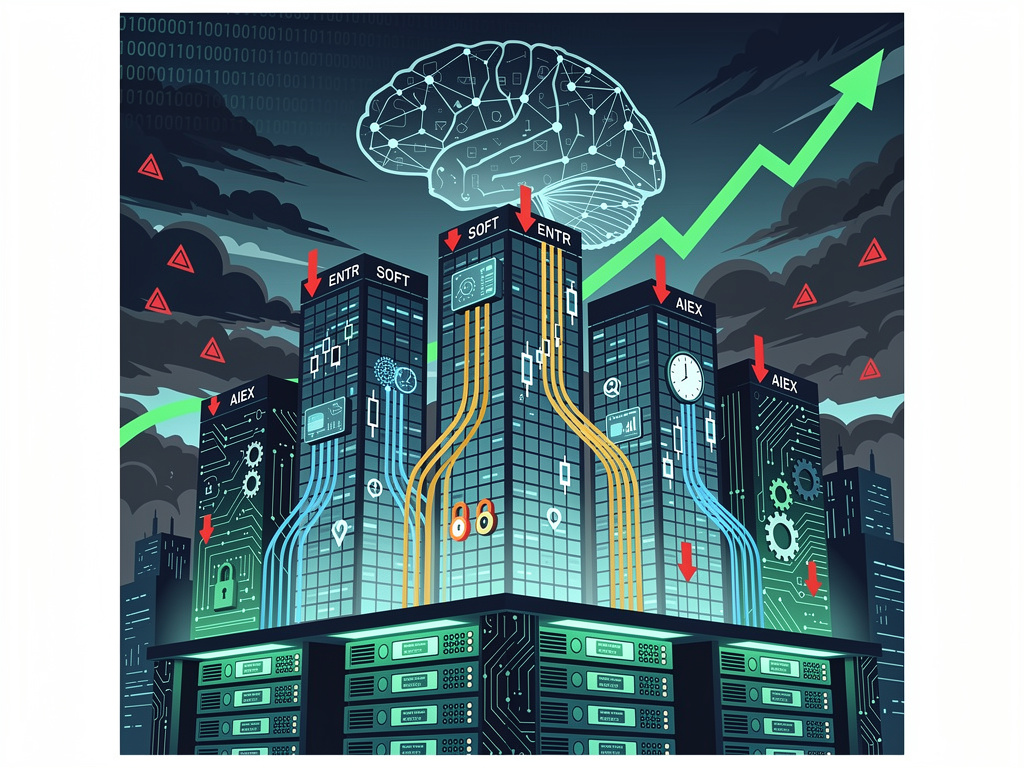
A wave of fear has swept through the enterprise software sector in recent weeks, sending share prices tumbling and triggering anxious conversations in boardrooms from San Francisco to New York. The thesis is deceptively simple: artificial intelligence is about to devour traditional software companies whole, rendering their subscription-based business models obsolete almost overnight. But a closer examination of the fundamentals, the actual pace of enterprise technology adoption, and the structural realities of corporate IT spending suggests that this narrative — while containing kernels of truth — has been dramatically overstated.
The selloff has been broad and punishing. Shares of major enterprise software companies, from customer relationship management giants to cybersecurity firms, have seen significant declines as investors rotate capital toward pure-play AI infrastructure companies and chipmakers. The fear is that AI agents — autonomous software programs capable of performing complex tasks — will replace the need for traditional SaaS (software-as-a-service) platforms that have powered corporate America for the past two decades. As Yahoo Finance reported, the AI-fueled software meltdown narrative has taken hold with remarkable speed, but the underlying assumptions deserve serious scrutiny.
The Bear Case: AI Agents as Software Killers
The bearish argument is not without intellectual merit. Companies like Anthropic, OpenAI, and Google have made extraordinary progress in developing AI systems that can write code, analyze data, manage workflows, and even interact with customers in ways that were unimaginable just two years ago. Venture capitalists have poured billions into startups promising to replace entire categories of enterprise software with AI-native alternatives. The vision is compelling: instead of paying per-seat licenses for dozens of specialized tools, companies could deploy AI agents that handle everything from accounting to customer support at a fraction of the cost.
This narrative gained further momentum as several high-profile technology executives publicly speculated about the diminishing need for traditional software. When Klarna’s CEO declared the company had stopped purchasing Salesforce licenses and was building AI replacements internally, it sent shockwaves through the market. Similar announcements from other companies created a cascade of negative sentiment, leading analysts to question whether the entire SaaS model was entering a period of secular decline.
Enterprise Reality: The Gap Between Demo and Deployment
Yet the gap between a compelling AI demo and enterprise-wide deployment remains enormous — and it is a gap that Wall Street, in its rush to price in the future, has largely ignored. According to Yahoo Finance’s analysis, the fears are overblown because they fundamentally misunderstand how large organizations actually adopt new technology. Enterprise software purchasing decisions involve layers of compliance review, security auditing, integration testing, and change management that simply cannot be compressed into the timelines that the market’s panic implies.
Consider the practical realities. A Fortune 500 company running its operations on a major ERP system like SAP or Oracle has decades of customized workflows, regulatory compliance frameworks, and institutional knowledge embedded in that software. Ripping it out and replacing it with an AI agent — no matter how impressive — introduces risks that most chief information officers and chief financial officers are unwilling to accept. The cost of failure in mission-critical enterprise systems is measured not in lost productivity but in regulatory penalties, broken supply chains, and potential legal liability.
Incumbents Are Not Standing Still
Perhaps the most significant flaw in the bear thesis is the assumption that existing software companies will sit passively while AI disrupts their businesses. In reality, the opposite is happening. Virtually every major enterprise software company has been aggressively integrating AI capabilities into their existing platforms. Salesforce has launched its Agentforce platform. Microsoft has embedded Copilot across its entire Office and Dynamics suite. ServiceNow, Workday, and others have rolled out AI-powered features that enhance rather than replace their core products.
This is a critical distinction that the market seems to be overlooking. The incumbents possess something that AI startups do not: massive installed bases, deep customer relationships, proprietary data sets, and the trust that comes from years of reliable service. When a company like ServiceNow adds AI capabilities to its IT service management platform, it creates additional value for existing customers rather than giving them a reason to leave. As Yahoo Finance noted, the AI revolution may actually benefit established software players by giving them new pricing power and expanded total addressable markets.
The Historical Playbook: Cloud Didn’t Kill On-Premise, and AI Won’t Kill SaaS
History offers a useful guide here. When cloud computing emerged in the late 2000s, the prevailing narrative was that it would rapidly destroy on-premise software companies. Oracle and SAP were supposed to be dead within a decade. Instead, both companies successfully transitioned to cloud-based models, and their market capitalizations are higher today than they were during the peak of cloud disruption fears. The transition took much longer than predicted, and the incumbents proved far more adaptable than the market expected.
The same pattern played out with mobile computing, social media integration, and big data analytics — each of which was supposed to upend enterprise software but instead became features that incumbents absorbed and monetized. There is every reason to believe that AI will follow a similar trajectory. The technology is transformative, but transformation in the enterprise context happens incrementally, not overnight. Companies do not abandon mission-critical systems on the basis of a promising technology trend; they integrate new capabilities into existing workflows gradually and cautiously.
Valuation Disconnects Create Opportunity
The selloff has created what many seasoned technology investors view as a significant valuation disconnect. High-quality enterprise software companies with strong recurring revenue, high gross margins, and deep competitive moats are now trading at multiples that imply serious revenue declines — declines that simply are not showing up in the actual financial results. Most major SaaS companies reported solid earnings in their most recent quarters, with stable or improving net retention rates and healthy pipeline growth.
This disconnect between market sentiment and financial reality is precisely the kind of environment that creates opportunities for patient, fundamentally oriented investors. When the market prices in a worst-case scenario that the underlying data does not support, the risk-reward calculus shifts dramatically in favor of the contrarian position. Several prominent hedge fund managers and institutional investors have reportedly been adding to their software positions during the recent weakness, viewing the selloff as an overreaction driven more by narrative than by numbers.
Where the Real Risk Lies
That said, not all software companies are equally positioned to weather the AI transition. The companies most vulnerable are those offering relatively simple, single-function tools that AI can genuinely replicate at lower cost — basic data visualization, simple workflow automation, or commodity-level customer support ticketing systems. These categories face legitimate disruption risk, and investors should differentiate carefully between platform-level software companies with deep integrations and point-solution providers that lack strategic moats.
The cybersecurity sector, for instance, may actually see increased demand as AI proliferates, since AI-powered attacks will require AI-powered defenses. Similarly, companies that manage complex regulatory compliance workflows are unlikely to be displaced by AI agents anytime soon, given the legal and reputational risks associated with automated compliance decisions. The nuance matters enormously, and the market’s tendency to sell the entire sector indiscriminately has created a situation where high-quality companies are being punished alongside genuinely vulnerable ones.
The Smarter Bet: AI as Catalyst, Not Catastrophe
The most likely outcome is not the wholesale destruction of the enterprise software industry but rather its evolution. AI will change how software is built, sold, and consumed — but it will do so within the existing ecosystem of enterprise vendors, not by obliterating it. The companies that successfully integrate AI into their platforms will emerge stronger, with higher average revenue per user, improved customer retention, and expanded addressable markets. Those that fail to adapt will struggle, just as those that failed to embrace cloud computing a decade ago eventually lost ground.
For industry insiders watching this drama unfold, the key takeaway is that technology transitions are almost always messier, slower, and more nuanced than the initial market reaction suggests. The AI revolution is real, and its impact on enterprise software will be profound. But the idea that it will render the entire sector obsolete within the next few years is a fantasy born of hype cycles and momentum trading, not a sober assessment of how large organizations actually operate. The smart money, as it so often does, appears to be betting against the panic — and history suggests that bet will pay off handsomely.


 WebProNews is an iEntry Publication