
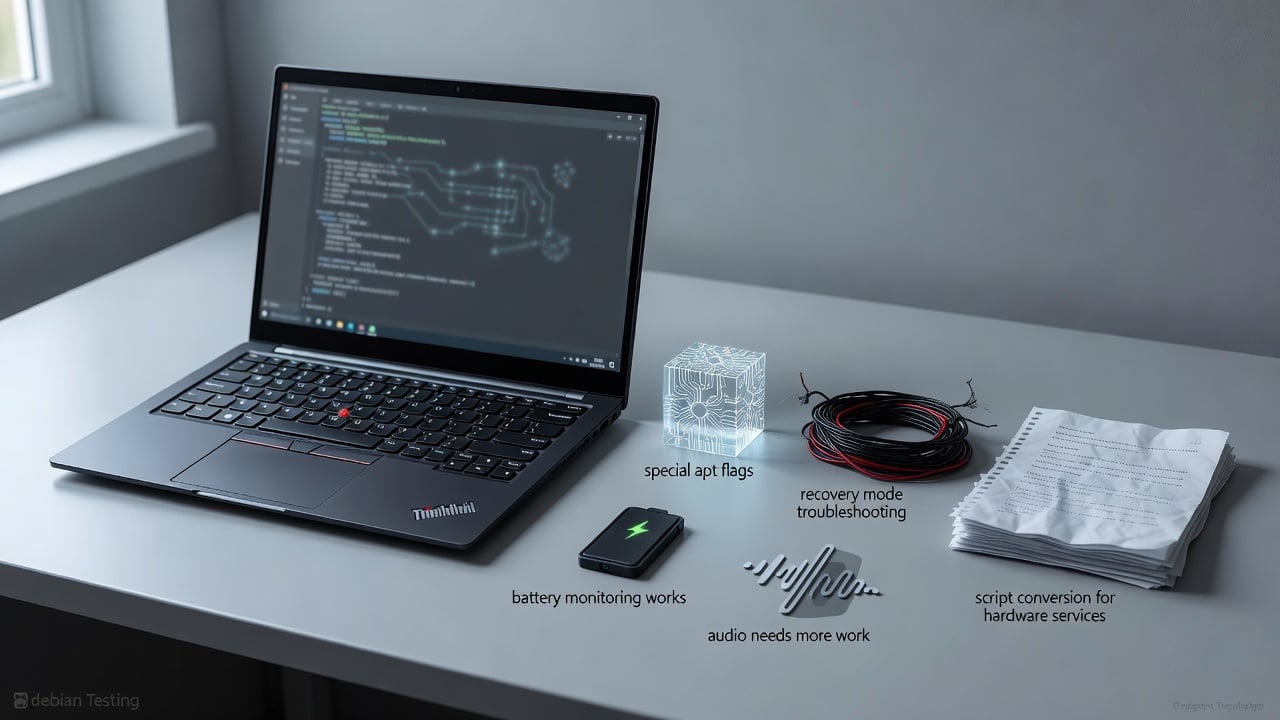
Daniel Cordova runs Debian Testing on a Thinkpad X13s powered by Snapdragon hardware. He does not hate systemd. He simply grew tired of watching it swallow responsibilities once handled by separate projects. So last week he removed it.
The results surprised him. Battery monitoring returned after a quick script conversion. The system boots. Basic services run under OpenRC. Audio still needs attention. Yet the experiment worked well enough that Cordova now considers migrating his work laptop too. His blog post published June 24, 2026, quickly climbed Hacker News and sparked fresh conversation across Linux forums.
Discomfort built over time. Cordova recalls reading about production failures tied to systemd changes that could have been isolated. Then came reports of systemd adding age-verification hooks before laws passed in many jurisdictions. “I got pretty mad about it,” he wrote. “I know, I’m not a contributor of that project and it’s only an optional field but it didn’t feel right at all.”
News that systemd 261 would ship its own system installer pushed him over the edge. One moment an init system. The next a full installer. The scope creep felt wrong. Curiosity took over. How exactly do alternative init systems behave in 2026? Could OpenRC deliver a simpler experience on modern Debian without breaking everything?
Installation proved trickier than expected. Standard apt commands refused to purge systemd. The package counts as essential. Cordova learned he needed a special flag. The working command combined removal and installation in one line: sudo apt purge --allow-remove-essential systemd && sudo apt install openrc sysvinit-core. Even that did not go smoothly.
The laptop refused to boot properly after the change. Recovery mode saved the day. A quick Ctrl-D continued to a shell. Cordova connected to Wi-Fi, reinstalled the OpenRC packages, and the system came back. Such hiccups match warnings long present in Debian documentation. The project has packaged OpenRC for years as an alternative, yet it never became default. Most users never notice the option exists.
Hardware quirks added complexity. The Snapdragon platform already carried a known kernel regression affecting battery reporting. Cordova converted the original systemd unit into a simple shell script placed in /etc/init.d/. OpenRC picked it up without complaint. The script echoes start commands to remoteproc state files for Qualcomm components. Audio drivers tied to PipeWire and WirePlumber still require manual configuration or a login script. He plans further tests.
His experience echoes older guides. A 2022 post on LeCorbeau’s Vault outlined nearly identical steps for Bullseye, confirming the process has remained stable across releases. Debian’s own wiki once detailed how OpenRC could replace sysv-rc with minimal disruption. That conversation dates back more than a decade.
Yet systemd won. A March 2026 How-To Geek article examined four init systems that nearly challenged it. OpenRC took the conservative route. It improved SysV init with dependency tracking, parallel startup, and supervision while preserving shell scripts. It never tried to become the entire user space. That restraint kept it clean. It also limited its reach. “Ecosystem alignment” proved decisive, the article noted. Once Fedora and then Debian adopted systemd in 2014, package maintainers and documentation followed. Network effects took hold. Learning a few systemctl commands became easier than mastering different tools per distribution.
Critics still point to the same issues Cordova encountered. Systemd integrates logging, device management, timers, and now installers. A single breaking change can ripple across unrelated services. OpenRC stays focused. It runs atop sysvinit or similar. Commands feel familiar to veterans of Gentoo or Alpine. Service files remain readable shell scripts instead of declarative unit files that sometimes hide complexity.
Recent chatter on X shows the debate refuses to die. Users still recommend Devuan for those wanting Debian without systemd by default. Others experiment with OpenRC on top of standard installs for specific workloads. One post praised OpenRC for servers where predictability matters more than the latest integration features. Another noted that migrating production systems carries risk exactly because so many packages now assume systemd.
Cordova remains pragmatic. “I’m not a fan of systemd but I’m not against its use either. AKA if it works for you then it’s ok.” His discomfort grew from specific design decisions rather than ideology. The age-verification episode and the new sysinstall feature crystallized a broader pattern. Projects that start small can grow into something unrecognizable.
Debian 13, released in 2025 and now at version 13.4, ships with systemd 257. The distribution continues to support alternative inits for those willing to do the work. No plans exist to make OpenRC default. Maintainers value stability above philosophical purity. For most administrators the current setup simply works.
That leaves enthusiasts like Cordova to test the road less traveled. His Thinkpad now runs without systemd. Remoteproc services launch at boot. Battery status displays correctly after the script adjustment. Daily tasks continue uninterrupted. The change cost a few hours of recovery-mode troubleshooting. It delivered a system that feels lighter and more aligned with his preferences.
Whether others follow depends on their tolerance for friction. Removing an essential package will never be one-click. Hardware vendors optimize for the dominant init. Desktop environments sometimes tie notifications or power management to systemd components. Yet the option persists. Debian’s packaging ensures curious users can try OpenRC without abandoning the distribution’s vast repositories.
Cordova plans weeks of additional testing. If comfort remains high he will convert his primary machine. The experience reinforced his view that Unix freedom means exactly this. Choose what works. Accept the trade-offs. Avoid dogma. In 2026 that choice still exists, even if it requires a recovery shell and a carefully written init script.
His closing line captures the spirit. “In the end that’s part of the unix freedom to use whatever you want and whatever works for you.” Plenty of administrators will stick with systemd. A few will read the blog, open a terminal, and type that purge command. Both groups prove the same point. The platform remains flexible enough to support genuine experimentation.


 WebProNews is an iEntry Publication