
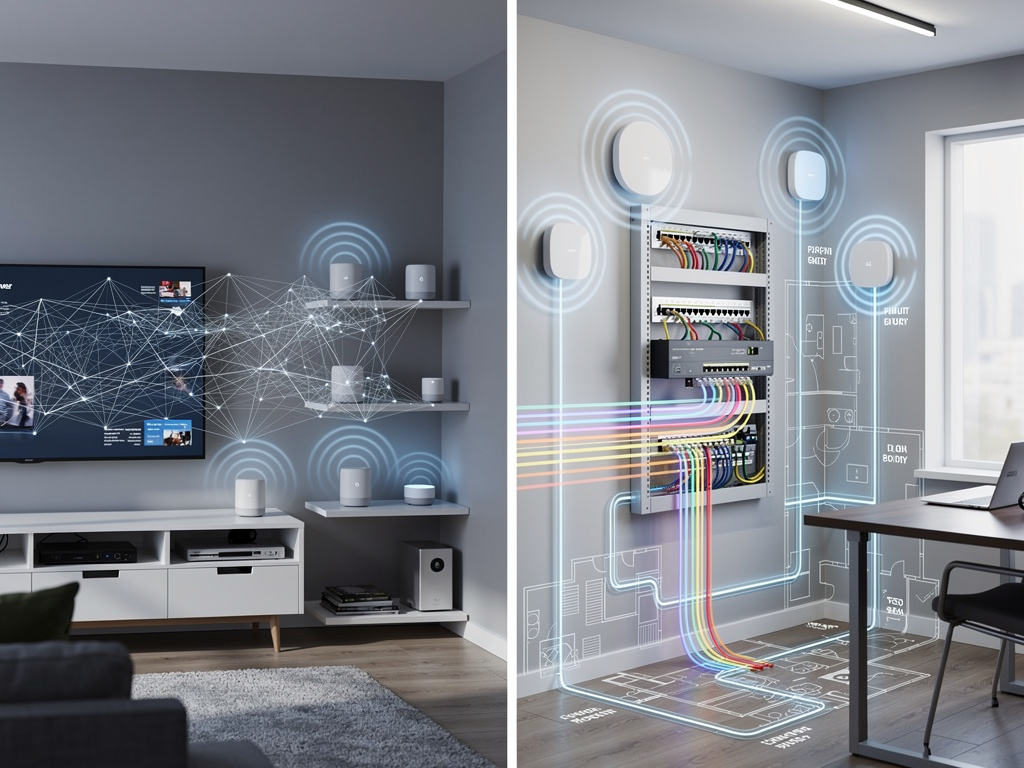
Beyond Mesh: The Ethernet Revolution Reshaping Home Internet
In an era where seamless connectivity underpins everything from remote work to smart home ecosystems, many homeowners have turned to mesh Wi-Fi systems as a panacea for spotty coverage. These networks, which use multiple nodes to blanket a house with wireless signals, promised an end to dead zones. Yet, as one tech enthusiast discovered, swapping out a mesh setup for a managed Ethernet system with dedicated access points can yield dramatic gains in speed, reliability, and overall performance. This shift highlights a growing realization in the networking world: wireless mesh, while convenient, often falls short in demanding environments, prompting a reevaluation of wired alternatives.
The story begins with a common frustration. A user, detailed in an article from MakeUseOf, grappled with persistent issues in their mesh Wi-Fi system, including inconsistent speeds and frequent dropouts, especially in larger homes or those with thick walls. Mesh systems work by relaying signals between nodes, but this hopscotching can introduce latency and reduce bandwidth, particularly when nodes are far apart or obstructed. The solution? Transitioning to a setup where Ethernet cables form the backbone, connecting a central switch to multiple access points that broadcast Wi-Fi locally. This approach, often called a “wired backhaul,” minimizes wireless interference and maximizes throughput.
Industry experts echo this sentiment, noting that while mesh has democratized home networking, it’s not always the optimal choice. According to reviews from Wirecutter, mesh kits excel in ease of setup but can struggle with high-bandwidth tasks like 4K streaming or online gaming in multi-story homes. The MakeUseOf piece describes how the author installed Cat6 Ethernet cables throughout their house, linking them to a managed switch and enterprise-grade access points from brands like Ubiquiti. The result was a network that not only eliminated dead spots but also delivered consistent gigabit speeds, far surpassing the mesh system’s capabilities.
Wired Backhauls: The Backbone of Superior Performance
Delving deeper, the advantages of Ethernet over wireless mesh become clear in technical terms. Wireless mesh relies on shared spectrum, where each node competes for airtime, leading to what’s known as “half-duplex” communication—data can only flow in one direction at a time. In contrast, Ethernet provides full-duplex connections, allowing simultaneous upload and download without bottlenecks. This is particularly crucial in homes with numerous connected devices, from smart thermostats to security cameras, all vying for bandwidth.
Recent advancements in networking hardware have made such setups more accessible. For instance, Power over Ethernet (PoE) technology enables access points to draw power directly from the Ethernet cable, simplifying installation without needing separate power outlets. Publications like WIRED have tested systems incorporating PoE, praising their stability in real-world scenarios. The MakeUseOf author reported download speeds jumping from erratic 200-300 Mbps on mesh to steady 900 Mbps on the new system, a testament to the efficiency of wired connections.
Moreover, managed switches introduce intelligent traffic management. Unlike basic consumer routers, these devices support features like VLANs (Virtual Local Area Networks) for segmenting traffic—say, isolating guest networks or IoT devices to enhance security. This level of control is often absent in off-the-shelf mesh kits, which prioritize simplicity over customization. As PCMag points out in their evaluations, professional-grade setups can handle enterprise-like demands, making them ideal for power users or small businesses operating from home.
Emerging Technologies Challenging Mesh Dominance
Beyond traditional Ethernet, innovative technologies are emerging to rival mesh Wi-Fi. One such development is the integration of Wi-Fi 7 standards, which promise multi-gigabit speeds and better handling of dense device environments. However, even Wi-Fi 7 benefits from wired backhauls, as noted in tests by RTINGS.com, where systems like the TP-Link Deco BE63 shone when nodes were hardwired rather than relying solely on wireless links.
Another avenue is the rise of MoCA (Multimedia over Coax) adapters, which repurpose existing coaxial cable lines in homes for high-speed data transmission. This can serve as an alternative to running new Ethernet cables, offering speeds up to 2.5 Gbps with minimal latency. CNET has highlighted MoCA as a viable mesh replacement in older homes where rewiring is impractical, providing a bridge between fully wireless and fully wired worlds.
On the horizon, decentralized networking concepts are gaining traction, inspired by blockchain and peer-to-peer models. Posts on X from tech influencers discuss projects like Helium’s decentralized wireless networks, which use community-driven hotspots to create expansive coverage without central infrastructure. While still nascent, these could disrupt traditional home setups by offering incentivized, community-maintained alternatives to proprietary mesh systems.
Installation Challenges and Cost Considerations
Implementing a wired system isn’t without hurdles. The MakeUseOf article details the labor involved in fishing cables through walls and ceilings, a process that can be daunting for non-professionals. Costs can escalate too: quality Cat6 cabling, a PoE switch, and access points might total $500-$1,000, compared to $200-$400 for a basic mesh kit. Yet, for those willing to invest, the long-term benefits in performance and scalability often outweigh the upfront expense.
Professional installation services are increasingly available, with companies like Ubiquiti offering user-friendly interfaces via their UniFi app. This democratizes access to what was once enterprise-only tech. As per insights from Dong Knows Tech, proper planning—such as mapping out access point placements for optimal coverage—can mitigate common pitfalls, ensuring the network performs as intended.
Security also improves with wired systems. Mesh networks, being wireless, are more susceptible to eavesdropping or interference. Ethernet, by nature, is harder to intercept, and managed systems allow for advanced encryption and monitoring. Recent news on X emphasizes this, with users sharing experiences of reduced vulnerability after switching, aligning with broader industry trends toward fortified home networks.
Real-World Case Studies and User Experiences
Drawing from user anecdotes, the transition’s impact is profound. One homeowner, as recounted in various X posts, upgraded their aging mesh to a Ubiquiti setup and saw latency drop from 50ms to under 10ms, crucial for competitive gaming. This mirrors findings in NETGEAR’s guide, which, while promoting mesh, acknowledges wired options for superior reliability.
In larger properties, the difference is stark. A case in point: businesses repurposing home offices have reported in industry forums that Ethernet-based systems handle video conferencing and large file transfers without hiccups, unlike mesh setups that falter under load. BGR contrasts this by noting mesh’s strengths in coverage but weaknesses in sustained performance, pushing users toward hybrids.
Furthermore, integration with smart home protocols like Matter enhances these systems. Access points can support multiple bands simultaneously, ensuring compatibility with emerging devices. Recent X discussions highlight how such setups future-proof homes against the IoT explosion, where mesh might struggle with device density.
Future Directions in Home Networking
Looking ahead, hybrid models combining Ethernet with wireless elements are poised to dominate. Wi-Fi 7’s multi-link operation, which bonds channels for faster speeds, pairs ideally with wired backhauls. Tests from PCMag (previously referenced) show these hybrids outperforming pure mesh in throughput by up to 50%.
Sustainability is another angle. Wired systems consume less power than constantly transmitting mesh nodes, appealing to eco-conscious consumers. News articles on X point to growing interest in energy-efficient networking, with some users calculating significant savings on electricity bills post-upgrade.
Regulatory shifts could accelerate adoption. With governments pushing for better broadband infrastructure, incentives for home wiring upgrades might emerge, making Ethernet systems more affordable. This aligns with global efforts to bridge digital divides, where reliable connectivity is key.
Scaling for Tomorrow’s Demands
As 5G home internet and fiber optics become ubiquitous, the need for robust internal networks intensifies. Ethernet setups scale effortlessly, allowing easy addition of access points without degrading performance—a limitation in mesh where adding nodes can halve speeds due to backhaul constraints.
User communities on platforms like Reddit and X are abuzz with tutorials and success stories, fostering a DIY culture around these upgrades. One viral thread detailed a budget build using surplus enterprise gear, achieving professional results for under $300.
In essence, while mesh Wi-Fi revolutionized accessibility, the Ethernet renaissance offers a compelling upgrade path for those seeking peak performance. By addressing mesh’s inherent flaws through wired reliability, homeowners can unlock a new era of seamless, high-speed connectivity tailored to modern demands.


 WebProNews is an iEntry Publication