
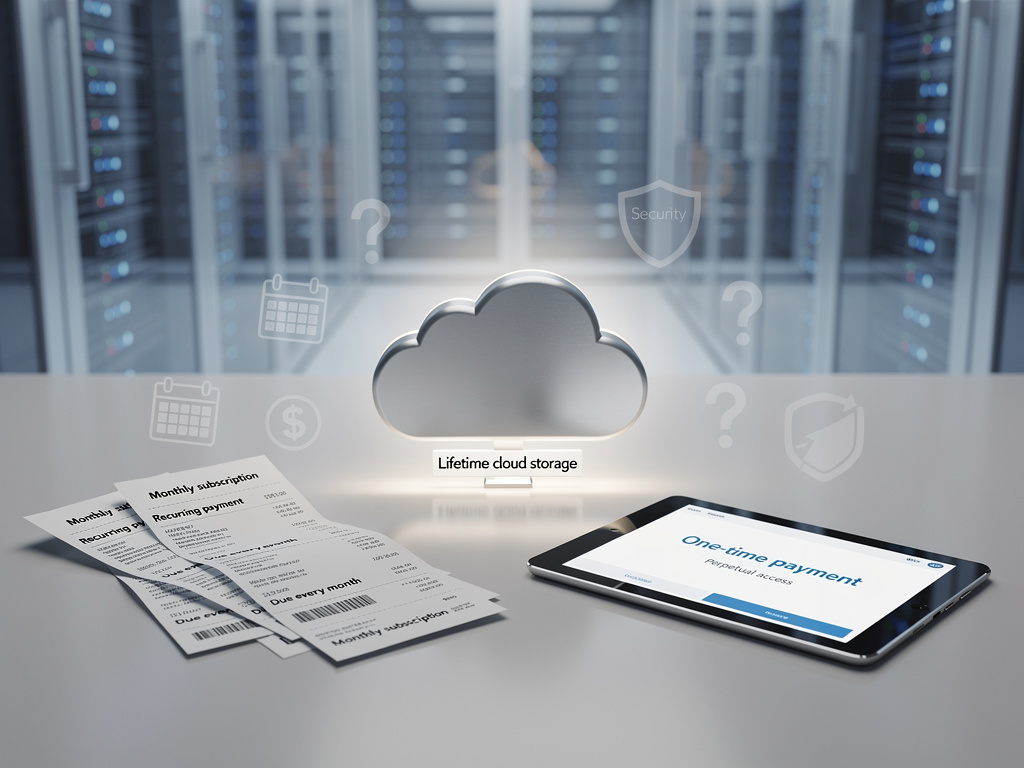
The cloud storage market has reached an inflection point. As consumers and businesses alike grapple with mounting subscription costs across dozens of services, a once-niche offering is gaining mainstream attention: lifetime cloud storage plans. These one-time payment models promise to eliminate recurring fees while providing perpetual access to digital storage space, challenging the dominance of subscription giants like Google Drive, Dropbox, and Microsoft OneDrive.
According to MakeUseOf, pCloud has emerged as a leading contender in this space, offering lifetime storage plans that have caught the attention of both individual users and enterprise decision-makers. The Swiss-based company’s approach represents a fundamental departure from the subscription model that has defined cloud services for the past decade, raising questions about whether this alternative pricing structure can sustain long-term viability while delivering on its promises.
The timing couldn’t be more opportune. Recent market analysis indicates that the average American household now spends over $273 monthly on subscription services, with cloud storage representing a growing portion of that expenditure. As digital content creation explodes and file sizes balloon with 4K video, high-resolution photography, and increasingly complex business documents, storage needs continue to escalate. The traditional response—upgrading to higher-tier subscription plans—compounds the financial burden, creating an opening for alternative models.
The Economics Behind Lifetime Storage Offers
The business model underpinning lifetime cloud storage plans operates on fundamentally different assumptions than subscription services. Traditional cloud providers rely on predictable recurring revenue streams, using customer lifetime value calculations to justify infrastructure investments and operational costs. Lifetime storage providers, by contrast, must front-load their revenue while committing to indefinite service provision, creating a delicate balance between upfront pricing and long-term sustainability.
Industry analysts point to several factors that make lifetime storage economically feasible. Storage costs have declined precipitously over the past decade, with enterprise-grade storage now costing a fraction of historical rates. Additionally, not all customers utilize their full allocation, allowing providers to employ oversubscription strategies similar to those used by airlines and telecommunications companies. The key lies in sophisticated actuarial modeling that accounts for user behavior patterns, storage utilization rates, and technology cost curves.
pCloud’s pricing structure exemplifies this approach. The company offers lifetime plans ranging from 500GB to 10TB, with one-time payments that, when amortized over even a five-year period, undercut equivalent subscription costs from major competitors. However, the true value proposition extends beyond mere price comparison. For users who maintain consistent storage needs over extended periods, lifetime plans eliminate the uncertainty of future price increases and the administrative overhead of managing recurring payments.
Security and Privacy Considerations in the Lifetime Model
The shift to lifetime storage raises critical questions about data security and privacy that extend beyond typical cloud storage concerns. When users commit to a provider for the indefinite future, they’re making a bet not just on pricing stability but on the company’s long-term viability, security practices, and commitment to privacy standards. This becomes particularly salient given the geopolitical dimensions of data storage, with different jurisdictions offering varying levels of protection.
pCloud’s Swiss domiciliation provides certain advantages in this regard. Switzerland’s robust privacy laws and position outside the European Union and United States regulatory frameworks offer a degree of independence from government data requests that appeals to privacy-conscious users. The company offers client-side encryption as an optional add-on, ensuring that even pCloud itself cannot access user files—a feature that addresses one of the primary concerns about entrusting data to any third-party provider.
Yet lifetime commitments amplify the stakes of security breaches. While subscription services allow users to easily migrate if security concerns arise, lifetime plan holders face a more complex calculus: abandon their investment or trust in remediation efforts. This dynamic places additional pressure on lifetime storage providers to maintain exemplary security practices and transparent communication about vulnerabilities and responses.
Feature Parity and the Innovation Question
A persistent criticism of lifetime storage offerings centers on feature development and innovation velocity. Subscription models create ongoing financial incentives for providers to continuously enhance their platforms, adding collaboration tools, AI-powered organization features, and integrations with other services. Lifetime models, critics argue, reduce the economic motivation for such improvements once the initial sale is complete.
The reality proves more nuanced. pCloud has consistently updated its platform with new features, including file versioning, remote upload capabilities, and improved sharing controls. The company’s business model depends not just on existing customers but on attracting new ones, creating ongoing pressure to remain competitive with feature-rich subscription alternatives. Additionally, the reputational costs of stagnation—which could undermine future sales and enterprise adoption—provide powerful incentives for continued development.
However, the pace and scope of innovation do differ. While Google Drive rapidly integrates with the broader Google ecosystem and leverages the company’s AI capabilities, lifetime storage providers typically focus on core functionality and reliability rather than cutting-edge features. For many users, particularly those seeking straightforward storage without extensive collaboration needs, this represents an acceptable trade-off. For others, especially enterprise users requiring sophisticated workflow integrations, it may prove limiting.
The Enterprise Adoption Dilemma
The potential for lifetime cloud storage to penetrate enterprise markets remains an open question with significant implications for the broader industry. While individual consumers can readily evaluate the value proposition based on personal storage needs and budget constraints, enterprises face more complex considerations around vendor stability, compliance requirements, and integration with existing IT infrastructure.
Enterprise decision-makers must weigh the appeal of predictable, one-time costs against concerns about long-term vendor viability and support quality. The subscription model, despite its ongoing costs, provides a form of assurance: as long as customers keep paying, providers have strong incentives to maintain service quality and support. Lifetime models invert this dynamic, potentially creating scenarios where providers have already extracted maximum revenue from customers, theoretically reducing service quality incentives.
These concerns explain why lifetime storage adoption in enterprise contexts has remained limited compared to consumer markets. However, small and medium-sized businesses increasingly view lifetime plans as viable alternatives, particularly for archival storage, backup solutions, and departmental file sharing where integration requirements are less stringent. The key determinant appears to be use case specificity: well-defined storage needs with minimal collaboration requirements favor lifetime models, while dynamic, integration-heavy applications continue to favor subscriptions.
Regulatory and Sustainability Dimensions
The rise of lifetime cloud storage occurs against a backdrop of increasing regulatory scrutiny of subscription services and growing awareness of digital sustainability. Consumer protection agencies in multiple jurisdictions have begun examining subscription practices, particularly around cancellation difficulties and automatic renewals. Lifetime models sidestep many of these concerns by eliminating recurring charges, potentially positioning them favorably in evolving regulatory environments.
Sustainability considerations add another dimension to the equation. The environmental impact of data centers has come under increasing scrutiny, with cloud providers facing pressure to reduce their carbon footprints. Lifetime storage models, by encouraging users to be more deliberate about their storage needs rather than automatically upgrading subscriptions, could theoretically promote more efficient resource utilization. However, the actual environmental impact depends heavily on provider-specific practices around data center efficiency, renewable energy usage, and hardware lifecycle management.
pCloud has made commitments to sustainable operations, though the company’s environmental reporting remains less comprehensive than that of larger competitors like Google and Microsoft, which publish detailed sustainability reports and have made significant renewable energy investments. For environmentally conscious consumers and businesses, this information gap represents a consideration in provider selection, though the relative environmental impact of storage models themselves remains difficult to quantify precisely.
The Future of Cloud Storage Pricing Models
The emergence of viable lifetime storage alternatives signals a potential diversification in cloud storage business models rather than a wholesale replacement of subscriptions. Market dynamics suggest room for multiple approaches, with different models serving distinct user segments and use cases. Power users with extensive collaboration needs will likely continue gravitating toward feature-rich subscription services, while cost-conscious consumers with stable storage requirements may increasingly opt for lifetime plans.
The competitive pressure from lifetime offerings may also influence subscription providers’ pricing and retention strategies. Already, major providers periodically offer promotional rates and multi-year discounts that narrow the cost gap with lifetime alternatives. As lifetime models gain market share, subscription providers may need to demonstrate clearer value propositions around advanced features, integration ecosystems, and service quality to justify their ongoing costs.
Looking ahead, hybrid models may emerge that combine elements of both approaches. Some providers might offer lifetime storage with optional subscription add-ons for premium features, or tiered lifetime plans with different service level commitments. The key will be finding sustainable economic models that align provider incentives with customer interests over extended time horizons, ensuring both service quality and business viability.
For consumers and businesses evaluating cloud storage options in 2026 and beyond, the decision increasingly requires looking beyond simple price comparisons to consider total cost of ownership, use case requirements, privacy priorities, and risk tolerance around vendor longevity. Lifetime storage plans like those offered by pCloud represent a legitimate alternative worthy of serious consideration, particularly for users who value cost predictability and have well-defined storage needs. However, they’re not a universal solution, and careful evaluation of specific requirements remains essential. As the cloud storage market continues evolving, the diversity of business models ultimately benefits consumers by providing choices that can be matched to individual circumstances rather than forcing everyone into a one-size-fits-all subscription paradigm.


 WebProNews is an iEntry Publication