
Abhishaike Mahajan admits he has never worked in a wet lab. The closest he came was during his first semester of undergrad. Every morning he would wake up, walk to the lab, and jam a wire into a surgically implanted port on a rat’s brain. The experience ended when a squirmy rat ripped the port system out of its skull. Despite that horror, Mahajan knows his lack of hands-on experience leaves him vulnerable to hype in lab automation. He wrote about it in an essay published February 9, 2026, on Owlposting.
His piece lays out practical rules of thumb gathered from conversations with two dozen experts. Those include leaders from Emerald Cloud Lab, Ginkgo Bioworks, and startups such as Tetsuwan Scientific and Zeon Systems. The heuristics cut through the dazzle of whirring arms and glowing dashboards. They explain why so many automation projects stall. And they hint at where real progress may finally arrive.
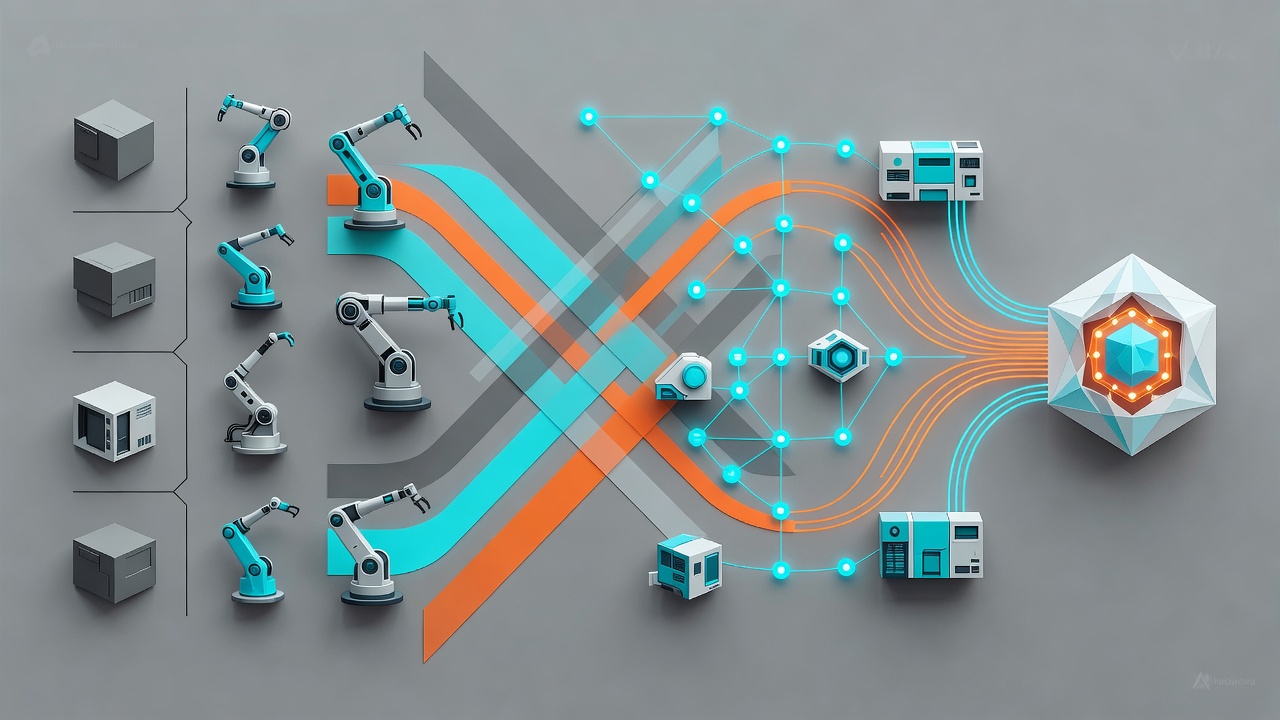
Automation in biology splits into two camps. One relies on boxes. The other bets on arms. Liquid handlers represent the box approach. A Hamilton system, priced between $40,000 and $100,000, moves precise volumes of fluid across thousands of wells without tiring. Plate readers, autostainers, and incubators follow the same pattern. Each device handles one tightly defined slice of a protocol. Once scripted, it repeats with high reliability.
But boxes stay isolated. A liquid handler does not talk to the incubator down the bench. A grad student still carries plates between stations. That human link caps the entire workflow’s speed. Connect the islands with robotic arms and scheduling software and you create a workcell. Arms promise to mimic the missing pair of hands. They shuttle plates, load decks, and open doors. Yet the mechanical grad student brings its own headaches.
Mahajan quotes a blunt economic reality. “If the task is worth automating, it actually isn’t that big of a deal to automate.” Most protocols run too few times to justify the upfront cost. He calculates that forty hours of an automation engineer’s time at $100 per hour equals $4,000. Spread across 10,000 runs and the per-run cost drops to forty cents. Below that volume the math collapses. This explains why many academic labs still pipette by hand.
Hardware vendors have consolidated around proven boxes. Hamilton, Beckman Coulter, Tecan, Agilent, Thermo Fisher, and Opentrons dominate. Their systems excel at narrow, high-volume tasks such as drug screening. Run 80,000 wells across multiple concentrations and even tiny pipetting errors can bury a promising compound or promote a false positive. Boxes solve that. But scaling to an entire experiment demands integration that most organizations never master.
Cloud labs tried to solve the integration problem by offering remote access. Emerald Cloud Lab pioneered the model. Users submit code-like instructions and receive standardized data without ever touching a bench. Strateos, born from the merger of Transcriptic and 3Scan, pursued a similar vision. Transcriptic itself had aimed to turn biology into an API call. Yet adoption stayed narrower than promoters hoped. Many protocols resist full parameterization. Subtle differences in reagents, temperatures, or even lab humidity create failure modes that scripts cannot anticipate.
Recent developments show the field is moving. On March 2, 2026, Ginkgo Bioworks launched its Ginkgo Cloud Lab, allowing researchers to submit protocols through a web browser and run them on the company’s autonomous infrastructure in Boston (PR Newswire). The system uses reconfigurable automation carts that integrate more than 70 instruments. Jason Kelly, Ginkgo’s CEO, noted on X that adding 50 devices into an integrated system in a few weeks marked real progress in a domain where such work usually drags.
Ginkgo’s collaboration with OpenAI produced striking numbers. Over six months the partnership ran roughly 36,000 experiments and cut cell-free protein synthesis costs by 40 percent while reducing reagent costs by 57 percent. Those figures, shared in industry presentations and echoed in recent coverage, demonstrate that closed-loop systems can learn and improve when fed consistent data at scale. The Department of Energy has also pushed forward. It commissioned over 100 integrated laboratory robots as part of the White House Genesis Mission aimed at bringing AI to science.
Yet challenges persist. Integration remains the silent killer. Different vendors use incompatible control languages. Even when hardware connects, software layers struggle to handle exceptions. A plate stuck in a gripper or a misread barcode can halt an entire run. Tuning protocols for robotic execution often takes longer than running them manually the first few times. One expert told Mahajan that automation engineers spend most of their hours debugging edge cases rather than writing elegant code.
Two philosophies have emerged. The hardware camp, represented by Automata and parts of Ginkgo’s earlier work, focuses on building flexible physical systems that can be reconfigured quickly. The intelligence camp, including Medra and Zeon Systems, bets that smarter software and better abstraction layers will let existing robots handle greater variety. Brontë Kolar, CEO of Zeon Systems, and Michelle Lee, CEO of Medra, emphasized in discussions with Mahajan that improving the translation layer between human intent and machine action offers higher returns than buying fancier arms.
Recent industry gatherings reinforce these tensions. The 2026 AI in Lab Automation Digital Summit highlighted practical approaches for overcoming integration challenges between AI platforms, robotics, and legacy systems (Lab Manager). Speakers at the Bio-IT World Expo discussed autonomous labs drawing from projects with OpenAI and Pacific Northwest National Laboratory. One presentation noted that self-driving labs still require substantial human oversight for protocol development and exception handling.
Cost remains a barrier. Automated labs can consume up to ten times the energy of traditional wet labs and demand specialized HVAC and power infrastructure, according to a February 2025 Gensler analysis that still applies today (Gensler). Upfront capital for a full workcell can run into millions. Return on investment appears only when experiment volume justifies the spend and when data consistency feeds downstream AI models that actually improve.
Reproducibility drives much of the urgency. Human pipetting introduces subtle variations that accumulate across labs and researchers. AI models trained on such noisy data struggle to generalize. Cristian Ponce, CEO of Tetsuwan Scientific, posted on X in June 2026 that automating the lab bench is the best thing we can do for AI in biology. His company lets users specify experiments in an exact syntax. Robots then execute them and return transparent, reproducible output. Ponce and his co-founder built the platform after resenting the manual grind of traditional labs at Caltech.
Legislation signals growing policy interest. In March 2026, lawmakers introduced the bipartisan Cloud Labs to Advance Biotechnology Act. The bill directs the National Science Foundation to create a national network of cloud-enabled automated labs to generate high-quality biological data (House press release). Supporters argue standardized data from these facilities will accelerate AI-driven discovery while strengthening U.S. leadership.
Universities are experimenting too. The University of Chicago’s Pritzker School of Molecular Engineering deployed a self-driving lab that uses AI and robotics to create new materials with minimal human input. Carnegie Mellon University’s AI Science Foundry combines automated laboratories, foundation models, and high-performance computing to tackle problems once considered too complex.
Mahajan ends his essay on a note of cautious optimism. He points to the concept of carcinization. In nature, many unrelated lineages evolve into crab-like forms because the body plan works. In lab automation, different approaches may converge on similar architectures that combine modular hardware, strong orchestration software, and tight feedback loops with AI. The winners will likely be those who solve the translation problem. They will turn vague scientific intent into reliable machine instructions without armies of engineers.
That future is not here yet. Solo founders cannot yet send a thousand drug screens from their laptop over coffee and receive clean data by lunch. But the pieces are assembling faster than before. Ginkgo’s recent launch, Tetsuwan’s upcoming functional screens for protein design, and federal investment in cloud labs suggest momentum is building. The heuristics Mahajan collected offer a map. Follow the economics. Prioritize high-volume, repeatable tasks. Invest in software that abstracts complexity. And never underestimate how many ways a simple plate transfer can fail.
Progress will feel incremental until it suddenly compounds. When consistent robotic data finally feeds powerful models at sufficient scale, the productivity curve in biological research could bend sharply upward. Until then, the humble pipette still wins many days. The robots are learning. The labs are watching. The next few years will reveal which heuristics hold and which companies listened.


 WebProNews is an iEntry Publication