
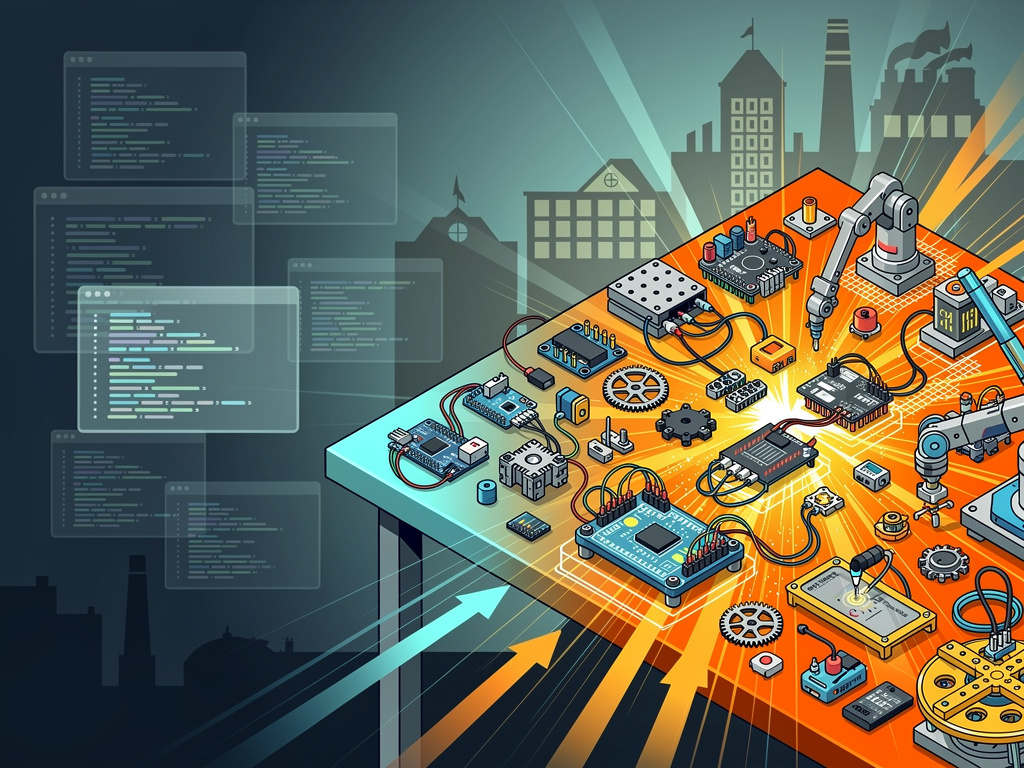
Software hackathons once ruled the weekend warrior circuit. Coders crammed energy drinks, shipped minimum viable products in 48 hours and walked away with prizes, portfolios and sometimes even startup ideas. But the format has grown stale. Repetitive CRUD apps. AI wrappers on top of other AI. Judges struggling to tell one demo from the next.
Enter the hardware alternative. Builders now solder, 3D print and debug physical devices under the same tight deadlines. The results feel tangible. They break. They light up. They interact with the real world in ways screens never could. And the events keep multiplying.
Oscar’s blog laid out the case clearly last year. In a post titled “RIP software hackathons. Long live the hardware hackathon,” the author argued that software events suffer from low barriers and infinite iteration. Anyone can spin up yet another web app. Feedback loops collapse into sameness. Oscar’s blog noted how hardware demands real constraints. Parts cost money. Assembly takes time. Bugs appear in the physical realm where compilers can’t help.
That observation has aged well. Look at the calendar in 2026. Purdue University’s Humanoid Robot Club drew more than 750 participants from 80 universities and 10 countries to StarkHacks in April. The 36-hour event, cohosted by Ford and presented with AMD, offered $100,000 in prizes and aimed at a Guinness World Record. Organizers explicitly chose hardware because software-only events had become too common. “Hardware hackathons, which are focused on physical builds rather than software, are still rare compared to their software-only counterparts,” reported Purdue Engineering News.
But rarity brings opportunity. Makers at these gatherings produce drones that navigate rooms, wearables that monitor health signals in real time, and robotic arms controlled by gestures. The demos don’t just run in a browser tab. They move.
MIT Media Lab took the trend further in March with HARD MODE, a 48-hour Hardware × AI hackathon. Participants built intelligent objects that sense, learn, adapt and respond. No chatbots allowed. The event, hosted by the AHA and Design Intelligence Lab, pushed creators toward devices people could hold, wear or install in their lives. “The challenge is to imagine what else AI could be. Not another chatbot. Not another app. Real hardware you can hold,” the organizers declared on the event page.
Healthcare has emerged as a hot focus. Out of Pocket Health organized a hardware edition in San Francisco in April 2026. Attendees received wearables, Raspberry Pis and access to AI tools plus medical experts. No prior hardware experience required. The goal? Build applications that combine sensors with intelligence to solve actual patient problems. “Hardware is having its moment—we’re seeing more wearables, smart glasses, ambient listening pins, and more,” the organizers wrote. Out of Pocket Health positioned the event as a direct response to the physical turn in technology.
These gatherings don’t replace software skill. They demand it. Successful hardware projects require firmware, mobile apps, cloud backends and machine learning models. The difference lies in the integration. Builders must make electrons and code talk to each other under time pressure. That marriage creates higher stakes.
Cost remains a barrier. Sponsors step in with kits, 3D printers and soldering stations. StarkHacks provided free equipment. MakeMIT at Harvard supplied laser cutters and components for its 24-hour event in February 2026. Yet the financial reality filters participants. Only those serious enough to wrestle with supply chains and failed prototypes show up. The crowds may be smaller than all-night coding marathons, but engagement runs deeper.
Universities have noticed. Purdue’s effort stands out for scale. The Humanoid Robot Club started smaller but scaled to hundreds in a single year and a half. Their success signals demand among mechanical, electrical and computer engineers who want to build beyond simulations. Similar events popped up globally. Canada’s MakeUofT, India’s Open Source Hardware Hackathon by FOSSEE at IIT Bombay, and numerous regional contests all emphasize physical prototypes.
AllHackathons.com now maintains a dedicated list of hardware-focused events for 2026. The directory highlights in-person gatherings where participants tinker, solder and ship real gadgets. Organizers report higher retention and stronger post-event projects. Some hardware prototypes from these weekends have evolved into funded startups or research papers.
Critics point to iteration limits. Software lets teams pivot endlessly. Hardware demands decisions early. A wrong sensor choice can sink a project by hour 20. But that pressure, according to participants, sharpens focus. No one hides behind “it works on my machine.” The device either responds or it doesn’t.
AI has accelerated the shift. Tools now help generate circuit designs, suggest component substitutions and even debug code for microcontrollers. The combination lowers the entry bar without removing the physical challenge. A builder can prototype faster than five years ago yet still confront the laws of physics.
MLH, the Major League Hacking organization, published guidance for running hardware events. Their guide explains that these hackathons deliver the same networking and learning benefits as traditional ones while highlighting fabrication skills. Recent partnered events include HardHack, MakeCU and MakeUofT. “Hardware hackathons share the core benefits of non-specialized events but break the status quo by bringing hardware and fabrication into the limelight,” the MLH resource states. MLH Guide.
Teenagers have joined the movement too. One group organized what they called the largest four-day hardware hackathon for young builders, using GitHub’s San Francisco space. Videos from the event show sleep-deprived creators wiring robots and testing autonomous vehicles. The energy mirrors classic software hackathons but with added smells of solder and hot glue.
Corporate interest grows. Ford’s sponsorship of StarkHacks reflects a desire to scout talent that understands both mechanical systems and software. AMD supplies processors and development boards. These companies gain visibility among students who might one day design the next generation of vehicles or chips.
The format isn’t perfect. Logistics get complicated. Shipping components, managing safety with power tools, and handling broken hardware all add overhead. Yet the payoff appears worth it. Judges can evaluate working physical systems rather than slick pitch decks. Investors see prototypes that demonstrate engineering tradeoffs in ways no slide can capture.
Software hackathons won’t disappear. They still serve as excellent onboarding for new coders and quick collaboration exercises. But their dominance has faded. The weekend warrior scene has bifurcated. One track stays in the cloud. The other has moved to the bench, the workbench, the lab.
That change reflects broader industry trends. Edge computing, robotics, sustainable devices and human-computer interaction all require tight hardware-software codesign. Hackathons that force that integration in compressed time produce builders ready for those challenges.
Attendance numbers tell part of the story. Purdue’s 750 participants across 10 countries suggest critical mass. MIT’s HARD MODE sold out quickly. Regional events in India and Canada report waiting lists. The supply of motivated hardware tinkerers clearly exists.
What comes next? Longer format events that allow more complex builds. Hybrid formats where remote teams contribute software while local groups handle assembly. Standardized kits that reduce friction without removing creativity. And perhaps integration with manufacturing partners who can turn winning prototypes into small production runs.
The hardware renaissance in hackathons didn’t arrive overnight. It built on years of accessible tools like Arduino, Raspberry Pi, affordable 3D printers and open source designs. Those foundations let weekend events scale beyond the university lab.
Yet the spark comes from something simpler. People like to make things they can touch. They like to see their code change the physical world. Software delivered speed and scale. Hardware delivers presence. Both matter. But after years of purely digital sprints, many builders have voted with their soldering irons.
The events keep coming. Purdue plans to repeat and expand. MIT will host more themed challenges. Independent organizers fill calendars with niche focuses from open source hardware to medical devices. Each one reinforces the same message. The screen is no longer enough.
So the next time a friend mentions spending the weekend at a hackathon, don’t assume laptops and pizza. Ask what they’re building. The answer might involve wires, sensors and a working model that does something useful in the room. That shift, modest as it seems, points to a generation less content with simulation alone.


 WebProNews is an iEntry Publication