
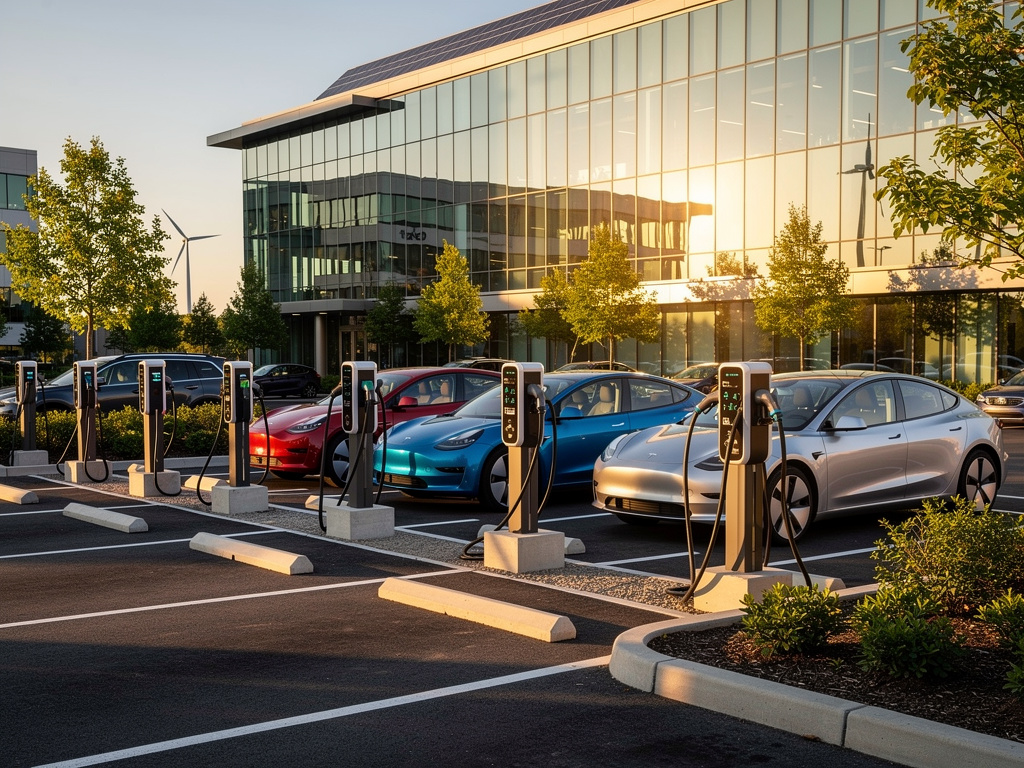
Forget the ping-pong tables. The new workplace amenity war is being fought in parking lots.
A growing number of companies are installing electric vehicle chargers at their offices, and the pitch isn’t just environmental virtue signaling — it’s a calculated play to attract and retain talent while cutting a real cost burden for employees. According to a recent Business Insider report, at least one company founder is making the case that workplace EV charging should be viewed as a core benefit, on par with health insurance or retirement contributions, because it directly offsets what employees spend on fuel.
The logic is straightforward. Gas prices remain volatile and stubbornly high in many parts of the country. EV adoption is accelerating — the International Energy Agency reported that global EV sales topped 17 million in 2024, and the U.S. market has followed that upward curve. But charging infrastructure hasn’t kept pace with demand, particularly for people who live in apartments or older homes without garage access. Workplace charging fills that gap neatly.
And it’s not a trivial savings. The average American spends roughly $2,000 to $3,000 per year on gasoline, depending on commute length and vehicle efficiency. Charging an EV at a workplace station — especially one powered by a commercial electricity rate — can slash that figure dramatically. For employees, it’s money back in their pockets every single pay period. That kind of tangible, recurring benefit tends to generate more loyalty than a free lunch on Fridays.
The business case extends beyond recruitment. Companies installing chargers can tap into federal tax credits under the Inflation Reduction Act, which offers up to 30% back on the cost of installing qualified EV charging equipment, capped at $100,000 per unit for commercial properties. Several states layer additional incentives on top. So the upfront investment, while real, is substantially offset by public subsidies designed to accelerate exactly this kind of infrastructure buildout.
There’s a branding dimension too. Sustainability commitments are now table stakes for many large employers, particularly those competing for younger workers. A 2023 Deloitte survey found that climate change is a top concern for Gen Z and millennial employees, and that these groups actively factor a company’s environmental track record into employment decisions. Visible EV chargers in a company parking lot are a concrete, hard-to-fake signal that a firm is putting capital behind its stated values.
But here’s where it gets interesting for facilities managers and CFOs. The technology around workplace charging has matured quickly. Networked Level 2 chargers — the most common type for workplace installations — now come with sophisticated load management software that distributes power across multiple vehicles without overwhelming a building’s electrical capacity. Companies like ChargePoint, Blink, and Tesla have all expanded their commercial offerings, and newer entrants are competing aggressively on price and software features. Some providers offer revenue-sharing models where the employer pays nothing upfront and takes a cut of charging fees paid by employees or visitors.
Not everyone’s convinced the math works universally. Smaller companies with limited parking or older electrical infrastructure face higher per-unit installation costs. And in regions where electricity prices are themselves elevated — parts of California, for instance — the savings advantage over gasoline narrows. Context matters.
Still, the momentum is clear. The Department of Energy’s Alternative Fuels Station Locator shows that the number of workplace charging locations in the U.S. has grown steadily year over year, and commercial charger shipments hit record levels in late 2024. Major employers including Google, Salesforce, and Microsoft have had workplace charging programs for years; what’s changed is that mid-size and even smaller firms are now following suit, driven by falling hardware costs and stronger incentive structures.
So what should companies actually do with this information? First, audit your parking infrastructure and electrical capacity. Second, talk to multiple charging network providers — the market is competitive enough that you shouldn’t accept the first quote. Third, check both federal and state incentive programs before budgeting, because the effective cost may be far lower than the sticker price. And fourth, communicate the benefit clearly to employees. A charger nobody knows about is a charger nobody uses.
The broader trend here isn’t really about cars. It’s about how employee benefits are evolving from generic perks toward practical, financial relief. Housing assistance, student loan contributions, childcare subsidies — EV charging fits squarely into that category of benefits that reduce real monthly expenses. Companies that recognize this early will have an edge in hiring markets that remain tight for skilled workers.
The parking lot, it turns out, is the new benefits package.


 WebProNews is an iEntry Publication