
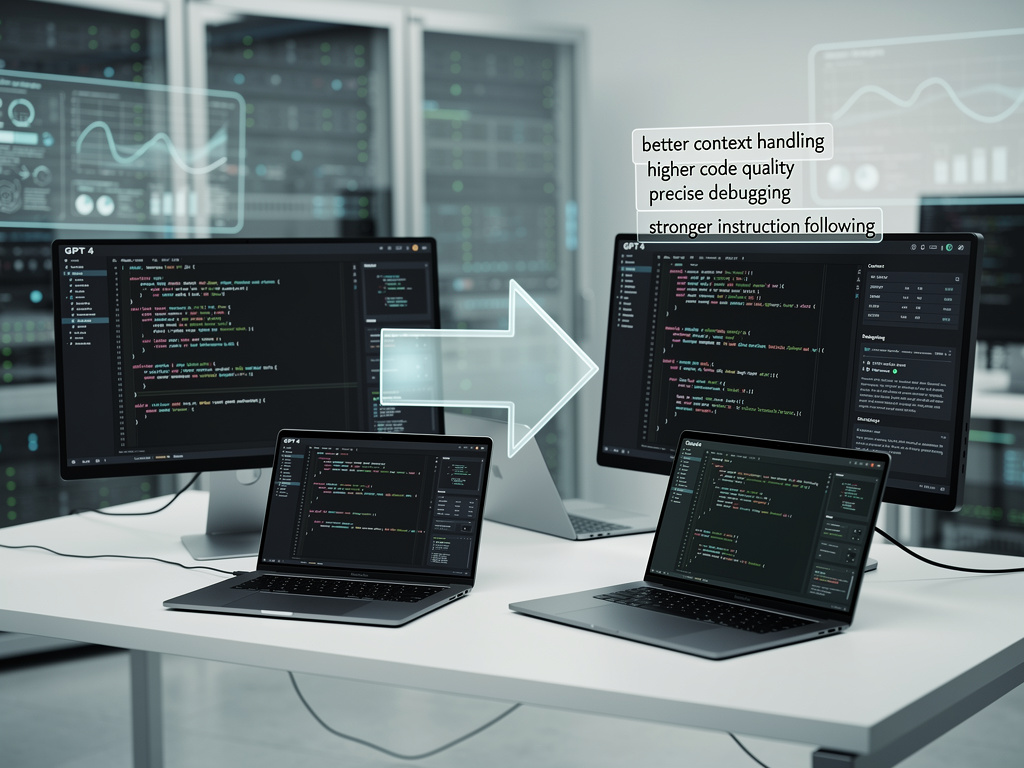
In software engineering circles, a quiet but significant migration is underway. Developers who once relied almost exclusively on OpenAI’s GPT-4 for code generation, debugging, and architectural planning are increasingly switching their primary AI assistant to Anthropic’s Claude — particularly the Claude 3.5 Sonnet and Claude 4 models. The shift isn’t driven by marketing hype or brand loyalty. It’s driven by measurable differences in output quality, contextual understanding, and what programmers describe as a fundamentally different approach to reasoning about code.
A detailed technical analysis published by developer Manish Bhusal on bhusalmanish.com.np lays out the case with specificity that resonates with working engineers. Bhusal’s argument centers not on benchmarks or abstract capability comparisons, but on the practical, day-to-day experience of writing production software with AI assistance. His findings align with a growing chorus of developers on X (formerly Twitter) and in programming forums who report similar experiences.
The Context Window Advantage and Why It Matters for Real Projects
One of the most frequently cited advantages of Claude in coding tasks is its handling of large context windows. Claude 3.5 Sonnet offers a 200,000-token context window, and Claude’s newer models maintain this capacity. For developers, this isn’t a theoretical feature — it’s the difference between an AI that can reason about an entire codebase and one that loses track of critical dependencies halfway through a conversation.
As Bhusal explains in his analysis, GPT-4’s context window, while substantial, often leads to degraded performance as conversations grow longer. Developers report that GPT-4 begins to “forget” earlier instructions, repeat itself, or produce code that contradicts architectural decisions established earlier in the same session. Claude, by contrast, maintains coherence across extended interactions, which is essential when working through complex refactoring tasks or multi-file changes that require awareness of how components interact across a project.
Code Quality: Beyond Syntax Correctness to Architectural Awareness
The distinction between Claude and its competitors goes deeper than simply producing code that compiles. According to Bhusal’s technical breakdown, Claude demonstrates a notably stronger grasp of software design patterns, separation of concerns, and idiomatic code style. When asked to implement a feature, Claude tends to produce code that follows established conventions of the language and framework in question, rather than generating technically correct but stylistically inconsistent output.
This matters enormously in professional settings. Code that works but violates team conventions creates technical debt. Code that solves the immediate problem but introduces tight coupling or ignores error handling creates maintenance burdens. Bhusal notes that Claude more consistently produces code that a senior engineer would approve in a code review — handling edge cases, following naming conventions, and structuring logic in ways that are readable and maintainable. GPT-4, while capable of producing excellent code in isolated prompts, more frequently requires follow-up corrections on these qualitative dimensions.
Debugging and Error Analysis: Where Claude Pulls Ahead
Perhaps the most striking difference between the two models, according to multiple developer accounts, is in debugging. When presented with broken code and an error message, Claude tends to analyze the problem systematically — identifying the root cause, explaining why the error occurs, and proposing a fix that addresses the underlying issue rather than just suppressing the symptom. GPT-4, developers report, more often suggests surface-level fixes that may resolve the immediate error but leave the deeper problem intact.
Bhusal’s analysis provides specific examples of this pattern. In one case involving a React application with a state management bug, Claude correctly identified that the issue stemmed from a stale closure in a useEffect hook, explained the JavaScript closure mechanics that caused the problem, and restructured the code to eliminate the bug. GPT-4, given the same prompt, suggested adding a dependency to the useEffect array — a fix that resolved the immediate symptom but introduced a re-rendering loop that would have created a new bug in production.
The “Thinking” Models and How Claude Approaches Multi-Step Reasoning
Anthropic’s introduction of extended thinking capabilities in Claude has further widened the gap in complex coding scenarios. When Claude engages its extended thinking mode, it works through problems step by step before producing output, much like a developer sketching out an approach on a whiteboard before writing code. This is particularly valuable for algorithmic problems, system design questions, and debugging scenarios where the solution requires connecting multiple pieces of information.
OpenAI has its own reasoning models — the o1 and o3 series — which also demonstrate strong step-by-step reasoning. However, developers on X and in forums like Hacker News have noted that Claude’s reasoning feels more transparent and more directly applicable to coding tasks. The model’s “thought process” tends to mirror how experienced developers actually think about problems: considering constraints, evaluating trade-offs, and anticipating edge cases before committing to an implementation approach. Recent discussions on X from developers comparing Claude Sonnet 4 and GPT-4o in coding tasks have reinforced this perception, with many noting that Claude’s outputs require fewer iterations to reach production-ready quality.
Instruction Following and the Problem of “AI Slop”
A persistent complaint about GPT-4 in coding contexts is its tendency toward verbosity and unsolicited additions. Developers frequently report that GPT-4 adds comments explaining obvious code, wraps responses in unnecessary markdown formatting, or includes features that weren’t requested. This phenomenon — sometimes called “AI slop” in developer communities — creates extra work, as engineers must strip away the unwanted additions before integrating the output into their projects.
Claude, according to Bhusal and corroborated by numerous developer testimonials, follows instructions more precisely. When asked to produce only the modified function without explanation, Claude is more likely to comply. When given specific constraints — “use TypeScript strict mode,” “follow the repository’s existing pattern of dependency injection,” “don’t use any external libraries” — Claude adheres to those constraints more reliably. This precision in instruction following saves significant time in professional workflows where developers may be generating dozens of code snippets per day.
Where GPT-4 Still Holds Ground
The picture isn’t entirely one-sided. GPT-4 retains advantages in certain areas that matter to developers. Its integration with the broader OpenAI platform, including the Assistants API and function calling capabilities, gives it an edge in building AI-powered applications. GPT-4’s training data appears to include more extensive coverage of niche programming languages and legacy frameworks, making it sometimes more helpful when working with older or less popular technologies.
Additionally, OpenAI’s Codex and the GitHub Copilot integration — powered by OpenAI models — remain the dominant AI coding tools in terms of IDE integration and workflow automation. Developers who rely heavily on inline code completion within their editors may find the GPT-4-powered tools more immediately accessible, even if Claude produces better results in conversational coding sessions. Microsoft’s continued investment in Copilot, which recently incorporated GPT-4 Turbo, keeps OpenAI’s models firmly embedded in many developers’ daily workflows regardless of their preferences in standalone AI conversations.
The Broader Implications for AI-Assisted Software Development
The developer migration toward Claude reflects something larger than a simple product preference. It signals that the market for AI coding assistants is maturing beyond raw capability benchmarks toward qualitative factors like consistency, instruction adherence, and output that integrates cleanly into professional workflows. Developers aren’t just asking “can this model write code?” — they’re asking “can this model write code that I’d actually ship?”
Anthropic appears to have recognized this distinction early. The company’s focus on safety and alignment, often discussed in the context of AI risk, has a practical byproduct: models that are more careful, more precise, and less likely to produce confidently wrong output. In coding, where a single misplaced character can cause a production outage, this carefulness translates directly into utility. As Bhusal concludes in his analysis on bhusalmanish.com.np, the choice between AI coding assistants increasingly comes down to whether you want a model that impresses with its breadth of knowledge or one that consistently produces code you can trust.
For enterprise engineering teams evaluating AI tools, the implications are significant. The model that performs best on standardized benchmarks may not be the model that delivers the most value in a production software development workflow. As AI-assisted coding moves from novelty to standard practice, the metrics that matter are shifting — from “can it solve LeetCode problems?” to “does it reduce our bug rate and accelerate our release cycles?” On those measures, the evidence increasingly favors Claude, and the developer community is voting with its keystrokes.


 WebProNews is an iEntry Publication