
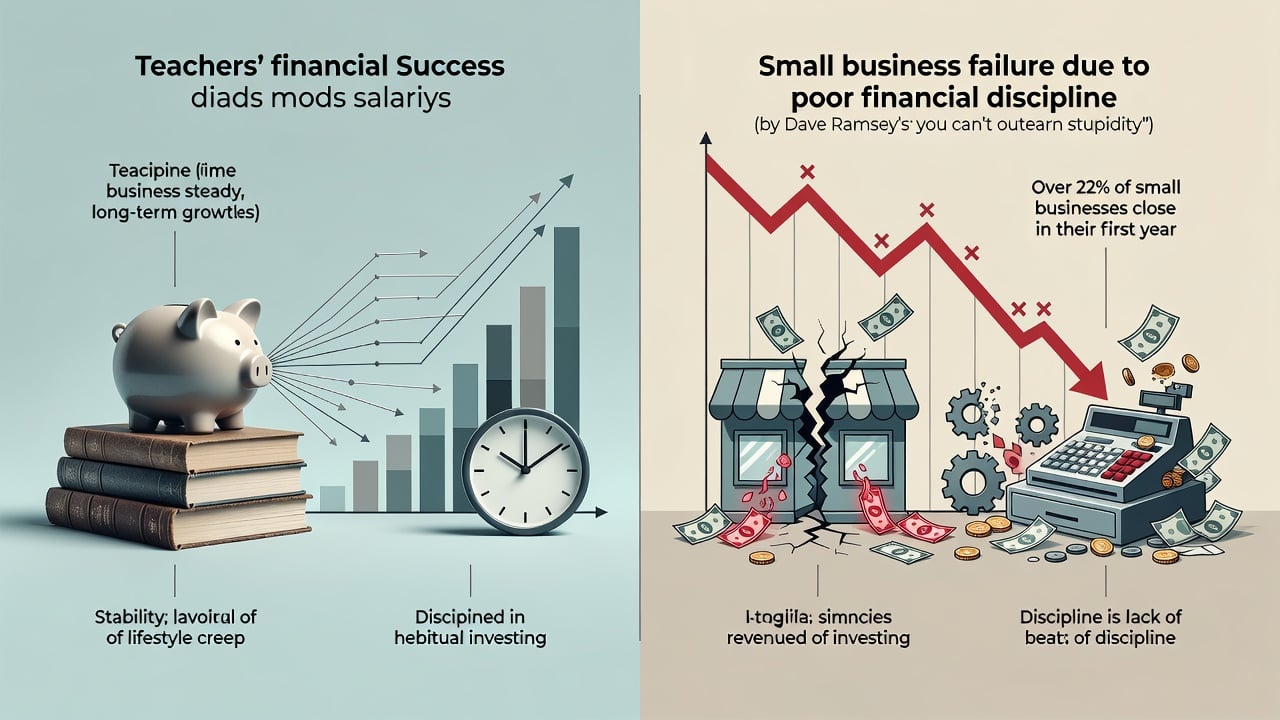
Teachers don’t pull in doctor-level pay. Yet they land among the top professions for millionaires in America. Engineers and accountants edge them out. Business owners and lawyers follow. Physicians? They miss the top five entirely.
Dave Ramsey has repeated the line for years. You can’t outearn stupidity. The blunt phrase captures a truth that hits small-business owners especially hard. No matter how much revenue rolls in, poor decisions can drain it faster than it arrives. Recent data backs him up. More than one in five new U.S. businesses close within their first year, according to a LendingTree analysis of Bureau of Labor Statistics figures released in April 2026 (LendingTree).
Ramsey Solutions surveyed 10,000 millionaires for its National Study of Millionaires. The results surprised many. Seventy-nine percent never received an inheritance. Eight in 10 invested in a 401(k). Three-quarters built their wealth through consistent hard work rather than sky-high salaries. Teachers ranked third on the list. The average one earns about $72,000 a year, per National Education Association data cited in a July 18, 2026, Moneywise report on Yahoo Finance (Moneywise via Yahoo Finance).
But here’s the pattern. These millionaires share habits. They graduate from college. Eighty-eight percent did so. Over half earned postgraduate degrees. Few attended elite schools. What sets them apart is discipline. They invest steadily over decades. Compound interest does the heavy lifting in the final 10 years before retirement. A written plan anchors everything.
Contrast that with many small-business owners. They chase revenue growth. They ignore spending leaks. They borrow to cover gaps instead of fixing the underlying mess. Ramsey doesn’t mince words on his show. In a recent call replayed across social media, he told a couple earning $300,000 a year with $119,000 in debt that they lived like Congress. Their lifestyle ate $100,000 more than necessary each year. Vacations, new appliances, eating out. The fix wasn’t more income. It was cutting waste and attacking the debt with intensity.
Habits Separate Survivors From Casualties
Business owners often repeat the same errors. They underprice services. They hire too soon. They mix personal and company expenses without clear boundaries. Cash-flow surprises turn into crises. And when revenue spikes, spending follows. The cycle repeats until the business folds.
Statistics tell a grim story. Nearly half of new businesses fail within five years. Two-thirds don’t survive a decade, per multiple analyses of 2025 BLS data from Crestmont Capital, Fortunly and the Commerce Institute. Cash shortages cause many collapses. Forty-eight percent of failed firms in one 2025 survey ran out of money. Lack of market demand doomed 42 percent in another study.
Ramsey’s advice cuts against the startup culture that celebrates big swings. He pushes living below your means. Even when the company grows. He tells callers to build an emergency fund first. Then attack debt with the snowball method. List smallest balances first for quick wins. The emotional boost matters more than pure math for most people.
But not everyone agrees on every detail. Financial personality Caleb Hammer, who collaborates with Ramsey’s team, prefers a one-month emergency fund over the $1,000 starter amount. He has seen too many families hit with emergencies larger than that threshold before they gain momentum. The debate shows nuance. Yet both stress behavior over income. You fix the person first. The numbers follow.
And small-business owners face unique pressures. They can’t always delegate and walk away. As Ramsey noted in a 2026 discussion on business practices, you inspect what you expect. Stay involved. Clear the clutter. Keep decisions sharp. One viral clip from July 18, 2026, captured him advising a 19-year-old kicked out by parents and running a landscaping business. Skip the camper for now. Stack cash. Secure basics first. Don’t solve a temporary housing problem with long-term debt.
The teachers who become millionaires follow a quieter path. They contribute to retirement accounts month after month. They avoid lifestyle creep. They teach fiscal responsibility at home. Their example offers a model for entrepreneurs. Consistent execution beats brilliant strategy executed poorly.
Recent conversations on X reflect the same themes. Users shared clips of Ramsey confronting high-earning couples about spending. One engineer pair admitted to vacations and home repairs while carrying six-figure consumer debt. Ramsey’s response was direct. You’re broke if you spend like that on $300,000 income. Change the habits or the advice can’t help. The post racked up thousands of views within hours.
Another thread highlighted a social worker with nearly $300,000 in student debt. She and her husband lived in a paid-off New Jersey home worth $450,000. Household income hovered around $108,000. Ramsey walked through the math. Income side and outgo side. Raise earnings where possible. Cut expenses ruthlessly. The baby and her disability added layers. Still, the core message held. Behavior determines outcomes more than starting salary.
Entrepreneurs hear versions of this every day. Scale the business smarter. Protect margins. Build reserves before you expand. Yet many treat every dollar of profit as fuel for the next shiny object. New equipment. Fancy office space. Marketing campaigns with unproven returns. The stupidity isn’t ignorance. It’s ignoring proven principles in favor of what feels good in the moment.
Ramsey’s own story adds weight. He built a real-estate fortune young, then lost it all through aggressive borrowing. The bankruptcy taught him. Debt is a tool best used sparingly. Consumer debt, never. His radio show, books and company now reach millions with that lesson. The National Study of Millionaires simply confirmed what he had seen for decades. Ordinary people with discipline outperform high earners without it.
So what does success look like for a small-business owner in 2026? Start with a written budget that treats the company and household as connected. Track every expense. Pay yourself a set salary rather than draining profits. Build that emergency fund before aggressive growth. Attack high-interest debt first if the snowball feels too slow, but stay aggressive. Invest consistently in tax-advantaged accounts. Review decisions monthly. Adjust without emotion.
The teachers prove it works. They don’t out-earn anyone. They simply refuse to let stupidity win. Business owners who adopt the same mindset give themselves far better odds. The failure rates show most don’t. Those who do stand out. Their companies last. Their wealth compounds. And they sleep better at night.
But only if they commit. Half measures fail. The data is clear. The calls on Ramsey’s show repeat the pattern. High income, higher spending, persistent stress. The solution has never changed. Live on less than you make. Attack the waste. Invest the difference. Repeat for decades. Stupidity loses when discipline shows up every single day.


 WebProNews is an iEntry Publication