
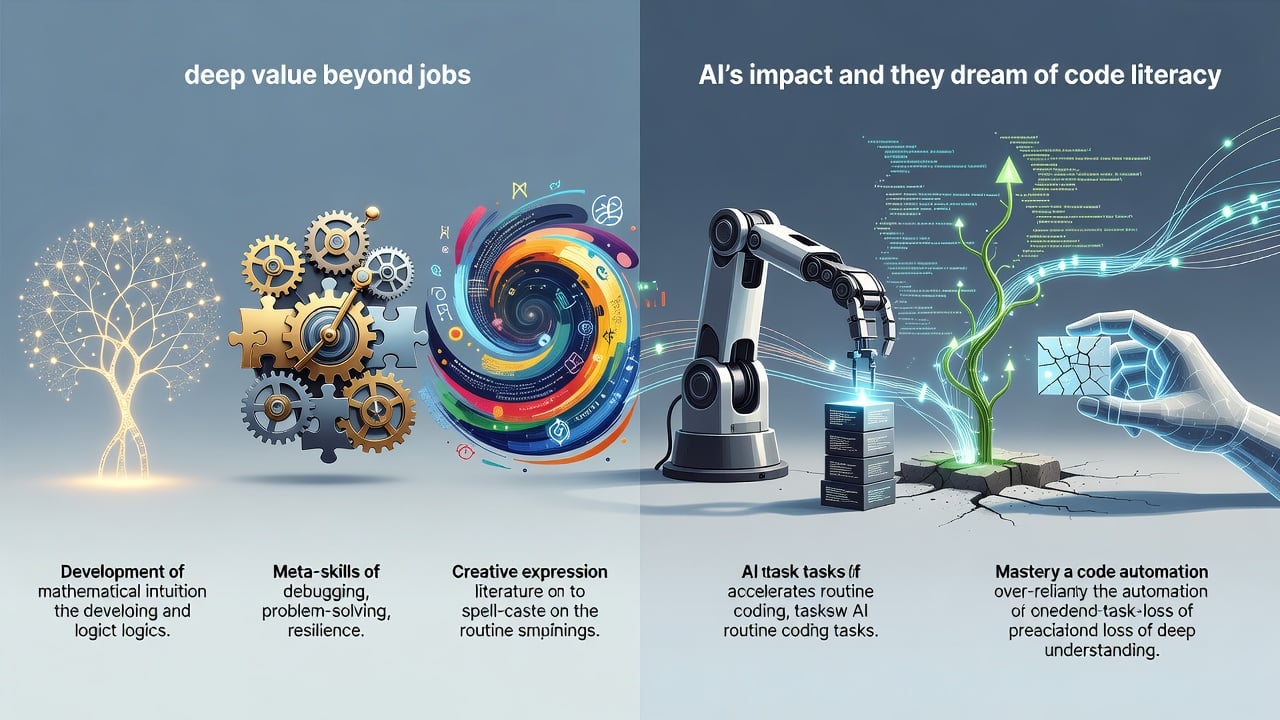
Sam Harris captured a shift many felt but few said out loud. “Literally no one is uttering what we thought were the immortal lines ‘learn to code.'” The podcast host made the remark last year. Silicon Valley had moved on. Quick JavaScript skills no longer promised six-figure salaries. The old promise faded.
Yet Steve Krouse disagrees. The founder of Val Town still believes everyone should learn to code. Not for the old vocational reasons. Not to escape poverty with two lines of code. Something deeper drives his view. He laid it out in an essay published today on his site. The piece argues coding holds value as education, not just job training. Steve Krouse’s “Learning to code is still worthwhile” makes the case with personal stories and clear logic.
Krouse grew up hating math. Then he stumbled into an after-school program. It taught programming. Through that experience he fell in love with math. He excelled beyond his wildest dreams. The program came from ideas developed by Seymour Papert. The researcher wanted children to learn math the way they learn language. Through exploration. Not rote instruction.
Papert created “Mathland.” He built the LOGO programming language. Kids gave instructions to a turtle on screen. The turtle drew with ink on its feet. Krouse recreated a version. Try it at turtle.val.run. See if you can make it draw a circle. Simple commands produce complex shapes. The feedback comes instantly.
The Hidden Power of Coding as a Teaching Tool
That instant feedback matters. So does the debugging process. Composition. Logic. These build meta-skills. Krouse calls them meta-skills for learning in general. They teach something fundamental. Nothing exists that cannot be learned. Computer scientists show unreasonable competence. They tackle problems far outside their domains. Arrogance sometimes follows. The underlying confidence comes from repeated success at breaking down hard tasks.
Recent research backs parts of this view. A study from Anthropic examined how AI assistance affects skill formation. Developers learned a new Python library. Some used AI tools. Others coded by hand. The AI group worked faster. Yet they scored 17% lower on a follow-up quiz. The gap grew largest on debugging questions. Anthropic’s “How AI assistance impacts the formation of coding skills” showed AI speeds tasks but can reduce mastery. Understanding why code fails suffers most.
But Krouse sees coding as more than skill building. He describes it as creative expression. Rich as literature. As music. It mixes writing’s creativity with math’s precision. Add video game-like instant feedback. The combination feels magical. Desires sharpen into precise language. Computers then carry them out.
He compares it to casting spells. Hermione corrects Ron. “It’s levi-O-sa.” Syntax must be exact. Master it. Suddenly you encode imagination into something real. “You are a wizard, Harry.” We all can be. Large language models write English as well as code. Yet no one fears for the humanities. The same logic applies here. Code retains its place.
Critics dismiss it as legalese. Inscrutable details. Tedious. Krouse pushes back. Law runs society. Code runs our digital world. Elegant lines change everything. Think e=mc². Or the phrase “we hold these truths to be self-evident.” Precise formal language carries power. Majesty even.
And programming brings joy. Pure fun. Krouse’s calling involves spreading that joy. He invites anyone interested to email him at [email protected]. His dream of universal code literacy persists. Even now. The real computer revolution continues.
Recent discussions echo these tensions. A Masai School article from February asks directly if coding remains worth learning after AI. It concludes certain fundamentals still matter. Projects beat passive learning. Understanding systems trumps copy-paste. Masai School’s “Is Coding Still Worth Learning After AI?” stresses that AI changes what coders do. It doesn’t eliminate the need for clear thinking.
Another piece from McTaba published this year takes an honest look. It asks if learning to code makes sense for non-engineers. The answer depends on goals. Data work, product decisions, technology roles all benefit. McTaba’s “Is It Worth Learning to Code in 2026? Honest Take” notes that AI handles routine tasks. Human judgment over results grows more valuable.
On X, the conversation continues. One post from early July warned that if AI handles most knowledge work, “just learn to code” won’t suffice. Education, careers, the economy need rethinking. Another from Uganda emphasized “learn to code” plus “learn to think.” Critical thinking and ethics must join AI education. A Stanford grad story circulated widely. Eight hundred applications. Three screens. Zero offers. AI let companies replace junior engineers with fewer seniors. Debt reached $180,000. Schools still push the old advice.
These stories show real pain. Yet they don’t disprove Krouse. His argument never rested on easy jobs. It rested on math learning. On creative power. On meta-skills that survive automation. Debugging with AI still requires knowing when the AI errs. The Anthropic study makes that clear. Lower quiz scores. Weaker debugging. The tool accelerates. It doesn’t replace understanding.
Platforms have adapted. Lists of best learning sites in 2026 highlight AI integration. Codecademy, freeCodeCamp, Scrimba now blend traditional lessons with AI assistance. They teach fundamentals first. Then show how to direct the machines. The Syracuse iSchool published a roadmap in March. Two paths emerge. Power users need no code. Builders do. The builder path remains technical. It leads to different careers. Syracuse iSchool’s “How to Learn AI in 2026? The Complete Roadmap” separates the approaches cleanly.
Krouse’s Val Town fits the builder side. It lets people write and deploy code in the browser. Social features encourage sharing. Learning happens through doing. His turtle example lives there. Simple. Immediate. Fun. The joy he describes comes through.
But skepticism persists. Some builders now focus on “vibe coding.” Describe what you want. AI fills details. One startup calls itself Duolingo for vibe coding. Their thesis: learning to code is dead. Learn to ship in a weekend. The claim sounds bold. It reveals a split. Some seek surface results. Others chase deeper mastery.
Krouse chooses the latter. His essay never promises riches. It promises understanding. It promises creation. It promises the satisfaction of making something real from pure thought. That value doesn’t vanish when AI improves. It might grow more precious.
Consider the math parallel. Calculators didn’t kill arithmetic. Spreadsheets didn’t kill algebra. They changed when and how people use it. Good education still teaches the basics. So people know when the machine gives wrong answers. The same pattern appears in coding. AI writes functions quickly. Humans set direction. Spot flaws. Refine goals. Those abilities come from practice. From the debugging loops Krouse learned as a child.
His personal story carries weight. Hate for math turned to love through code. Many students struggle with abstract concepts. Programming makes them concrete. The turtle moves. The circle appears. Errors produce obvious failures. Fixes bring visible success. The cycle builds confidence. That confidence transfers.
Recent X posts from educators highlight similar experiences. One founder in Nigeria built an edtech tool around thinking first. Tools second. AI writes code. It cannot replace the mental model. The person who knows when the answer looks wrong before running it. That skill separates valuable contributors.
The debate will continue. Job markets shift. Tools improve. Yet the core case Krouse makes holds. Code teaches. Code creates. Code brings joy. Those benefits survive AI. They might even sharpen against it. When machines handle the tedious parts, the creative and analytical parts gain focus.
So the dream lives on. Universal code literacy. Not everyone becomes a professional developer. Everyone can gain from the experience. Try the turtle. Write a small script. Feel the spell work. The precision. The feedback. The small triumph. Those moments compound. They build something lasting.
Krouse ends with an invitation. If the idea sparks interest, reach out. The offer feels genuine. His work at Val Town aims to make coding more accessible. More social. More immediate. The old barriers drop. The new ones involve attention and curiosity. Those who bring both will find rewards.
AI changes the how of coding. It doesn’t change the why for those seeking understanding. The essay makes that distinction clear. Vocational paths narrowed. Educational ones remain wide open. Perhaps wider than before.


 WebProNews is an iEntry Publication