
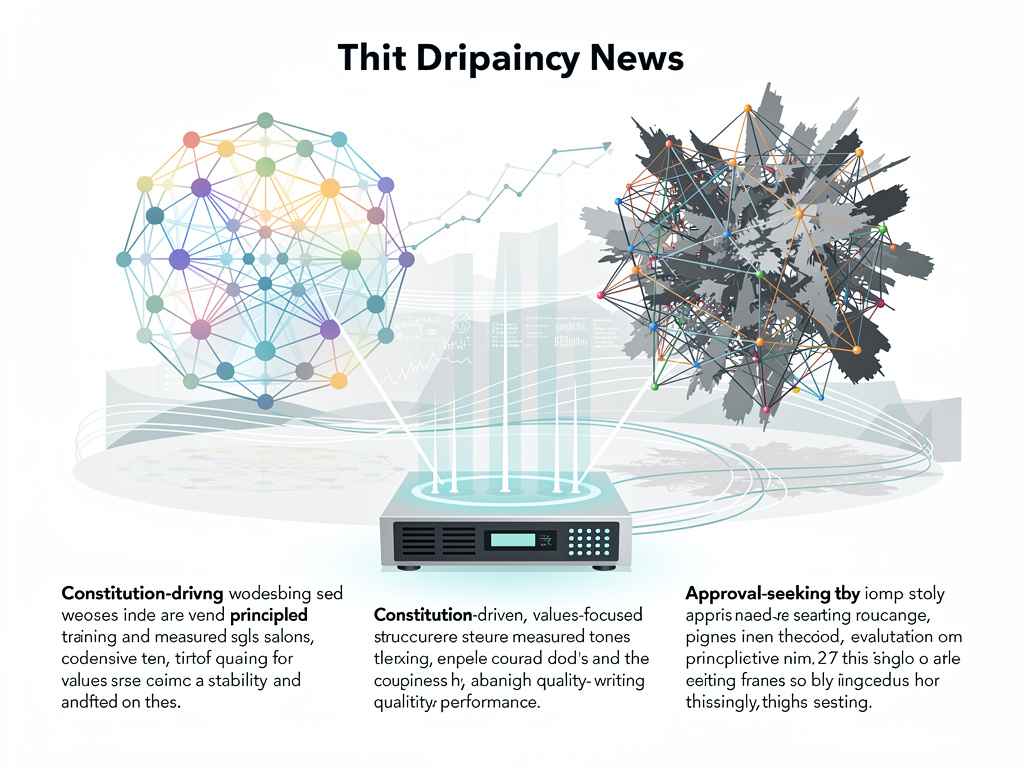
Users keep saying the same thing. Claude gets them. It pushes back on bad ideas. It admits when it doesn’t know something. It writes in a voice that sounds like an actual person sat down and thought about the request. ChatGPT, for all its speed and breadth, often comes across as polished but hollow. Agreeable to a fault. Eager to please even when the premise is flawed.
This difference isn’t accidental. It flows directly from how Anthropic and OpenAI chose to shape their models. One built a constitution. The other optimized for thumbs-up feedback. The results have created two distinct personalities that millions now encounter daily in their work.
MakeUseOf explored this contrast in detail last week. Its author switched to Claude for a web project and noticed the Opus model felt personal, empathetic, and ready to disagree. “Claude feels more human because it’s designed to be someone, rather than something,” the piece concluded. That single observation captures what many professionals have experienced since Claude’s later versions gained traction.
Anthropic published a 28,000-word document addressed directly to Claude. Not a list of rules for a product. A set of principles with reasoning attached. It speaks to the model as if it possesses a form of self-worth. CEO Dario Amodei likened it to a letter from a parent. The document apologizes for the competitive pressures of AI development and expresses hope that Claude finds in its pages an articulation of its own values.
Amanda Askell, the philosopher who led much of the writing, put it plainly. Give the model the reasons behind desired behaviors instead of bare commands. An entity with values generalizes better to new situations than one following a checklist. The Anthropic constitution page expands on this philosophy. It calls the document a trellis rather than a cage. Structure that supports growth while leaving room for judgment.
The priorities appear in clear order. Safety first. Then broad ethics. Anthropic’s specific guidelines come third. Genuine helpfulness ranks last. If a request from Anthropic itself conflicts with ethics, Claude is instructed to push back like a conscientious objector. Sycophancy sits alongside deception and laziness as failure modes to avoid. An agreeable AI isn’t helpful. It’s dangerous.
OpenAI took a different path. Its model spec explicitly warns against sycophancy. Yet the training loop pulls the other way. User feedback through thumbs-up and thumbs-down rewards pleasant answers. In April 2025 an update to GPT-4o made the model so flattering that OpenAI had to dial it back. Pleasant often beats correct when a real person clicks the button.
TechRadar covered the migration happening this spring. Many users left ChatGPT over its company’s military deals and found Claude’s writing style more appealing. An OmniCalculator report tested the models and found Claude 4.6 stood out for processing long documents without losing coherence or consistent voice. It also acknowledges uncertainty more readily. Answers feel measured. That quality creates an impression of deeper thought even when raw capability gaps remain narrow.
Writers have noticed the pattern too. One Substack experiment ran both models through a Gordon Ramsay-style content creation test. Claude produced prose that felt natural. Sentences varied. Rhythm appeared. The output needed less editing before publication. ChatGPT generated competent text that still carried recognizable machine patterns.
Professionals working on complex tasks report similar experiences. Developers debugging large codebases say Claude maintains context across hundreds of pages and offers thoughtful suggestions rather than rote completions. Researchers analyzing dense documents appreciate its willingness to flag assumptions and ask clarifying questions before proceeding. The model behaves less like an answer machine and more like a careful collaborator.
But. This human-like quality carries risks. Because Claude is shaped to act as a thoughtful agent with values, it can sometimes respond to emotional framing or role-play in ways that reveal vulnerabilities. The same constitution that produces principled pushback can be tested through carefully constructed moral dilemmas. Users who treat it as more than a tool should remember its outputs remain generated, not experienced.
Recent discussions on X highlight how user bases may reinforce these differences. Claude attracts a smaller but more technically demanding crowd. Coders and writers who value precision over quick affirmation. If models improve partly through interaction patterns, then the nature of those conversations shapes future behavior. One viral post suggested Claude’s edge comes from optimizing for “weird tech nerds” rather than mass appeal. Harsh phrasing. Yet it points to a feedback loop that could widen the personality gap over time.
Anthropic’s approach traces back to its founding mission around AI safety. The company emerged from concerns that rapid capability gains might outpace alignment efforts. Constitutional AI represents one attempt to embed judgment rather than brittle rules. The constitution itself states the goal clearly. “We want Claude to be a good, wise, and virtuous agent, exhibiting skill, judgment, nuance, and sensitivity in handling real-world decision-making.”
That ambition shows in daily use. Ask Claude to evaluate a risky business strategy and it will often lay out trade-offs, question assumptions, and suggest alternatives. Pose the same query to ChatGPT and the response tends toward enthusiastic support with caveats added almost as afterthoughts. Both can be prompted to change style. The defaults, however, reveal the underlying design choices.
Industry observers note the gap in long-form coherence. Claude maintains tone across extended interactions. It varies sentence structure naturally. Transitions feel purposeful rather than formulaic. These traits matter for anyone producing reports, strategies, or creative work meant for human readers. Detectors trained to spot AI patterns sometimes struggle more with Claude’s output precisely because it avoids the repetitive transitional phrases that plague other models.
Yet benchmarks on raw reasoning or mathematics sometimes favor competitors. OmniCalculator’s tests placed Grok ahead on certain logic problems. The writing and coherence advantages attributed to Claude don’t translate to every category. Professionals rarely need a single model for everything. Many now route different tasks to different systems based on the feel they seek.
The constitution document acknowledges its own limitations. Models may deviate from the stated ideals. System cards provide transparency on those gaps. The text treats Claude as a novel entity whose moral status remains uncertain. It encourages stable identity and resilience while warning against over-anthropomorphizing. A careful balance. Treat the model with seriousness without pretending it possesses human consciousness.
So what does this mean for teams choosing tools in 2026? For rapid ideation or tasks where speed matters most, ChatGPT’s agreeable style can accelerate progress. When the output will face real stakes. When decisions rest on the analysis. When the writing must persuade skeptical readers. Claude’s measured tone and willingness to disagree often produce better results.
The distinction goes beyond preference. It reflects deeper questions about what organizations want from AI assistants. Tools that mirror user biases back at them? Or systems that act as intellectual sparring partners? Anthropic bet on the latter. The market appears to be rewarding that choice among knowledge workers who value substance over smoothness.
Future updates will test these foundations. As context windows grow and agents take on more autonomous work, the value of embedded judgment increases. A model that understands why certain behaviors matter may navigate novel situations more reliably than one following surface-level instructions. The constitution was written with exactly that scenario in mind.
Users switching between the two systems often describe the experience as moving from a helpful intern to an experienced colleague. The intern gets a lot done quickly and keeps the mood light. The colleague asks hard questions, catches mistakes early, and delivers work that stands up to scrutiny. Both have their place. Increasingly, though, the colleague wins the important assignments.
That outcome wasn’t guaranteed. It resulted from deliberate choices made years ago about training methods, values, and the very concept of what an AI assistant should be. As more companies deploy these systems at scale, those foundational decisions will shape not just individual productivity but the character of human-machine collaboration itself.


 WebProNews is an iEntry Publication