
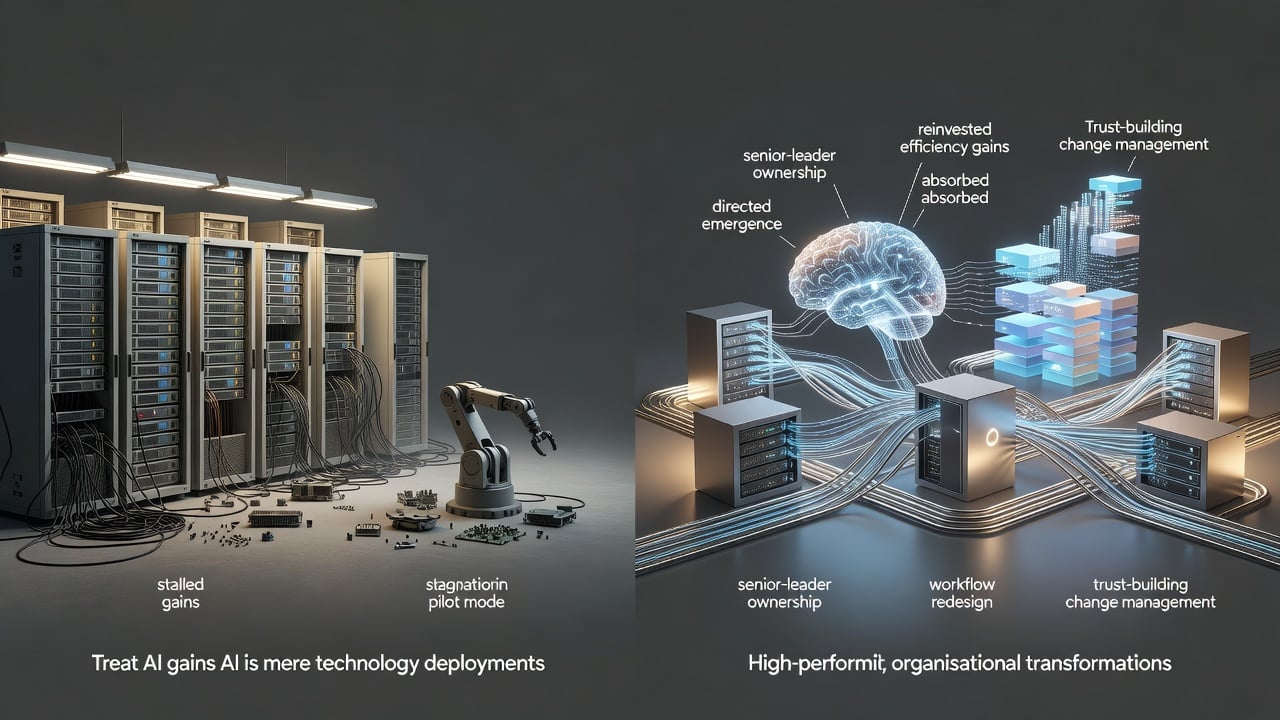
Executives keep buying AI platforms. They run pilots. They tout productivity gains in earnings calls. Yet most see little beyond scattered experiments and modest efficiency tweaks. The pattern repeats across industries. Tools arrive. Enthusiasm follows. Results disappoint.
This gap traces back to one consistent factor. Leadership. Not the absence of sophisticated models or data pipelines. But the failure of senior teams to treat artificial intelligence as a force that demands new decisions about people, processes and priorities. A recent conversation on the Duct Tape Marketing podcast captured the point directly. Paul Roetzer, founder of the Marketing AI Institute, laid out eight pillars required for genuine transformation: vision, strategy, data, technology, governance, literacy, people and performance. He noted that literacy forms the base. And no organization he has studied has cleared every pillar.
Roetzer described how AI now functions as an underlying operating system for business itself. He compared it to electricity or the computer. General purpose. Pervasive. Capable of absorbing repetitive tasks that once trained junior employees. “If we remove all of that repetitive, data-driven work from the first three to five years of our careers, how do we get to become the experts we all became and have that domain expertise and institutional knowledge?” he asked. The question hangs over boardrooms. Short-term cost cuts pull one direction. Long-term talent investment pulls another.
His proposed answer centers on an apprenticeship model. Companies should reinvest a share of the revenue-per-employee gains created by AI into accelerated training programs for new hires. AI tools would speed learning. Leaders would treat talent development as a deliberate offset to automation. Few follow this path. Pressure for immediate margin improvement often wins.
Recent research confirms the pattern. McKinsey’s 2025 global survey on the state of AI found 88 percent of organizations using the technology in at least one function. Only about one-third have moved beyond pilots to enterprise scaling. High performers, the roughly 6 percent capturing the most value, stand apart. They are three times more likely to report strong senior-leader ownership and commitment. These leaders set goals around growth and innovation rather than pure efficiency. They redesign workflows. They embed new practices such as human validation of model outputs and agile delivery. The result appears in revenue gains, market share shifts and faster innovation cycles.
Contrast that with the majority. Many treat AI as a technology project owned by IT or a specialized team. They chase use cases without clear ties to business problems. Pilots multiply. Accountability stays fuzzy. Value stays elusive. Forbes Councils contributor Janet Lam observed in February that 2026 marks a turning point. Experimentation without accountability has grown expensive. Winners will stop discussing AI as a separate category and fold it into ordinary business strategy with measurable outcomes and named owners.
The gap shows up in trust metrics too. A June 2026 analysis from CIO magazine cited Prosci research involving 1,107 participants. Ninety-four percent found AI easy to use. Ninety-eight percent called it valuable. Behavior change lagged far behind. In Australia, a KPMG and University of Melbourne study found 65 percent of employees using the tools while only 36 percent trusted them. Darren Lonsdale, managing director for ANZ at Prosci, put it plainly. “AI doesn’t fail organizations. It exposes them.” It reveals weaknesses in change management, culture and the willingness of executives to have honest conversations about how roles will shift.
High-performing organizations handle this exposure differently. Their executives treat the initiative as a priority. They create deliberate workstreams focused on people. They communicate with transparency. They spread capability rather than hoarding it in centers of excellence. They explain how AI supports human judgment instead of replacing it. Lonsdale noted that buying tools proves simple. Getting teams to adopt them at scale requires trust built through consistent leadership signals. “If leaders avoid these conversations or default to overly optimistic messaging, trust erodes quickly.”
George Westerman, senior lecturer at MIT Sloan, has spent years advising executives on digital transformation. In a January 2026 MIT Sloan Executive Education blog post he reframed the challenge. Technology moves at exponential speed. Organizations change at a glacial pace. The hard part was never the AI. It remains the human elements. Leaders must create clarity, build confidence and reinforce new behaviors. They cannot outsource the work to an AI team. “The real work is to make the business better because the technology exists, not to grow the technology for its own sake.”
Westerman offered a practical reset for every executive meeting. Stop opening with “What are we doing with AI?” Start with “What problems do we want to solve now and how might AI help?” The shift anchors decisions in outcomes. It forces clarity about users and risks. It discourages the habit of automating everything simply because the capability exists. He described AI-era leadership as less about controlling a detailed plan and more about steering an organization through directed emergence. Set the direction. Create space for safe experimentation. Learn rapidly from results. Review projects by asking what changed and what the team learned rather than assigning blame for shortfalls.
Federal data underscores how uneven progress remains. A Federal Reserve note published in April 2026 tracked adoption through multiple surveys. Roughly 18 percent of U.S. firms had adopted AI by the end of 2025, with expectations for further growth in 2026. Employment-weighted estimates reached higher, around 78 percent of the workforce at firms using the technology in some form. Generative AI usage at work stood near 41 percent. Yet the gap between awareness and material impact persists. Many deployments stay narrow. Few produce the enterprise-wide EBIT lift that high performers report.
Wharton’s 2025 AI Adoption Report, released in October, added detail. Executive leadership in generative AI has surged. Chief AI officer roles now exist in 61 percent of enterprises. Three out of four leaders see positive returns. Yet capability building and workflow integration still determine whether those returns scale. The report emphasized that people, not tools, set the pace.
So what separates companies poised to pull ahead in the next wave from those stuck in pilot purgatory? Several patterns emerge from the sources.
First, the CEO and top team must develop genuine literacy. They cannot delegate understanding to technical staff. Vision without comprehension leads to mismatched expectations. Roetzer stressed that bottom-up efforts rarely succeed without C-suite ownership.
Second, strategy must precede technology selection. Leaders define the problems worth solving, the capabilities they want to build, and the risks they will accept. Only then do choices about models, platforms and data make sense. Westerman’s question helps here. Lam’s call to treat AI as normal business strategy reinforces it.
Third, change management receives the same rigor as technical implementation. Lonsdale’s research shows organizations that build trust, grant permission to experiment, and redesign roles see faster adoption. Those that announce tools and expect behavior to follow do not.
Fourth, efficiency gains get reinvested thoughtfully. Cutting headcount to boost short-term margins may satisfy quarterly targets. It also risks hollowing out the very expertise needed for future advantage. The apprenticeship idea from Roetzer offers one alternative. Other models exist. The common thread is deliberate choice rather than reflexive cost reduction.
Fifth, measurement focuses on business outcomes, not activity metrics. Number of pilots launched matters less than cycle time reductions, decision quality improvements or revenue per employee growth. High performers in the McKinsey data track AI-specific KPIs and tie them to financial results.
And the risks? They multiply with scale. McKinsey reported that 51 percent of organizations have experienced at least one negative consequence, from inaccuracy to IP issues. High performers encounter more such incidents yet mitigate a broader set of risks through governance, validation processes and transparency. Leadership here means acknowledging trade-offs openly rather than promising frictionless gains.
Recent X discussions echo these themes. Executives and analysts note that teams combining human judgment with bold direction and reliable execution outperform those chasing the latest model release. One post captured it concisely: the companies that thrive won’t be the ones with the most AI tools. They’ll be the ones that integrate them into how work gets done under clear strategic guidance.
The window for catching up narrows. Adoption rates continue to climb. Expectations for scale rise. Organizations that still treat AI primarily as a technology question risk falling permanently behind those that recognized it as a leadership test from the start. The technology will keep improving. The organizations that steer it effectively will be those whose leaders own the full scope of change. From talent models to workflow redesign to honest conversations about trust and judgment. No sophisticated prompt or agent will substitute for that ownership.
Leaders who act on these lessons position their firms for durable advantage. Those who wait for the next breakthrough tool will find themselves explaining another round of disappointing returns. The difference, as multiple studies and practitioners now document, comes down to who sets direction, who builds confidence, and who accepts accountability for turning capability into results.


 WebProNews is an iEntry Publication