
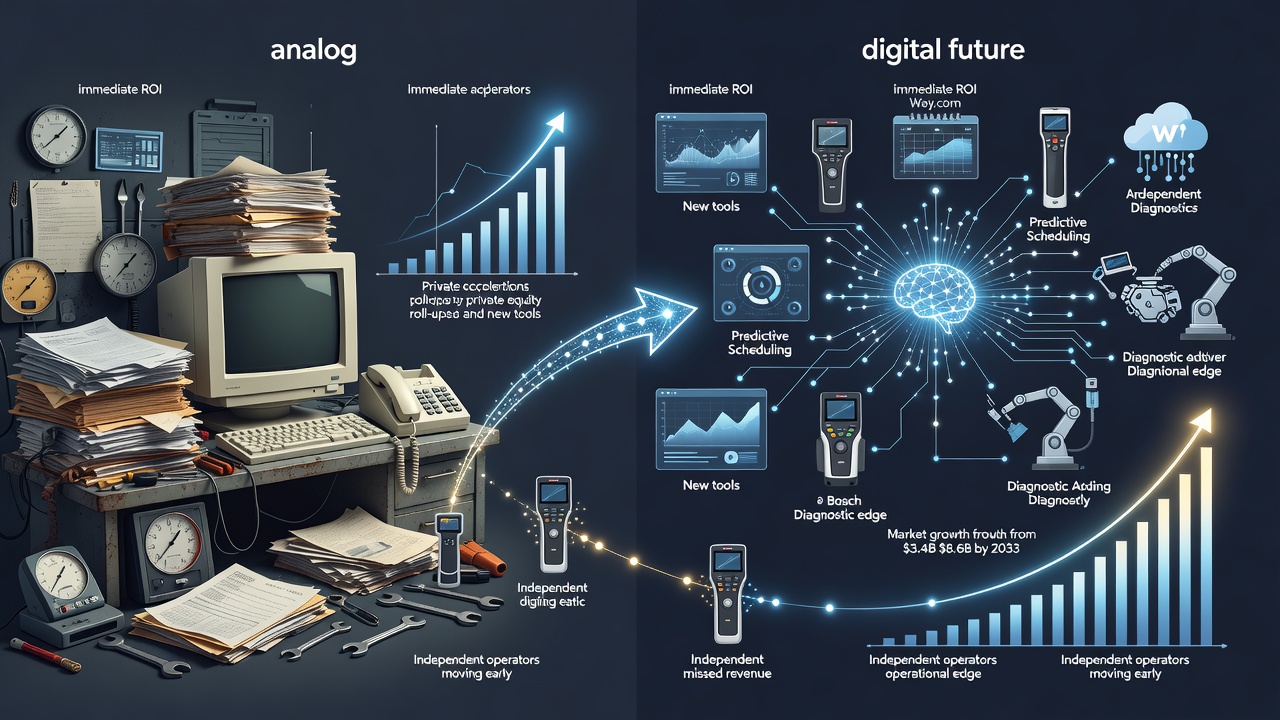
North America holds more than 280,000 independent auto repair shops. Most still schedule jobs by phone, scribble repair orders on paper, and order parts the way owners did in the 1990s. That stubborn manual habit created one of the largest remaining pockets of analog commerce in the U.S. economy. Now artificial intelligence is flipping the script.
The global auto repair software market stands at $3.4 billion in 2026. Analysts project it will reach $8.6 billion by 2033, expanding at a 14.2% compound annual growth rate, according to Persistence Market Research. Software itself grows two to three times faster than the broader automotive aftermarket. The acceleration arrives not from flashier hardware but from tools that remove the very data-entry burden that once made digitization unattractive.
Previous shop-management systems demanded owners feed them information before they produced reports. Owners weighed the hassle against the payoff and usually walked away. AI reverses the flow. It transcribes calls automatically. It categorizes photos of damaged parts. It pulls estimates straight from a VIN lookup. Follow-up texts fire off without anyone lifting a finger. The operator spends less time feeding the machine and more time running the business.
Nowhere does that shift show faster than at the front desk. Industry surveys show independent shops miss more than 40% of inbound calls. Every dropped ring equals forgone revenue. Voice-based AI receptionists built specifically for garages answer 24 hours a day. They book appointments directly into the calendar, escalate urgent matters to a human, and send confirmation texts. The economics prove immediate. One captured call often covers the monthly software fee.
Yet the highest lifetime value may sit elsewhere. Predictive scheduling turns an owner’s mental model of bay availability into a data-driven forecast. Automated customer-retention sequences replace the postcards that never get mailed. These quieter features lift average contract values as shops climb from basic management software toward full AI-augmented operations. The difference compounds quietly but relentlessly.
Distribution remains the hidden moat. Shop owners rarely live on LinkedIn. They skip SaaS conferences. Cold emails land in spam. Successful vendors therefore adopt tactics that feel more like industrial sales: booths at trade shows, alliances with parts distributors, articles placed in aftermarket magazines, and outbound reps recruited from the repair trade itself. Those relationships take years to build. Once established, they prove difficult to displace.
Private-equity roll-ups add another layer. In the past three years, operators such as Sun Auto Tire, Driven Brands, and Caliber Collision have assembled regional clusters numbering in the hundreds of locations. Their post-acquisition playbook almost always includes migrating every acquired shop onto a single software platform. The pattern creates parallel investment opportunities: the software providers that enable the transition and the consolidators that scale the newly digitized locations.
Recent data underscores the momentum. AI-native enterprise spending jumped 94% year over year while traditional SaaS stagnated, reports The Next Web. Auto repair offers one of the cleanest case studies. The prior baseline was so paper-heavy that even modest AI improvements deliver outsized returns. A 2026 Deloitte report cited by WickedFile found sanctioned AI tool access in automotive service rose 58.7% in a single year, with more than 60% of shops expected to adopt some form of AI by late 2026.
Newer entrants push the frontier further. Way.com unveiled its AI-powered Repair platform in January 2026, combining voice agents, automation, and direct customer acquisition from a network of more than 10 million users, according to Shop Owner Magazine. Bosch demonstrated its Super Technician diagnostic assistant at AAPEX in late 2025 and followed with the acquisition of predictive-analytics startup Uptake Technologies, S&P Global Mobility noted. Swedish distributor Meko and U.S. firm AutoTechIQ released similar AI estimate and diagnostic tools within weeks of each other in March 2026.
Established shop-management platforms have responded in kind. Tekmetric, Shopmonkey, AutoLeap, and others now embed AI for diagnostics, marketing, and customer messaging. A June 2026 analysis by Latka counted 37 SaaS companies focused on auto repair software. Collectively they generate roughly $530 million in annual revenue, have raised more than $405 million, and serve about 11 million customers. Penetration still hovers below 6% of the independent-shop universe, leaving vast headroom.
Chris Cloutier, CEO of AutoFlow and owner of three Golden Rule Auto Care locations, described AI as a “thought partner” in a recent podcast. It refines technician notes, drafts business plans, and cuts administrative time so owners can focus on leadership. His experience mirrors broader adoption patterns: the technology augments skilled workers rather than replacing them.
Yet challenges persist. Technicians must still validate AI-generated estimates. Older mechanics sometimes resist new interfaces. Data privacy concerns arise when customer records and vehicle histories feed cloud models. Integration with legacy parts catalogs and diagnostic scanners remains patchy in many shops. Vendors that solve these friction points fastest will widen their lead.
Market researchers differ on exact sizing. One report from Research and Markets places the 2026 market near $34 billion before reaching $57 billion by 2030. The discrepancy highlights how broadly observers define “auto repair software,” from basic scheduling tools to full diagnostic suites. Regardless of the numerator, direction and velocity look consistent. Software outpaces the underlying repair market because it attacks inefficiency at the point of highest leverage: the owner’s time.
Private equity’s interest in both software and shop consolidation suggests the next phase will blend vertical AI with scale. Roll-ups digitize acquired locations, feed them richer data, and train models that improve with volume. Larger chains gain pricing power with parts suppliers and insurance companies. Smaller independents that adopt early can compete on speed and transparency, potentially slowing the consolidation wave or forcing them to join it.
Look at the numbers again. Hundreds of thousands of shops. Billions in untapped labor hours spent on scheduling and paperwork. Decades of rational resistance to earlier technology. The conditions that once protected the status quo now accelerate its replacement. AI did not need to be dramatically smarter than prior tools. It simply needed to invert the work flow so the machine worked for the mechanic instead of the other way around.
That inversion is underway. The shops that embrace it first will capture more calls, retain more customers, and forecast capacity with confidence their analog competitors cannot match. The rest risk watching their missed calls, unmailed reminders, and guesswork estimates become competitive disadvantages that compound monthly. The data, the capital, and the technology have aligned. The only variable left is how quickly owners decide to let the machines handle what they never enjoyed doing anyway.


 WebProNews is an iEntry Publication