
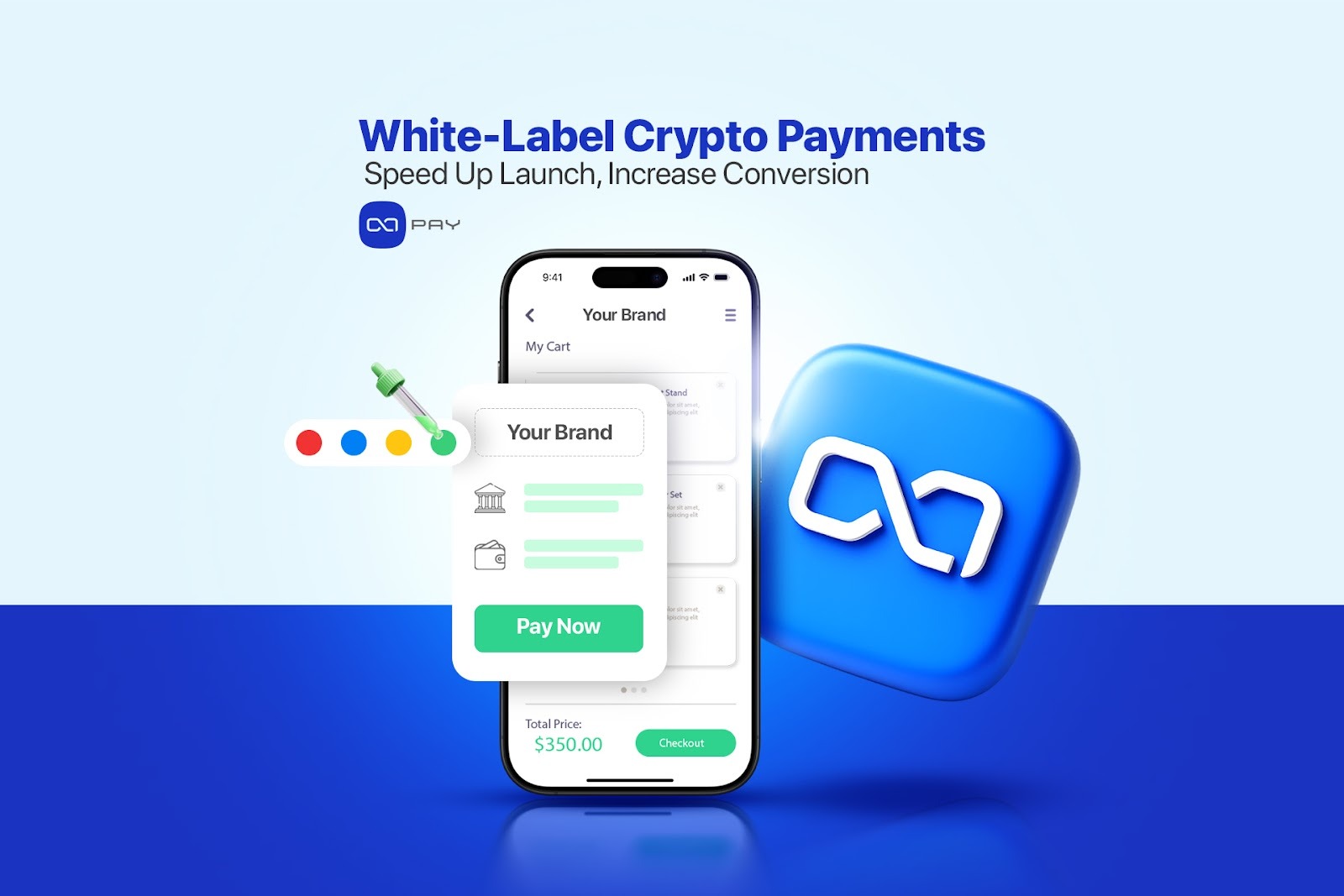
In 2025, brands face a hard reality: users decide fast, trust less, and even the smallest disruption in the payment step can kill the purchase. With a 70% checkout abandonment rate (Baymard Institute, 2025), payment has to feel like part of the brand, not a separate page. A change in domain, font, or environment immediately triggers insecurity, especially in crypto payments. Businesses need a fully branded experience without building a blockchain infrastructure. This is where White-Label Crypto Payment Gateway becomes a real competitive advantage.
The Hidden Drop-Off Problem Brands Keep Ignoring
For many businesses, drop-off begins exactly where everything seems to be working: the ad is seen, the user clicks, the landing page convinces, the product is chosen, and only one step remains. Then suddenly the funnel empties. In analytics it appears as a number, but in the user’s experience it means being “thrown outside the brand.” For international shoppers or high-value purchases, even a small mismatch is enough to trigger the question: “Is this really the same place I was a few seconds ago?” If the intuitive answer is “no,” they close the page silently. This is where ad budgets, SEO, and campaigns burn away without leaving a trace.
Where the Real Friction Comes From
Looking deeper, the problem is not just “weak UI.” It is a chain of micro-moments that erode trust. Today’s digital businesses face issues such as:
- slow or seemingly slow payment flows
- mismatch between payment page visuals and the previous experience
- redirects that force users into unfamiliar environments
- no personalized or contextual cues
- lack of behavioral data for analysis and A/B testing
- new tools requiring multi-week engineering work
In most cases, the issue is not card vs crypto.
The issue is the payment experience itself.
Why Crypto Enters the Conversation
At this point, crypto payments appear, not as a temporary trend, but as a practical growth lever. Businesses that serve multiple regions, work with freelancers and gamers, or sell digital and subscription products gain clear advantages:
- payments from anywhere without banking restrictions
- faster settlement than traditional remittance channels
- access to users without bank accounts but with crypto wallets
- appeal to younger digital-native audiences
- lower processing costs in some cross-border scenarios
For marketing teams and SaaS companies, this means markets that were once “unreachable” suddenly become viable.
But if crypto payments occur on a separate page, with mismatched domain or design, the previous drop-off loop repeats.
Crypto creates the potential for growth.
The delivery determines whether that potential becomes conversion.
From Payment Method to Payment Layer: Where White-Label Comes In
If the core challenge is keeping the payment experience fully branded, integrating tools in hours (not months), and enabling crypto without DevOps, then the problem is not the lack of another payment method.
The missing piece is a payment layer:
a structure that sits above all payment methods and delivers a unified, brand-consistent, fast experience without heavy engineering.
A white-label crypto Payment gateway is built exactly for this moment.
The user visually and emotionally stays inside the brand ecosystem. The domain, colors, typography, microcopy, and layout are owned by the business. The payment page becomes the natural continuation of the product journey. Meanwhile, blockchain infrastructure, security, and monitoring run behind the scenes.
The result is clear: crypto is added without building infrastructure, the experience stays cohesive, friction disappears, and payment data becomes usable for accurate decision-making.
What Businesses Actually Gain From Integrating a White-Label Crypto Payment Gateway
When a business adopts a white-label crypto payment gateway, it gains far more than “another payment option.”
It gains control, speed, and measurable growth.
- Full ownership of the payment experience
Payments happen on the brand’s own domain with its colors, tone, and UI. No break in familiarity, faster trust formation, and less hesitation. - A unified journey from product page to payment
Checkout becomes a continuation of the product flow, not an external module. This directly increases completion rates. - Real reduction in drop-off by eliminating redirects
All the friction typical of hosted or generic payment pages disappears. Users complete the transaction without leaving the environment. - Fast integration without infrastructure
Crypto payments launch with the quality of an in-house system, but without DevOps, blockchain management, or engineering overhead. - Dedicated data for marketing and product teams
Instead of a closed widget, teams get raw payment data, behavioral patterns, and drop-off signals for A/B testing, messaging, and funnel optimization.

What a Good White-Label Crypto Payment Gateway Must Offer
Businesses typically evaluate white-label solutions against seven criteria:
- Stable, real-world infrastructure
- Live pricing and multi-network support
- Transparent, data-driven API
- Full transaction and settlement management
- Integration in hours, not weeks
- Complete UI customization
- Advanced analytics and accurate webhooks
Anything less is not a growth tool.
Where OxaPay Naturally Fits In
When discussing white-label at a practical, production-ready level, OxaPay Merchant Services stands out because its infrastructure has already been used extensively across multi-network, cross-border payments before becoming a white-label offering. For teams unwilling to risk the most sensitive step of the customer journey, this matters.
OxaPay meets all seven core criteria: a stable payment infrastructure, live pricing engine, multi-network support, transparent API, Web3 wallet support, intelligent settlement, integration in hours, full customization on the brand’s domain, and a real-time dashboard for marketing teams.
The outcome is simple: businesses gain a branded, scalable, fast payment experience, without building blockchain infrastructure.
Quick Deployment: A Practical Blueprint
In white-label systems, speed is not a marketing phrase; it is a deployable, repeatable workflow that businesses can use the same day. The question is: How can a brand launch its fully branded payment layer in under 24 hours without building infrastructure?
With OxaPay, the process is straightforward:
- API keys in under 5 minutes
All payment data becomes available without DevOps. - Brand domain and visual identity in ~30 minutes
Logo, colors, and dedicated domain are applied, and the branded environment becomes active the same day. - Custom UI in 30 minutes to 2 hours
Since the API returns raw data only, designers have full freedom. - Transaction tests and webhook activation in under 1 hour
Marketing and product teams receive real-time signals. - Final deployment the same day
No servers, no nodes, no engineering overhead.
This blueprint shows that white-label is not a template.
It is a complete infrastructure plus total design freedom.
Conclusion
In a world where every second of delay risks a lost sale, white-label is no longer a technical choice, it is an instant competitive advantage. A brand that keeps the payment layer inside its own environment builds trust, not hesitation. If you have global traffic, active campaigns, or digital products, each day of delay means missed conversions. A white-label crypto Payment gateway is where growth and simplicity meet: no infrastructure to build, full control over the experience, and a measurable uplift in conversion.


 WebProNews is an iEntry Publication