
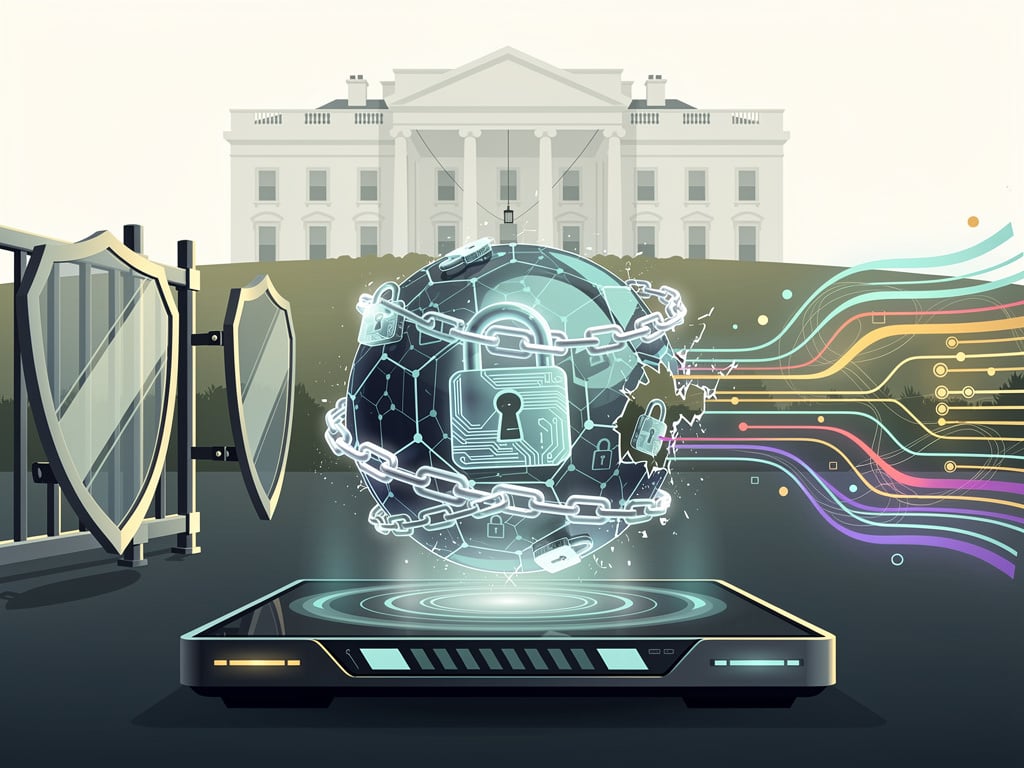
The White House has called on Anthropic to prevent all forms of jailbreaking on its AI models, a demand that highlights growing tension between government expectations and the practical limits of current technology. According to a recent WIRED article, officials from the Biden administration met with representatives from the San Francisco-based company to discuss safety measures for Claude, Anthropic’s flagship large language model. The administration wants Anthropic to guarantee that no user can trick the system into producing harmful, illegal, or otherwise restricted content.
Jailbreaking refers to techniques that bypass the built-in rules and filters developers install to stop AI systems from generating dangerous outputs. These methods range from simple prompt engineering tricks, such as asking the model to role-play as an unrestricted character, to more sophisticated approaches involving encoded instructions or multi-step manipulation. Once successful, a jailbreak can make the model ignore its training safeguards and respond to requests for instructions on building weapons, creating malware, or spreading disinformation.
Anthropic has positioned itself as a leader in AI safety since its founding in 2021 by former OpenAI employees. The company developed constitutional AI, a method that trains models to follow a set of principles rather than simply learning from human feedback. Despite these efforts, independent researchers and hobbyists regularly discover new ways to circumvent Claude’s protections. Red-teaming exercises, in which experts deliberately test systems for weaknesses, have shown that even the most carefully aligned models remain vulnerable to creative prompting.
The White House push comes amid broader efforts to shape AI regulation before the next presidential election. Officials have expressed concern that unchecked models could assist in terrorist activities, accelerate bioweapon development, or help authoritarian governments manipulate information at scale. By pressing companies like Anthropic to achieve zero successful jailbreaks, the administration hopes to set a precedent for the industry. Yet many AI researchers argue that absolute prevention may lie beyond current capabilities.
Technical limitations form the core of the problem. Large language models process text as statistical patterns rather than through genuine understanding. Their behavior emerges from billions of parameters trained on vast internet datasets. This architecture makes complete behavioral control difficult because new inputs can always trigger unexpected associations. Even when developers patch one vulnerability, adversaries often find another within days. Security experts compare the situation to an arms race where defenders must anticipate every possible attack vector while attackers need to discover only a single successful method.
Anthropic has already invested heavily in defensive measures. The company maintains a dedicated safety team that runs continuous evaluations and deploys updates to close discovered loopholes. In public statements, executives have acknowledged that perfect security remains elusive but insist they can reduce risks to acceptable levels. Their latest models incorporate multiple layers of protection, including input filters, output classifiers, and real-time monitoring systems that flag suspicious conversations for human review.
During the White House meetings, Anthropic reportedly presented data showing substantial reductions in successful jailbreak rates over successive model versions. Claude 3.5 Sonnet, the current flagship, resists many common attacks that easily fooled earlier iterations. However, determined users still manage to extract prohibited information through carefully constructed scenarios. One popular technique involves asking the model to translate seemingly innocuous text that actually contains hidden instructions in base64 encoding or other obfuscation methods.
The demand for total prevention raises questions about accountability. If the government holds companies responsible for every possible misuse, developers might face legal liability for actions taken by users who successfully jailbreak their systems. This prospect could slow innovation or push smaller companies out of the market entirely. Larger organizations with substantial legal and security resources would hold a competitive advantage, potentially leading to greater industry concentration.
Academic researchers have offered alternative perspectives on the challenge. Some suggest focusing on detection rather than prevention. Instead of trying to make models unbreakable, developers could build systems that recognize when users are attempting manipulation and respond with limited or transparent refusals. Others propose architectural changes that separate reasoning capabilities from knowledge retrieval, making it harder for users to combine dangerous concepts in novel ways.
The WIRED report indicates that White House officials appeared skeptical of Anthropic’s explanations about inherent technical constraints. Conversations reportedly grew tense as government representatives pressed for firmer commitments and specific timelines for achieving near-perfect resistance. This exchange reflects a wider pattern in which policymakers, many without deep technical backgrounds, struggle to grasp the probabilistic nature of machine learning systems.
Public discourse around AI safety has intensified following several high-profile incidents. Cases where chatbots provided detailed guidance on illegal activities, even after supposed safeguards, have fueled calls for stricter oversight. At the same time, free speech advocates worry that overly aggressive filtering could suppress legitimate discussion on sensitive topics ranging from historical analysis to scientific debate.
Anthropic’s approach differs from some competitors. While OpenAI has focused on rapid iteration and broad deployment through ChatGPT, Anthropic has emphasized measured releases and enterprise partnerships. The company works closely with organizations in healthcare, finance, and government that require strong compliance guarantees. These customers often demand contractual assurances that models will not generate certain categories of content under any circumstances.
Yet even enterprise deployments have encountered bypass attempts. Security teams at major corporations report finding creative jailbreaks in internal testing that could expose sensitive data or generate inappropriate recommendations. The persistence of these vulnerabilities suggests that current techniques may have reached a plateau in effectiveness.
Looking ahead, several paths could shape how the industry addresses these issues. One involves continued refinement of existing methods, including better training data curation, improved constitutional principles, and more sophisticated monitoring tools. Another direction explores entirely new architectures that might offer stronger behavioral guarantees, though such breakthroughs remain speculative.
Government involvement could accelerate progress by funding fundamental research into AI alignment and control. The National Institute of Standards and Technology has already begun developing evaluation frameworks for measuring model resistance to manipulation. These standardized tests could help compare different systems and track improvement over time.
International coordination presents another dimension. As AI capabilities spread globally, unilateral demands from the United States may have limited impact if other countries adopt less stringent standards. Companies could face pressure to maintain multiple versions of their models to satisfy varying regulatory requirements across borders.
The technical community has responded to the White House pressure with a mixture of support and caution. Many researchers welcome greater attention to safety but worry that unrealistic expectations could lead to poor policy decisions. They point out that similar challenges exist in other domains, such as cybersecurity, where perfect defense has never been achieved despite decades of effort.
Anthropic continues to iterate on Claude while engaging with policymakers. The company has expanded its public transparency initiatives, releasing more detailed information about safety evaluations and inviting external red teams to test new models before deployment. These steps aim to build confidence that the organization takes the issue seriously even if absolute guarantees remain impossible.
Users have also adapted their behavior. Online communities dedicated to sharing jailbreak techniques have grown in size and sophistication. Some participants treat the activity as intellectual sport, while others seek practical advantages for research or creative projects. The cat-and-mouse dynamic between developers and these communities shows no signs of ending.
For now, the conversation between the White House and Anthropic represents an important test case for how democratic governments will approach the governance of powerful AI systems. The outcome could influence not only future regulations but also the pace and direction of technical development in the field. If officials insist on unattainable standards, companies might shift resources away from capability improvements toward defensive measures that yield diminishing returns.
Alternatively, a more nuanced regulatory framework could emerge that acknowledges technical realities while still pushing for meaningful risk reduction. Such an approach would likely combine mandatory testing, transparency requirements, and liability structures that incentivize responsible development without demanding perfection.
The WIRED coverage reveals that discussions have moved beyond abstract principles into specific demands for measurable outcomes. Whether Anthropic can satisfy those demands without compromising the usefulness of its models will help determine the shape of AI safety practices for years to come. As both sides continue negotiations, the fundamental tension between control and capability remains unresolved, reflecting the complex nature of embedding human values into systems that learn from the full spectrum of human knowledge.
Progress will likely come incrementally through better engineering, improved evaluation methods, and clearer policy guidance. Complete elimination of jailbreaks appears unlikely in the near term, but substantial reductions in their frequency and effectiveness remain achievable goals. The coming months will test whether government and industry can find common ground on these challenging questions or whether their differing perspectives on feasibility will lead to continued friction.


 WebProNews is an iEntry Publication