
A copywriter who once counted Apple, Netflix and Nike among her clients now takes any gig she can find. “I’ve given up on any sort of dream scenario,” Kerry Harrington told Yahoo Finance. “I’m just trying to survive.” She knows a former creative director working as a mailman. Stories like hers have multiplied across LinkedIn feeds and X threads in recent months.
White-collar professionals once seemed insulated from the brutal dislocations that hollowed out factory towns decades ago. No longer. Artificial intelligence has flipped the script. What began as a tool for coders and analysts now threatens a broad slice of office roles from marketing to back-office operations. Yet the data paints a more complicated picture than outright elimination. Many jobs will transform instead of disappear.
The shift has corporate leaders speaking openly about cuts. Ford CEO Jim Farley declared in 2025 that AI will replace literally half of all white-collar workers in the U.S. Anthropic CEO Dario Amodei warned that the technology could eliminate 50% of entry-level white-collar jobs within five years. Those statements fueled anxiety. But recent studies suggest the outcome may involve more augmentation than annihilation.
Yahoo Finance captured the mood in a June 2026 piece that went viral. It described a “nervous breakdown” among knowledge workers accustomed to six-figure pay and remote flexibility. Molly Kinder, who has studied these changes, likened the moment to the 1980s manufacturing collapse that cost eight million blue-collar jobs over three decades. The difference this time hits college-educated laptop warriors who expected to stay ahead.
Aaron Terrazas, former chief economist at Glassdoor, put it sharply. “For the first time in at least a generation — perhaps two — the future is up for grabs, and there’s a chance that they might not end up on top.” The remark resonated because it challenged decades of received wisdom. White-collar skills in design, sales targets and copywriting had delivered steady gains through the dot-com boom, smartphone era and pandemic hiring surge. Those advantages now feel fragile.
Back-office functions face particular pressure. The New York Times reported in June 2026 that millions of middle-class jobs in human resources, billing and payroll sit in the crosshairs. These positions often pay enough to sustain a middle-class life yet require no advanced degree. Many are held by women spread across the country in big firms and small businesses alike. As AI handles routine data entry, compliance checks and report generation, those roles shrink. The paper called them the “hidden workers” most threatened by the technology.
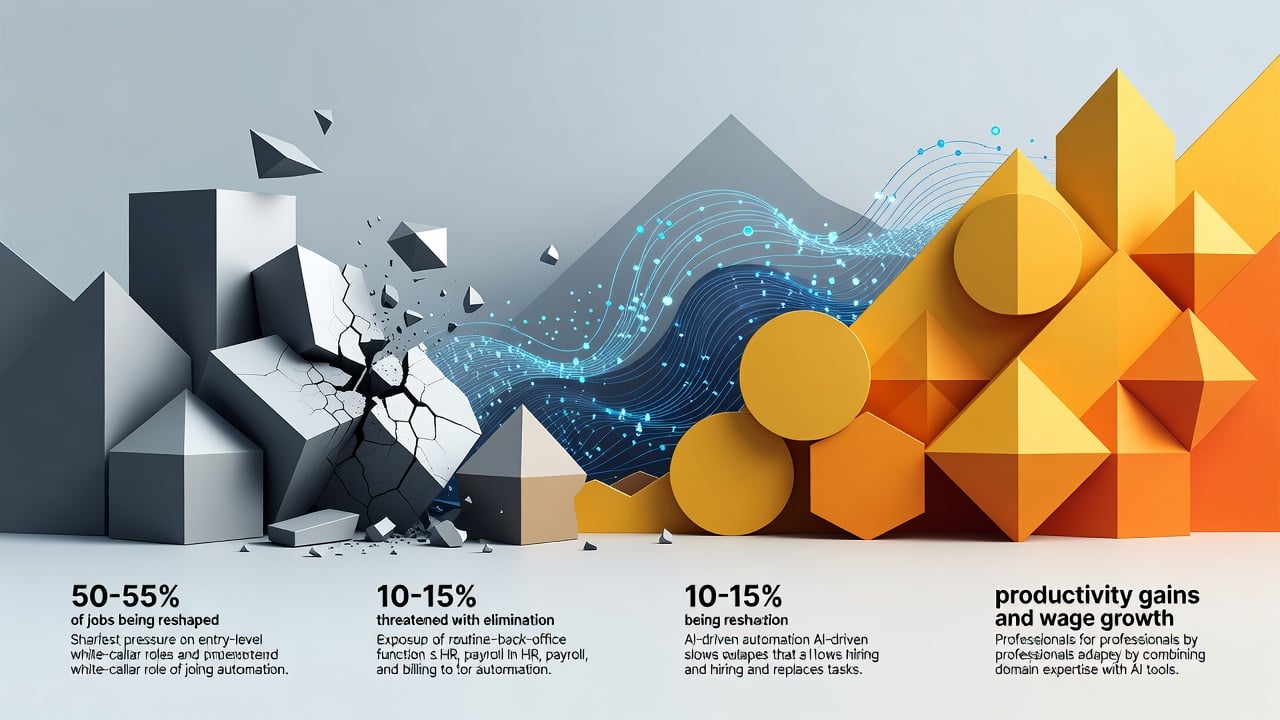
But elimination tells only part of the story. Boston Consulting Group laid out a more nuanced forecast in April 2026. Its analysis concluded that 50% to 55% of U.S. jobs will be reshaped by AI over the next two to three years. Only 10% to 15% face outright vulnerability to elimination in the four-to-five-year window. The firm sorted occupations into categories: amplified roles where AI boosts output, rebalanced ones where tasks shift, and substituted positions where demand stays flat while automation takes over.
Lawyers in advisory and judgment-heavy areas often fall into the amplified group. So do many software engineers. Content marketing roles tend toward rebalancing as budgets constrain output even while tools speed production. Financial analysts and call-center staff appear more exposed to substitution. Insurance sales agents see routine lead qualification and quoting automated, though complex sales still need human touch. The BCG authors stressed one point repeatedly. “Task automation doesn’t equal job loss. Most roles will remain — but will change substantially.”
PwC’s 2026 Global AI Jobs Barometer reinforced this view. It found AI drives higher productivity, wages and job growth in leading companies. The labor market splits into two tracks. Jobs “professionalised” by AI grow twice as fast as those merely “democratised” by the technology, with 42% faster wage growth since 2021. Professionalised roles become more valuable as AI demands greater human expertise on top of machine output. The report offered cautious optimism for workers who adapt.
Entry-level positions have absorbed the first blows. Stanford researchers documented a significant slowdown in hiring for young workers in AI-exposed fields after ChatGPT’s debut. Employment growth for 22-to-24-year-olds in finance, insurance and professional services dropped sharply between late 2022 and mid-2025. A related study from the Stanford Digital Economy Lab described these young professionals as “canaries in the coal mine.” Their job-finding rates collapsed while older workers in the same occupations held steadier.
Jamie Dimon, CEO of JPMorgan Chase, told the World Economic Forum that his bank expects to hire fewer people in coming years because of AI. Other executives echo the sentiment without always naming the technology. Hiring freezes and selective layoffs in marketing, legal, accounting and human resources have become common. Yet some companies have reversed course after discovering limits. Ford rehired 350 engineers in 2026 after an earlier AI-heavy approach led to quality problems and record recalls. The episode illustrated that institutional knowledge and judgment still resist full automation.
Economists debate the pace. Goldman Sachs has estimated AI could expose tasks equivalent to 300 million full-time jobs globally, with a quarter of work hours in the U.S. and Europe potentially automated. The bank’s analysts caution that displaced knowledge workers may struggle to transition into growing low-skill service roles such as home health aides or cleaners. MIT Sloan research from 2025 found that when AI can handle most tasks in a given job, headcount in that role within a company falls about 14%. The effect concentrates on specific functions rather than entire occupations.
The New York Times explored a countervailing force in April 2026. As AI generates more memos, strategy documents and product variants, the human work of coordination, persuasion and reassurance grows in value. Meetings that once seemed wasteful now serve as the glue holding AI-augmented teams together. Workers who master that interpersonal layer may find their roles enhanced rather than diminished. The pattern echoes earlier technology waves. Spreadsheets eliminated armies of manual calculators yet created demand for analysts who could interpret the numbers.
Amazon offers a live case study. CEO Andy Jassy has described layoffs of thousands in middle management as cultural and efficiency moves rather than pure AI plays. Internal memos, however, cite AI-driven workflow improvements that allow leaner teams. The company plans to hire 11,000 interns and recent graduates in 2026. AWS CEO Matt Garman called replacing junior software developers with AI “one of the dumbest things I’ve ever heard.” He argued that eliminating the talent pipeline damages long-term innovation. “You’ve gotta think longer term about the health of a company,” Garman said.
Public sentiment has darkened. A Quinnipiac poll in March 2026 found 70% of Americans believe AI will lead to fewer job opportunities, up from 56% the year before. Thirty percent worry about their own positions. Dark humor circulates online about starting a podcast before joining the “permanent underclass.” A single LinkedIn post warning that “something big is happening” racked up 90 million views on X. Substack essays predicting mass unemployment briefly roiled markets.
Real outcomes will hinge on adoption speed, new demand creation and policy responses. BCG projects meaningful job creation as AI unlocks capabilities and expands markets. PwC sees faster growth in AI-exposed sectors that embrace the technology aggressively. The Dallas Fed noted in early 2026 that overall U.S. employment has risen since ChatGPT’s release even as AI-exposed industries lagged, especially for young workers. Wages in those sectors have not fallen, suggesting productivity gains may eventually lift pay.
Harvard Business School researchers observed a 13% drop in job postings for roles heavy in structured, repetitive tasks after ChatGPT launched. Postings for analytical, technical or creative work rose 20%. The pattern favors workers who combine domain expertise with AI fluency. Translation, customer service and court clerk positions rank high on automation risk according to some analyses. Physicians, teachers and roles requiring complex physical or emotional intelligence remain harder to substitute.
History offers mixed lessons. Previous automation waves displaced routine work while creating higher-value positions. This cycle targets cognitive tasks long considered safe. The speed feels different. Models improve monthly. Investment in legal tech startups such as Harvey AI hit records in 2025. Companies test AI agents that draft contracts, analyze discovery and summarize case law. Similar experiments run inside OpenAI, Google and Anthropic, giving insiders a preview of broader office changes.
Yet full replacement has proven elusive. Ford’s experience with engineering automation showed that edge cases, qualitative judgment and institutional memory resist clean substitution. AI hallucinates. It lacks accountability. Human oversight remains essential in regulated industries, high-stakes decisions and creative strategy. The technology excels at scale and speed. It still needs people to set direction, interpret context and manage exceptions.
The coming years will test adaptability at scale. Reskilling programs, education reform and unemployment support could ease transitions. Without them, the class shock described by Yahoo Finance may deepen. Regions that once lost factories could lose headquarters functions next. College graduates who entered the workforce expecting automatic advancement now compete against tools that perform entry-level analysis in seconds.
Executives face their own balancing act. Short-term cost savings tempt aggressive automation. Long-term capability erosion warns against it. Garman’s insistence on preserving junior pipelines reflects that tension. Companies that treat AI as a pure labor replacement risk hollowing out the very expertise needed to guide the systems. Those that integrate it thoughtfully may amplify human performance and expand output.
The data so far shows no economy-wide collapse. Unemployment sits near 4.3%. Software engineering demand has rebounded in some reports despite coding assistants. Total employment has grown. The pain concentrates among younger workers entering AI-exposed fields and in specific back-office functions. That pattern could widen. Or it could stabilize as new roles emerge around AI governance, prompt engineering, model auditing and ethical oversight.
One conclusion stands out from the research. Change will be uneven, rapid in some functions, gradual in others. Workers who treat AI as a collaborator rather than competitor improve their odds. Organizations that invest in both technology and people stand to gain most. The white-collar reckoning is real. Its final shape remains unwritten.


 WebProNews is an iEntry Publication