
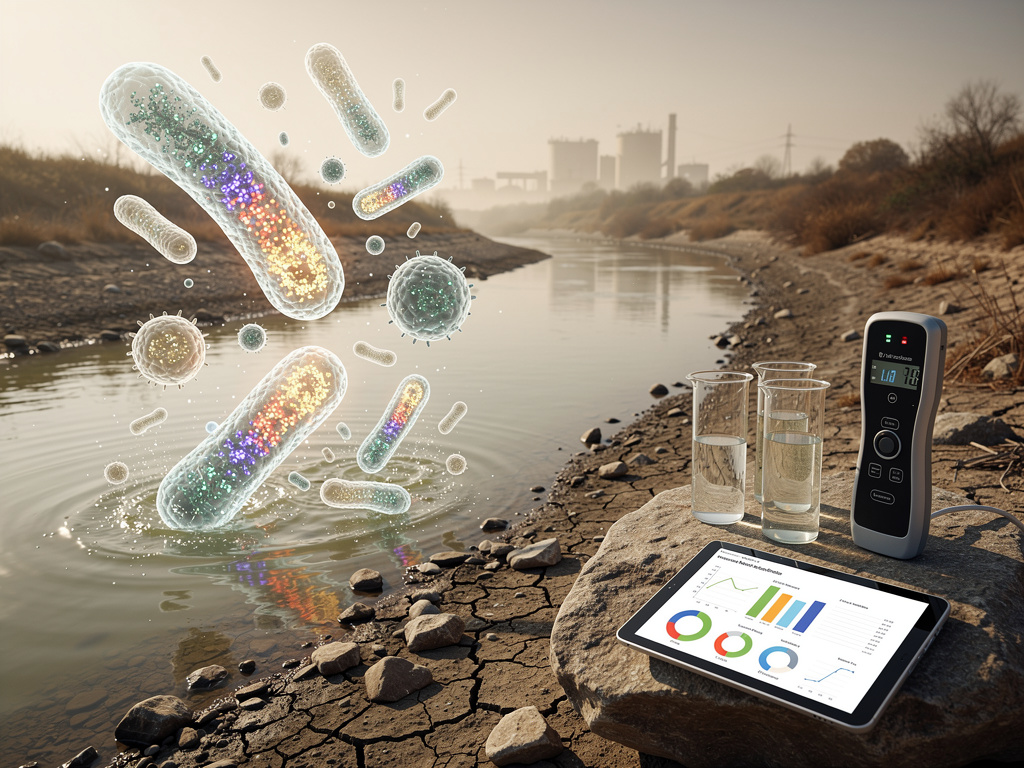
Drought kills crops. It drains reservoirs. It fuels wildfires. And according to a growing body of scientific evidence, it does something far less visible but potentially just as dangerous: it breeds antibiotic-resistant bacteria at alarming rates.
A sweeping new study published in Nature Water has drawn a striking connection between periods of drought and surges in antimicrobial resistance among waterborne pathogens. The research, conducted by an international team led by scientists at the University of Leeds, analyzed data from rivers across England and Wales over a 15-year period. What they found challenges the long-held assumption that antibiotic resistance is primarily a problem of overuse in medicine and agriculture. The environment itself — specifically, how it responds to climate stress — appears to be an accelerant.
As Ars Technica reported, the researchers examined concentrations of antibiotic-resistant Escherichia coli in waterways during and after drought conditions. They found that resistance levels climbed significantly when river flows dropped. The mechanism isn’t mysterious, but it is insidious. During droughts, rivers shrink. The water that remains becomes more concentrated with pollutants, including antibiotics, heavy metals, and resistant bacteria shed from agricultural runoff and wastewater. These concentrated cocktails create ideal conditions for bacteria to swap resistance genes — a process known as horizontal gene transfer.
Think of it as a petri dish that nature builds on its own.
The study’s lead author, Professor Ankur Desai of the University of Leeds, and his colleagues matched hydrological drought indices with microbial sampling data from England’s Environment Agency. They controlled for seasonal variation, temperature, and upstream land use. The correlation held. Drought periods consistently predicted higher proportions of antibiotic-resistant E. coli isolates, with resistance to ampicillin, trimethoprim, and ciprofloxacin all showing statistically significant increases during low-flow conditions.
This matters enormously. The World Health Organization has called antimicrobial resistance one of the top ten global public health threats. An estimated 1.27 million deaths were directly attributable to drug-resistant infections in 2019, according to a landmark study published in The Lancet. That number is projected to climb as resistance spreads. If drought — which climate models predict will become more frequent and severe in many regions — accelerates the problem, then the intersection of climate change and infectious disease just got considerably more complicated.
The findings don’t exist in isolation. Researchers have been accumulating evidence for years that environmental conditions shape resistance patterns. A 2024 study in Environmental Science & Technology demonstrated that warming water temperatures in European rivers correlated with increased prevalence of resistance genes. Work out of China’s Tsinghua University has shown similar dynamics in sediment during dry seasons. But the Leeds-led paper is among the first to systematically link meteorological drought data with resistance trends across a national river network over more than a decade.
So what’s actually happening at the microbial level?
When river volumes drop, the dilution effect that normally disperses contaminants weakens dramatically. Treated and untreated wastewater discharges — which contain trace antibiotics, resistant organisms, and resistance genes — become a larger fraction of total river flow. In some English rivers during peak drought, wastewater effluent can constitute the majority of flow. Bacteria in these concentrated environments encounter sub-lethal antibiotic concentrations: not enough to kill them, but enough to select for resistance. Surviving bacteria pass resistance genes to their neighbors. The population shifts.
Heavy metals compound the problem. Drought concentrates metals like zinc and copper in sediments and water columns. These metals exert co-selection pressure — bacteria that carry metal resistance genes often carry antibiotic resistance genes on the same mobile genetic elements. Select for one, you get the other for free.
Agricultural runoff adds another layer. During droughts, manure and fertilizer applied to fields don’t wash away gradually with rain. Instead, they accumulate. When rains finally return, a pulse of nutrients, antibiotics from livestock treatment, and resistant bacteria floods into waterways all at once. The study found that post-drought rainfall events triggered some of the highest spikes in resistant E. coli concentrations — a kind of rebound effect that the researchers termed “drought-break mobilization.”
England and Wales aren’t unique in facing this dynamic. They’re just where the data happened to be richest. The implications extend to any region where drought intersects with intensive agriculture and aging wastewater infrastructure. That includes large swaths of the American West and Midwest, southern Europe, Australia, India, and sub-Saharan Africa.
The United States faces its own version of this problem. The Colorado River basin, which supplies water to 40 million people, has experienced its worst drought in over a millennium. Municipal wastewater treatment plants along the river and its tributaries discharge effluent that becomes proportionally more significant as flows decline. Meanwhile, concentrated animal feeding operations in drought-prone states generate enormous volumes of antibiotic-laden waste. The conditions described in the Leeds study are not hypothetical in an American context. They’re present.
And the policy response hasn’t caught up.
Current frameworks for managing antimicrobial resistance focus overwhelmingly on clinical settings — hospital stewardship programs, prescription guidelines, surveillance of infections in patients. Environmental dimensions receive a fraction of the funding and attention. The U.S. National Action Plan for Combating Antibiotic-Resistant Bacteria, last updated in 2020, mentions environmental pathways but offers little in the way of concrete monitoring or mitigation strategies tied to hydrological conditions.
The European Union has moved somewhat further. Its 2023 Council Recommendation on antimicrobial resistance includes provisions for environmental monitoring, and the revised Urban Wastewater Treatment Directive will require advanced treatment to remove micropollutants — including antibiotics — at large treatment plants by the 2030s. But implementation timelines are long, and the directive doesn’t specifically address drought-related concentration effects.
Some researchers argue that water quality regulations need to incorporate resistance metrics directly. Currently, most regulatory frameworks monitor E. coli counts as indicators of fecal contamination but don’t assess what proportion of those bacteria carry resistance genes. “We’re counting the bacteria but not asking the right questions about them,” is how one environmental microbiologist at Imperial College London described the gap to Ars Technica.
The Leeds study’s authors propose several practical interventions. First, integrating antimicrobial resistance monitoring into existing hydrological and water quality surveillance networks. The data infrastructure already exists in many countries — what’s missing is the microbial dimension. Second, upgrading wastewater treatment in drought-vulnerable catchments to include tertiary treatment steps that can reduce antibiotic residues and resistant organisms. Third, managing agricultural antibiotic use with drought forecasts in mind, potentially restricting certain applications during predicted dry periods when runoff risk changes character.
None of these are simple. All of them cost money.
But the cost of inaction is staggering. The independent Review on Antimicrobial Resistance, commissioned by the UK government and chaired by economist Jim O’Neill, estimated in 2016 that drug-resistant infections could cause 10 million deaths annually by 2050 and cost the global economy $100 trillion in lost output. Those projections didn’t account for climate-driven amplification of resistance. They may prove conservative.
There’s also a food safety dimension that hasn’t received enough scrutiny. Resistant bacteria in rivers don’t stay in rivers. They contaminate irrigation water used on produce, infiltrate groundwater tapped by wells, and cycle through aquatic food chains. A drought that concentrates resistance in a river used to irrigate lettuce fields creates a direct pathway from environmental resistance reservoirs to the human gut. This isn’t theoretical — studies have repeatedly isolated multidrug-resistant E. coli from retail salad greens irrigated with surface water.
The timing of this research is pointed. Climate projections from the UK Met Office and the Intergovernmental Panel on Climate Change indicate that summer droughts in England will become 25% to 50% more frequent by mid-century under moderate warming scenarios. The American Southwest faces even starker odds. And the Horn of Africa, already reeling from consecutive failed rainy seasons, sits at the intersection of drought severity, limited wastewater infrastructure, and high baseline rates of antibiotic resistance — a convergence that public health systems in the region are ill-equipped to manage.
What makes the drought-resistance link particularly treacherous is its invisibility. A drought’s effects on crops are obvious. Its effects on microbial populations in waterways are not. No one sees resistance genes accumulating in river sediment. No one notices the shift in bacterial population genetics until resistant infections start appearing in clinics — and by then, tracing the environmental origin is nearly impossible. The Leeds study helps make the invisible visible, but translating that visibility into policy action requires political will that has historically been in short supply for slow-moving, complex threats.
The pharmaceutical industry’s retreat from antibiotic development makes the stakes even higher. Only a handful of truly novel antibiotics have reached the market in the past two decades, and the economic incentives for developing new ones remain broken. If environmental conditions are accelerating the erosion of existing antibiotics’ effectiveness, the gap between resistance and treatment options widens faster than anyone’s pipeline can fill it.
There is, at least, a growing recognition that climate change and antimicrobial resistance can’t be addressed in separate silos. The Quadripartite — a joint initiative of the WHO, the Food and Agriculture Organization, the World Organisation for Animal Health, and the UN Environment Programme — has begun framing antimicrobial resistance as a One Health issue with explicit environmental dimensions. Their 2023 global action plan update acknowledges climate as a driver. But acknowledgment and action remain miles apart.
The science is becoming harder to ignore. Drought breeds concentration. Concentration breeds resistance. Resistance breeds treatment failure. And climate change breeds drought. It’s a chain reaction that doesn’t require any single dramatic event to cause enormous harm — just the slow, steady tightening of conditions that favor the most dangerous microbes on the planet.
For water utilities, agricultural regulators, and public health agencies, the message from this research is blunt: the next drought isn’t just a water supply problem. It’s an antibiotic resistance problem. And the window for getting ahead of it is narrowing with every dry season that passes.


 WebProNews is an iEntry Publication