
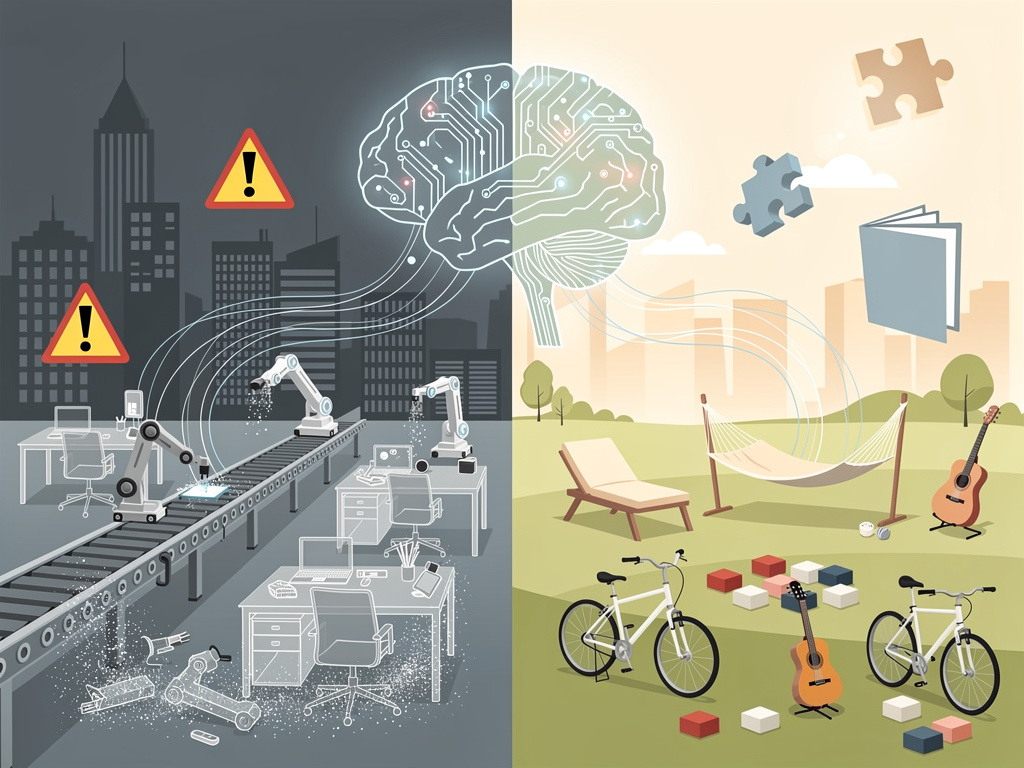
A Nobel Prize-winning economist now agrees with two of the world’s most prominent technologists: artificial intelligence is going to eliminate most human jobs, and it’s going to happen faster than almost anyone in policy circles is prepared to admit.
Christopher Pissarides, who won the 2010 Nobel Memorial Prize in Economic Sciences for his work on labor market friction and unemployment, told audiences at a recent event that Elon Musk and Bill Gates are essentially correct — the world should brace for an era in which traditional employment becomes optional for large portions of the population. His prescription isn’t panic. It’s preparation. And a fundamental rethinking of what human life looks like when work is no longer its organizing principle.
“We won’t need to work to earn a living,” Pissarides said, as reported by Talk Android. The statement, from a scholar whose entire career has been devoted to understanding how labor markets function, carries a weight that Silicon Valley predictions alone do not.
The Convergence of Billionaire Futurism and Academic Economics
For years, warnings about AI-driven job displacement came primarily from two camps that mainstream economists largely dismissed: technologists with products to sell and futurists with books to promote. Musk has repeatedly warned that AI represents an existential challenge to the traditional employment model. Gates has echoed similar sentiments, arguing that governments need to start thinking about taxation of robot labor and redistribution of AI-generated wealth. Both men have advocated for some form of universal basic income as a buffer against mass technological unemployment.
Academic economists, by contrast, have historically been more sanguine. The standard rebuttal has been simple and historically grounded: technology has always displaced jobs in the short run while creating new categories of employment in the long run. The automobile destroyed the horse-and-buggy industry but created millions of jobs in manufacturing, road construction, suburban development, and logistics. The internet wiped out travel agencies and record stores but spawned entirely new industries worth trillions.
Pissarides isn’t buying that analogy anymore. Not entirely.
His argument, as reported by Talk Android, centers on the idea that AI is qualitatively different from previous technological disruptions. Earlier waves of automation replaced human muscle. AI replaces human cognition. And the pace of improvement in large language models, computer vision, and autonomous systems suggests that the window for workforce adaptation is shrinking dramatically.
This isn’t a fringe position among economists any longer. A growing body of research supports the idea that this time really might be different. A 2023 Goldman Sachs report estimated that generative AI could automate the equivalent of 300 million full-time jobs globally. McKinsey Global Institute projected that by 2030, up to 30% of hours currently worked in the United States could be automated by AI — a figure the consultancy revised upward from earlier estimates. The International Monetary Fund published analysis in January 2024 suggesting that AI will affect roughly 40% of all jobs worldwide, with advanced economies facing the greatest exposure.
What makes Pissarides’s intervention significant is his credibility on exactly this subject. His Nobel-winning research modeled how job seekers and employers find each other, how labor markets clear (or fail to), and what happens during structural transitions. When he says the coming transition is unlike anything his models were built to handle, it’s not hyperbole. It’s a diagnostic assessment from someone who built the diagnostic tools.
The implications extend far beyond unemployment statistics. Pissarides has suggested that societies need to begin conceptualizing a world where leisure, not labor, forms the backbone of daily life. That means rethinking education, social status, mental health infrastructure, and the very concept of personal identity — all of which, in Western economies, are deeply entangled with employment.
Consider the psychological dimension alone. Studies have consistently shown that involuntary unemployment correlates with depression, substance abuse, family dissolution, and even increased mortality. But these findings reflect a world where joblessness is stigmatized and economically devastating. If AI-generated abundance makes material needs easily met, does unemployment still carry the same psychological toll? Or does it become something closer to retirement — a state that most people, given adequate resources, find liberating rather than crushing?
Nobody knows. And that uncertainty is precisely the problem.
Policy Vacuums and Political Paralysis
The policy response to AI-driven labor disruption has been, to put it charitably, inadequate. In the United States, the conversation remains stuck in a loop: Republicans generally argue that markets will adapt on their own, while Democrats propose retraining programs modeled on 20th-century assumptions about the pace of technological change. Neither approach grapples seriously with the possibility that retraining is futile when the target keeps moving — when the jobs you’re training people for might themselves be automated within a few years of the training’s completion.
Universal basic income, the policy most frequently associated with the AI displacement thesis, has seen limited real-world testing. Finland ran a two-year experiment from 2017 to 2018, giving 2,000 unemployed citizens €560 per month with no conditions. Participants reported better well-being and modest improvements in employment outcomes, but the experiment was too small and too short to draw definitive conclusions. Stockton, California, ran a similar pilot under then-Mayor Michael Tubbs. Results were encouraging but, again, limited in scale.
The political obstacles are enormous. UBI is expensive. A program providing every American adult $1,000 per month would cost roughly $3 trillion annually — more than the entire federal discretionary budget. Proponents argue that AI-driven productivity gains would generate sufficient tax revenue to fund such programs, but that assumes governments can actually capture that revenue from corporations with armies of tax attorneys and the ability to domicile profits in favorable jurisdictions.
Musk has proposed that AI companies themselves should fund the transition, though specifics remain vague. Gates has suggested a “robot tax” — essentially taxing automated labor at rates comparable to the income taxes that displaced human workers would have paid. The idea has intuitive appeal but faces fierce opposition from the technology industry, which argues that such taxes would slow innovation and push AI development to less regulated countries.
Pissarides, for his part, has emphasized that the transition need not be dystopian. The key variable, he argues, is whether societies plan for the shift or simply let it happen. Planned transitions can distribute the gains from AI broadly, funding public goods, shortening work weeks, and expanding access to education, healthcare, and creative pursuits. Unplanned transitions concentrate wealth among AI owners while leaving displaced workers to fend for themselves.
History offers cautionary examples of both. The post-World War II era in the United States saw massive government investment in education (the GI Bill), infrastructure (the Interstate Highway System), and housing (FHA loans), which distributed the gains of industrial productivity broadly and created the modern middle class. The deindustrialization of the 1970s and 1980s, by contrast, was largely unmanaged, devastating communities across the Rust Belt in ways that still reverberate politically today.
The AI transition is happening orders of magnitude faster than deindustrialization did. Entire white-collar professions — legal research, financial analysis, medical diagnostics, software development, content creation — are seeing AI tools perform at or near human levels within the span of months, not decades. The acceleration shows no signs of slowing.
Recent developments underscore the pace. OpenAI, Google DeepMind, and Anthropic have all released or announced models with significantly expanded capabilities in 2025. Coding assistants now handle substantial portions of software engineering workflows. AI agents are beginning to perform multi-step business processes autonomously. Customer service, data entry, and basic accounting are already being automated at scale across Fortune 500 companies.
And it’s not just routine work. Creative fields — long assumed to be the last bastion of human economic advantage — are feeling the pressure. AI-generated art, music, and writing have reached quality levels that blur the line between human and machine output. Hollywood’s 2023 strikes were, in significant part, about AI’s encroachment on writing and acting. The settlement terms included some protections, but few in the industry believe those guardrails will hold for more than a few years.
The Leisure Question Nobody Wants to Answer
Perhaps the most provocative element of Pissarides’s thesis is his emphasis on leisure. Not as a consolation prize for the unemployed, but as the actual point. The end goal.
This is where the economics profession meets philosophy, and where most policy discussions fall silent. Western culture — American culture in particular — has so thoroughly conflated personal worth with productive employment that imagining an alternative feels almost heretical. “What do you do?” is the first question Americans ask each other at social gatherings. Strip away the answer, and many people genuinely don’t know who they are.
But Pissarides argues that this is a cultural artifact, not a human constant. For most of history, the leisure class was the aristocracy — and they didn’t seem to suffer from an identity crisis. The ancient Greeks considered labor degrading; philosophy, athletics, and civic participation were the proper pursuits of free citizens (the fact that this freedom depended on slave labor is, of course, the uncomfortable asterisk on the whole model).
The question is whether modern democracies can construct a version of mass leisure that doesn’t replicate ancient hierarchies — one where AI plays the role that slaves and serfs played in previous civilizations, but without the moral catastrophe. It’s a question that sounds utopian until you realize that the alternative — billions of people rendered economically superfluous with no plan for what comes next — sounds considerably worse.
Some early signals are encouraging. The four-day work week trials conducted across the UK in 2022 and 2023 showed that most participating companies maintained or increased productivity while employees reported dramatically improved well-being. Iceland ran similar trials between 2015 and 2019 with comparable results. These experiments suggest that humans can, in fact, handle more free time without falling apart — provided they have financial security and social connection.
But a four-day work week is a modest reform compared to what Pissarides and others are describing. They’re talking about a world where most people work zero days per week. Or perhaps contribute a few hours to community projects and creative endeavors, not because they must, but because they choose to. The gap between a four-day work week and a zero-day work week is not just quantitative. It’s qualitative. It changes everything about how societies organize themselves.
Education would need to shift from job preparation to life preparation — teaching people how to think, create, relate, and find meaning independent of economic productivity. Healthcare systems would need to address the mental health challenges of purposelessness, which could become epidemic if the transition is mishandled. Urban planning would change. Transportation patterns would change. The entire rhythm of daily life would change.
So would politics. Work has historically been a powerful social stabilizer. People with jobs have schedules, colleagues, responsibilities, and stakes in the existing order. People without those things have time, grievances, and the internet. The political implications of mass technological unemployment — even well-funded mass technological unemployment — are difficult to overstate. Every populist movement of the past decade has drawn energy from communities where traditional employment has eroded. Scale that up, and the political consequences become unpredictable.
None of this is inevitable in any particular form. Technology doesn’t dictate social outcomes; policy choices do. But policy choices require political will, and political will requires public understanding of what’s coming. Right now, that understanding is thin. Most voters, most legislators, and most business leaders are still operating on the assumption that AI is a tool that will augment human workers, not replace them. Pissarides, Musk, and Gates are all saying the same thing: that assumption is wrong, and the sooner we abandon it, the better our chances of managing what comes next.
The Nobel laureate’s endorsement of the billionaires’ thesis doesn’t settle the debate. But it shifts the burden of proof. The question is no longer whether AI will fundamentally alter the relationship between humans and work. It’s whether we’ll be ready when it does.


 WebProNews is an iEntry Publication