
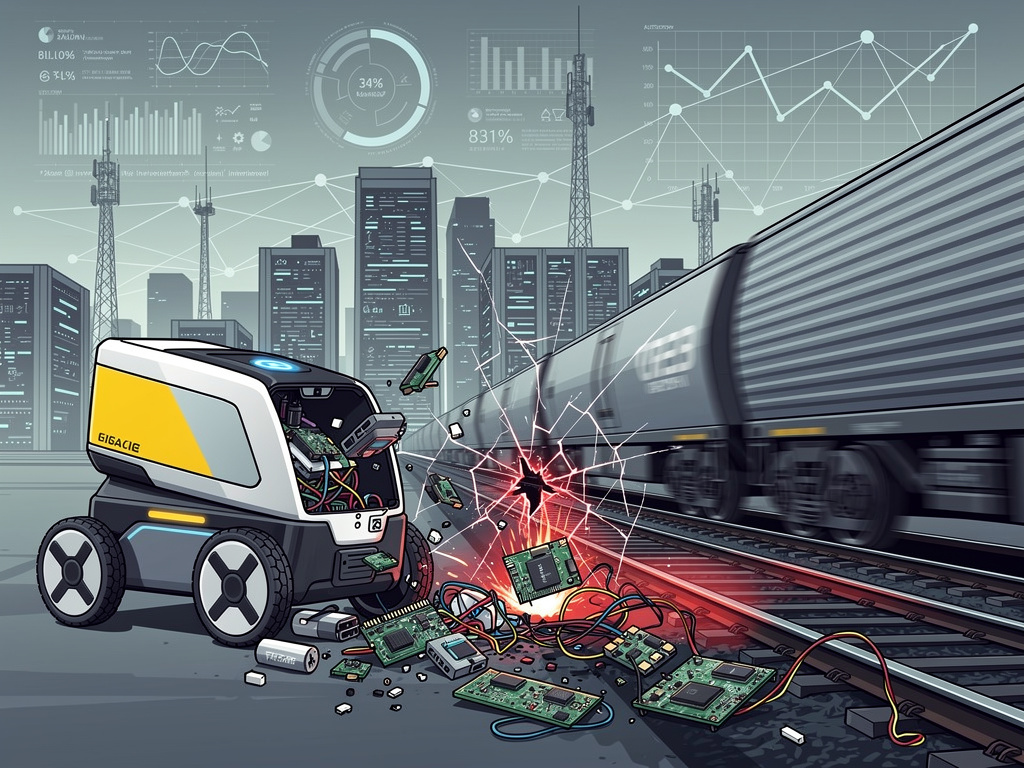
The grainy security footage tells a story that has become uncomfortably familiar in the age of autonomous delivery: a small, boxy robot approaches a railroad crossing, its sensors presumably scanning the environment. Moments later, a freight train barrels through the intersection, reducing the delivery bot to scattered debris. The incident, which occurred in late 2024 and was first reported by Futurism, has reignited a critical debate about the readiness of autonomous delivery systems to navigate complex urban infrastructure—particularly when that infrastructure includes one of humanity’s oldest transportation technologies: trains.
The destroyed robot, believed to be operated by one of several companies currently testing sidewalk delivery systems in American cities, represents more than just a loss of equipment and cargo. It symbolizes a broader technological challenge that the autonomous delivery industry has struggled to address: how to safely integrate slow-moving ground robots into environments designed for human judgment and split-second decision-making. While the specific company involved has not been officially confirmed, the incident bears the hallmarks of failures that have plagued multiple operators in the rapidly expanding autonomous delivery sector.
The Invisible Danger: Why Robots Struggle With Railroad Crossings
Railroad crossings present a unique challenge for autonomous systems that differs fundamentally from other traffic scenarios. Unlike intersections with traffic lights or stop signs, railroad crossings require vehicles to detect approaching trains through a combination of visual, auditory, and sometimes vibrational cues. Human drivers rely on flashing lights, warning bells, and the distinctive rumble of an approaching locomotive. They also possess the contextual awareness to recognize that a lowering crossing gate means imminent danger, even if they cannot yet see or hear the train itself.
Autonomous delivery robots, by contrast, typically rely on a suite of sensors including cameras, LIDAR, and GPS to navigate their environments. While these systems excel at detecting static obstacles and even moving vehicles on roads, they can struggle with the specific challenge of train detection. Trains approach on fixed rails, often at high speeds, and may not register as threats in the same way that a car or pedestrian would. The acoustic signature of a train can be difficult for microphones to isolate from urban noise, and visual detection systems may struggle with the angles and sightlines typical of railroad crossings, especially in areas where vegetation or buildings obscure the tracks.
A Pattern of Perilous Encounters
This incident is far from isolated. The autonomous delivery industry has witnessed a troubling series of encounters between robots and trains, though many have not resulted in complete destruction. In several documented cases, delivery robots have become stuck on tracks, requiring human intervention to remove them before trains arrived. In others, robots have attempted to cross active railroad tracks despite warning signals, only to be saved by emergency braking systems on the trains themselves or by alert human observers who manually stopped the robots.
The problem extends beyond just railroad crossings. Autonomous delivery robots have demonstrated difficulties with a range of infrastructure challenges that human couriers navigate instinctively. Robots have been found stuck in mud, trapped by curbs they misjudged, and unable to navigate construction zones that would pose minimal challenges to human workers. These failures suggest that while the technology has advanced significantly in controlled environments, real-world deployment reveals gaps in situational awareness that could take years to resolve through software updates and improved sensor arrays.
The Economics of Autonomous Delivery at a Crossroads
The financial stakes in autonomous delivery are substantial. Companies like Starship Technologies, Serve Robotics, and Amazon’s Scout program have collectively raised hundreds of millions of dollars based on the promise that autonomous robots could revolutionize last-mile delivery. The economic argument is compelling: robots don’t require wages, benefits, or breaks, and they can theoretically operate around the clock. In an era of rising labor costs and increasing demand for rapid delivery, the potential savings are enormous.
However, incidents like the train collision force a recalculation of these economic projections. Each destroyed robot represents a capital loss that can range from $5,000 to $20,000 or more, depending on the sophistication of the unit. More significantly, these incidents create liability exposure that could dwarf the cost of the robots themselves. If a delivery robot’s presence on tracks causes a train to brake suddenly or take evasive action, the resulting delays and potential safety risks could expose operators to significant legal and financial consequences. Insurance costs for autonomous delivery operations have already begun to reflect these risks, with some operators reporting premiums that significantly impact their unit economics.
Regulatory Reckoning and Municipal Pushback
Cities and towns across America are increasingly questioning whether they moved too quickly in welcoming autonomous delivery robots to their streets and sidewalks. The regulatory framework for these devices remains a patchwork of local ordinances, many of which were written before the full scope of operational challenges became apparent. Some municipalities approved pilot programs with minimal safety requirements, eager to position themselves as technology-friendly and innovative. The reality of robots blocking sidewalks, interfering with accessibility, and now colliding with trains has prompted a reassessment.
Pittsburgh, Pennsylvania, which was an early adopter of delivery robot testing, has implemented stricter rules requiring human monitors to maintain visual contact with robots during operation. San Francisco has capped the number of delivery robots allowed to operate simultaneously and requires detailed incident reporting. These regulatory changes reflect a growing recognition that autonomous delivery technology may need more oversight than initially anticipated. Railroad safety authorities, including the Federal Railroad Administration, are now examining whether specific regulations are needed to prevent autonomous vehicles—including delivery robots—from creating hazards at grade crossings.
The Human Element: What Robots Cannot Replicate
The train collision underscores a fundamental truth about human cognition that artificial intelligence has yet to fully replicate: the ability to recognize and respond to novel dangerous situations through intuition and common sense. A human delivery worker approaching a railroad crossing processes multiple streams of information simultaneously—the visual cue of flashing lights, the auditory warning of bells, the kinesthetic sense of vibration through the ground, and the learned knowledge that trains are massive, fast-moving objects that cannot stop quickly. This multi-modal processing happens almost instantaneously and triggers an immediate threat response.
Current autonomous systems, while sophisticated, process information more sequentially and rely on pattern recognition trained from existing data sets. If a robot’s training data doesn’t include sufficient examples of railroad crossing scenarios—or if the specific configuration of a crossing differs from those in its training—the system may fail to recognize the danger until it’s too late. This limitation extends beyond just physical safety. Human delivery workers make countless micro-decisions throughout their routes: choosing to wait for a safer crossing opportunity, recognizing when weather conditions make certain paths hazardous, or identifying when a package should not be left in a particular location due to security concerns. These judgment calls represent a form of intelligence that remains difficult to encode in algorithms.
Engineering Solutions and Their Limitations
In response to incidents like the train collision, autonomous delivery companies are pursuing several technological solutions. Enhanced sensor fusion—combining data from multiple sensor types to create more robust environmental models—represents one approach. By integrating radar capable of detecting large metal objects at greater distances, robots might gain earlier warning of approaching trains. Improved mapping systems that specifically flag railroad crossings as high-risk zones requiring extra caution offer another potential improvement. Some companies are exploring vehicle-to-infrastructure communication systems that would allow railroad crossing signals to directly communicate with autonomous robots, providing an additional layer of safety.
However, each of these solutions adds cost and complexity to systems that must remain economically viable to achieve widespread deployment. More sophisticated sensor arrays increase both the purchase price of robots and their maintenance requirements. Enhanced processing power to handle additional data streams draws more power, reducing operational range and increasing charging downtime. The economics of autonomous delivery depend on robots being simple, reliable, and cheap enough to deploy at scale. Safety enhancements that significantly increase costs threaten the fundamental business model, potentially making human delivery workers more economically attractive despite their higher ongoing labor costs.
The Path Forward: Hybrid Models and Realistic Expectations
The collision between delivery robot and train may ultimately prove to be a catalyst for a more realistic assessment of autonomous delivery’s near-term potential. Rather than fully autonomous operation in all environments, the industry appears to be moving toward hybrid models that combine robotic efficiency with human oversight for high-risk situations. Some companies now employ remote operators who can take control of robots when they encounter challenging scenarios, including railroad crossings. Others are limiting deployment to routes that have been extensively mapped and verified to be free of particularly hazardous infrastructure.
This evolution toward more conservative deployment strategies may disappoint investors who were promised rapid disruption of the delivery industry, but it represents a maturation of the technology sector’s approach to real-world robotics. The gap between controlled testing environments and the chaotic reality of urban infrastructure has proven wider than many anticipated. Success in autonomous delivery may ultimately depend not on creating robots that can handle every possible scenario, but on carefully selecting deployment environments where the technology’s current capabilities align with operational requirements. Railroad crossings, it seems, will remain in the domain of human judgment for the foreseeable future.
Implications for the Broader Autonomous Vehicle Industry
The challenges facing autonomous delivery robots offer sobering lessons for the wider autonomous vehicle industry. While self-driving cars operate at higher speeds and carry passengers, making their safety requirements more stringent, they face many of the same fundamental challenges in perceiving and responding to complex, dynamic environments. Railroad crossings have proven problematic for autonomous passenger vehicles as well, with several documented incidents of self-driving test vehicles failing to properly navigate grade crossings. The relatively low stakes of a delivery robot collision—no human occupants are at risk—make these incidents valuable learning opportunities for the entire autonomous transportation sector.
The incident also highlights the importance of edge cases in autonomous system design. Engineers in the field often note that achieving 90% reliability in autonomous systems is relatively straightforward, but the final 10%—the unusual scenarios, the unexpected configurations, the novel situations—proves exponentially more difficult. Railroad crossings represent exactly this type of edge case: common enough that autonomous systems will inevitably encounter them, but varied enough in their implementation and context that creating robust detection and response algorithms remains challenging. Until the industry solves these edge case problems, full autonomy will remain elusive, regardless of how well systems perform in more routine situations.


 WebProNews is an iEntry Publication