
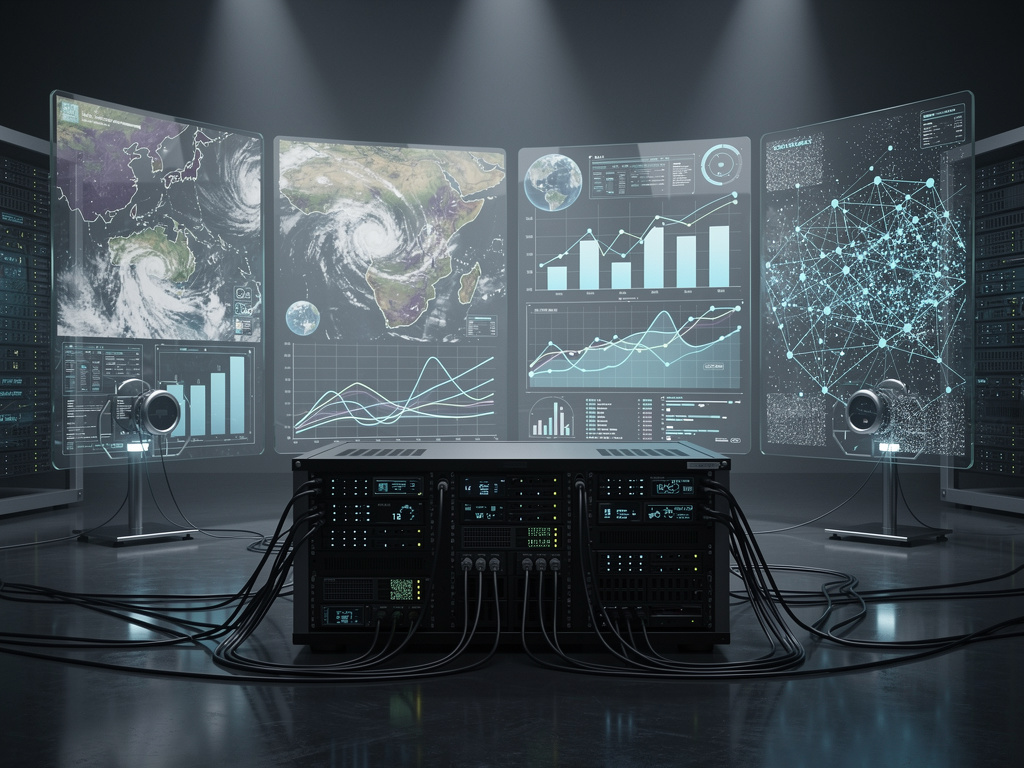
The artificial intelligence industry has developed an unusual obsession with predicting its own future, and nowhere is this more evident than in the proliferation of AI-powered forecasting tools attempting to peer into 2026. As machine learning models grow increasingly sophisticated at pattern recognition and data analysis, technology companies are betting that these same capabilities can unlock reliable long-term predictions about everything from weather patterns to economic trends. Yet this confidence in computational foresight raises fundamental questions about the limits of algorithmic prediction and whether AI has truly transcended the constraints that have historically made long-range forecasting notoriously unreliable.
According to CNET, several major AI platforms have recently unveiled prediction engines specifically designed to forecast conditions two years into the future, marking a significant departure from the shorter time horizons that have traditionally defined machine learning applications. These systems leverage vast datasets spanning decades of historical information, from meteorological records to financial market data, training neural networks to identify cyclical patterns and recurring trends that might indicate future states. The timing of these releases suggests a growing confidence within the AI sector that current models have achieved sufficient sophistication to make meaningful multi-year projections.
The technical architecture underlying these forecasting systems represents a substantial evolution from earlier prediction models. Rather than relying solely on statistical regression or simple pattern matching, contemporary AI forecasters employ ensemble methods that combine multiple neural network architectures, each specialized for different aspects of temporal analysis. These systems incorporate transformer models originally developed for natural language processing, recurrent neural networks optimized for sequential data, and specialized attention mechanisms that can weigh the relative importance of different historical periods when making forward-looking assessments.
The Meteorological Testing Ground for Long-Range AI Prediction
Weather forecasting has emerged as the primary proving ground for AI’s long-range prediction capabilities, offering a domain where success or failure can be objectively measured against eventual reality. Traditional meteorological models, which rely on physics-based simulations of atmospheric dynamics, have historically struggled to maintain accuracy beyond ten days due to the chaotic nature of weather systems. AI advocates argue that machine learning approaches can potentially extend this horizon by identifying subtle patterns in historical weather data that physics-based models might overlook, essentially learning from decades of observational records rather than attempting to simulate every molecular interaction in the atmosphere.
Several research institutions and private companies have reported promising results from AI weather models operating at medium-range timescales of one to two weeks, demonstrating accuracy comparable to or exceeding traditional numerical weather prediction systems. Google’s DeepMind, for instance, has published research showing that its GraphCast model can generate ten-day forecasts in under one minute while matching or surpassing the accuracy of the European Centre for Medium-Range Weather Forecasts, a system that requires hours of computation on supercomputers. These successes have fueled optimism that similar approaches might extend to seasonal or even multi-year climate predictions.
However, atmospheric scientists caution that extending AI prediction capabilities from weeks to years introduces qualitatively different challenges. Weather systems operate on timescales where initial conditions matter enormously, creating the famous “butterfly effect” where small measurement errors can cascade into completely divergent forecasts. Climate patterns operating over years or decades, by contrast, are influenced more by slower-moving factors like ocean temperatures, solar cycles, and atmospheric composition—domains where AI must compete with well-established climate models that incorporate fundamental physics rather than purely statistical relationships.
Economic Forecasting Enters the Neural Network Era
Financial institutions and economic research organizations have begun deploying AI systems for multi-year economic forecasting, seeking to predict everything from GDP growth rates to commodity prices two years hence. These applications represent particularly high-stakes territory, as accurate economic predictions could generate enormous financial advantages for institutions that achieve even marginal improvements over conventional forecasting methods. Major investment banks have quietly integrated machine learning models into their economic research divisions, training neural networks on decades of macroeconomic indicators, corporate earnings reports, central bank communications, and even alternative data sources like satellite imagery of shipping activity or social media sentiment.
The theoretical appeal of AI-driven economic forecasting rests on the assumption that machine learning systems can detect complex, non-linear relationships between economic variables that might elude traditional econometric models. Human economists typically build forecasting models based on explicit theories about how different economic factors interact—how interest rates influence investment decisions, how employment affects consumer spending, and so forth. AI systems, by contrast, can potentially discover predictive relationships in the data without requiring these relationships to conform to pre-existing economic theories, identifying correlations that human analysts might never hypothesize.
Yet skeptics point out that economic systems are fundamentally different from physical systems like weather, being subject to reflexivity—the phenomenon where predictions themselves can alter the outcomes they forecast. If an AI system predicts a recession in 2026 and that prediction becomes widely believed, businesses might curtail investment and consumers might reduce spending, potentially creating the very recession that was predicted. This reflexive quality makes economic forecasting inherently more challenging than predicting physical phenomena, as the act of prediction becomes part of the causal chain determining the outcome.
The Training Data Dilemma and Historical Bias
A fundamental challenge confronting all long-range AI prediction systems involves the quality and relevance of historical training data. Machine learning models learn by identifying patterns in past data, operating under the assumption that relationships observed historically will continue to hold in the future. This assumption becomes increasingly problematic when forecasting multiple years ahead, particularly in domains undergoing rapid structural change. An AI system trained on economic data from the pre-internet era, for instance, might fail to capture how digital platforms have fundamentally altered market dynamics, just as a climate model trained exclusively on pre-industrial data would miss the accelerating effects of anthropogenic greenhouse gas emissions.
The problem extends beyond simple data staleness to more subtle forms of historical bias. If an AI weather prediction system is trained primarily on data from the Northern Hemisphere, it may perform poorly when forecasting conditions in the Southern Hemisphere, where different seasonal patterns and oceanic influences dominate. Similarly, economic forecasting models trained during periods of low inflation and stable interest rates—as characterized much of the 2010s—may struggle to make accurate predictions during periods of monetary volatility, having never encountered similar conditions during their training phase.
Technology companies developing these systems have responded by implementing various strategies to mitigate training data limitations. Some employ transfer learning techniques, where models trained on abundant data from one domain are adapted to make predictions in related domains with sparser data. Others use synthetic data generation, creating artificial training examples that simulate conditions the model has never directly observed. However, these approaches introduce their own risks, potentially teaching AI systems to recognize patterns that exist only in simulated data rather than reality.
Uncertainty Quantification and the Confidence Problem
One of the most significant technical challenges in long-range AI forecasting involves accurately quantifying uncertainty—communicating not just what the model predicts, but how confident it is in that prediction and what range of alternative outcomes remain plausible. Early AI prediction systems often provided single-point forecasts without meaningful uncertainty estimates, essentially presenting their best guess without acknowledging the inherent unpredictability of complex systems. This approach proved problematic when users treated these forecasts as certainties rather than probability-weighted scenarios, making decisions based on overconfidence in AI predictions.
Contemporary forecasting systems have begun incorporating probabilistic outputs, generating not just a single predicted value but entire probability distributions representing the range of possible outcomes. These systems might predict, for instance, that there is a 40% chance of above-average temperatures in a particular region during summer 2026, a 35% chance of near-average temperatures, and a 25% chance of below-average temperatures. This probabilistic framing more honestly represents the inherent uncertainty in long-range predictions, acknowledging that even sophisticated AI systems cannot eliminate the fundamental unpredictability of complex systems.
However, effectively communicating probabilistic forecasts to end users remains an ongoing challenge. Research in decision science has repeatedly demonstrated that humans struggle to reason effectively about probabilities, often interpreting a 70% chance of rain as either a guarantee of precipitation or dismissing it as essentially uncertain. When AI systems provide probabilistic forecasts extending two years into the future, these cognitive difficulties compound, as users must simultaneously grapple with both probabilistic reasoning and the extended time horizon.
Regulatory Scrutiny and Accountability Questions
As AI prediction systems begin influencing consequential decisions—from infrastructure investments based on climate forecasts to monetary policy informed by economic predictions—regulatory bodies have started questioning the accountability frameworks surrounding these technologies. Unlike traditional forecasting methods, where the assumptions and methodologies can be explicitly documented and reviewed, many AI systems operate as black boxes, making predictions through neural network architectures containing billions of parameters whose individual contributions to the final forecast remain opaque even to their creators.
This opacity creates significant challenges for establishing accountability when predictions prove inaccurate. If a government agency makes costly infrastructure decisions based on an AI climate forecast that fails to materialize, who bears responsibility—the agency that relied on the forecast, the company that developed the AI system, or the data providers whose information trained the model? Traditional forecasting methods, despite their limitations, at least offer transparent methodologies that can be audited and critiqued. AI systems, by contrast, may provide superior accuracy on average while offering far less insight into why they make particular predictions or how their forecasts should be weighted against other information sources.
Some jurisdictions have begun developing regulatory frameworks specifically addressing AI-powered decision systems, including forecasting applications. The European Union’s proposed AI Act, for instance, would classify certain high-stakes prediction systems as “high-risk” applications subject to stringent transparency and documentation requirements. These regulations would require AI developers to maintain detailed records of training data, model architectures, and validation procedures, creating an audit trail that could be examined if predictions prove systematically biased or inaccurate.
The Philosophical Question of Predictability Itself
Beyond the technical and regulatory challenges, the proliferation of long-range AI forecasting raises deeper philosophical questions about the nature of predictability and the limits of computational foresight. Complex systems theory suggests that certain phenomena may be inherently unpredictable beyond specific time horizons, not because of measurement limitations or computational constraints, but because of fundamental properties of the systems themselves. Weather systems, economic markets, and ecological networks all exhibit characteristics—including non-linearity, feedback loops, and emergent behavior—that may impose hard limits on predictability regardless of how sophisticated our forecasting tools become.
This perspective suggests that the current enthusiasm for AI-powered long-range forecasting may represent a form of technological optimism that underestimates these fundamental constraints. Even if AI systems can identify subtle patterns in historical data and process information at scales impossible for human analysts, they remain subject to the same basic limitations that have always constrained prediction: the fact that complex systems can evolve in ways that have no precedent in their historical record, that small perturbations can cascade into large effects, and that the future is not simply a recombination of the past.
Proponents counter that this skepticism may itself reflect outdated assumptions about what constitutes predictability. They argue that AI systems are not simply extrapolating historical trends but learning fundamental relationships and dynamics that transcend specific historical contexts. A sufficiently advanced AI climate model, for instance, might learn underlying physical principles about how energy flows through atmospheric systems, enabling predictions that remain valid even under novel conditions. Whether this optimistic vision proves correct will likely become clearer as the 2026 forecasts these systems are now generating can be compared against actual outcomes.
Industry Investment Patterns Reveal Strategic Priorities
The pattern of corporate investment in AI forecasting technology reveals strategic calculations about where long-range prediction might generate the greatest competitive advantages. Energy companies have poured resources into AI systems predicting renewable energy generation years in advance, seeking to optimize long-term infrastructure investments in wind and solar facilities. Agricultural corporations are developing AI platforms forecasting crop yields and climate conditions multiple growing seasons ahead, information that could inform decisions about which crop varieties to develop and where to concentrate production capacity.
Insurance companies represent another sector making substantial investments in long-range AI prediction, particularly for climate-related forecasting that could inform underwriting decisions and risk pricing. The ability to accurately predict regional climate trends two years ahead could provide significant advantages in pricing policies and managing exposure to weather-related claims. Some insurers have begun partnering with AI research labs to develop proprietary forecasting models, viewing prediction capabilities as potential sources of competitive advantage rather than commoditized services purchased from third-party vendors.
These investment patterns suggest that industry leaders view long-range AI forecasting not as a speculative technology but as an emerging capability with near-term commercial applications. The question is whether this confidence is justified by the actual capabilities of current systems or whether it represents premature optimism about technologies that have yet to demonstrate consistent accuracy over multi-year horizons. As these systems begin generating verifiable predictions about 2026 conditions, the coming years will provide crucial evidence about whether AI has truly achieved a breakthrough in long-range forecasting or whether the fundamental limits of prediction remain firmly in place.


 WebProNews is an iEntry Publication