
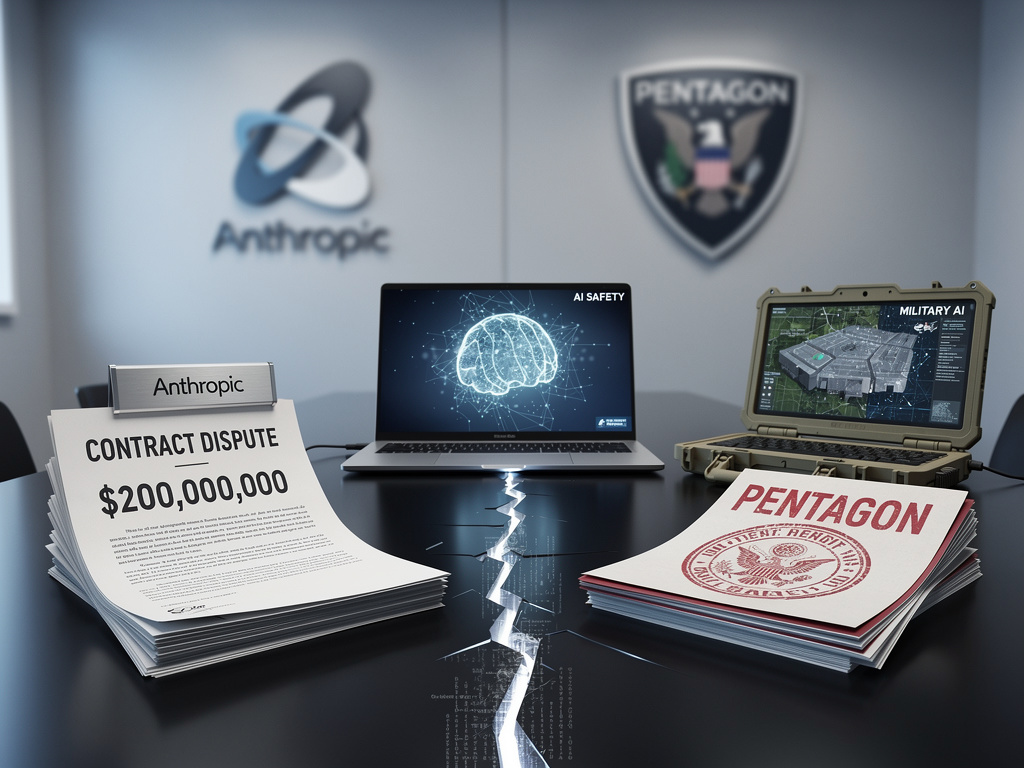
A high-stakes confrontation between Anthropic, one of artificial intelligence’s most prominent startups, and the Pentagon has exposed fundamental tensions over how advanced AI systems should be deployed in military applications. The dispute, which threatens a $200 million contract signed just months ago, represents more than a simple business disagreement—it reveals a widening philosophical chasm between tech companies founded on AI safety principles and defense agencies racing to maintain technological superiority.
According to Reuters, the conflict centers on restrictions Anthropic has attempted to impose on how the Department of Defense can utilize its Claude AI system. The San Francisco-based company, founded by former OpenAI executives who departed over safety concerns, has insisted on maintaining strict guardrails that would prevent certain military applications of its technology. Pentagon officials, meanwhile, argue these limitations render the contract effectively useless for their operational requirements.
The disagreement has escalated to the highest levels of both organizations, with defense officials reportedly considering contract termination while Anthropic’s leadership stands firm on its acceptable use policies. This standoff arrives at a particularly sensitive moment, as China’s rapid advances in military AI have intensified pressure on U.S. defense agencies to accelerate their own artificial intelligence capabilities.
The Philosophical Divide Over AI Governance
At the heart of this dispute lies a fundamental question that has haunted the AI industry since its inception: who should control the boundaries of artificial intelligence deployment, and how should those boundaries be enforced? Anthropic CEO Dario Amodei has been vocal about his vision for responsible AI development, articulating in a recent essay that humanity faces a critical test in managing what he calls “the adolescence of technology.” In his framework, powerful AI systems require careful stewardship precisely because their capabilities could reshape military power dynamics.
Amodei’s essay argues that we are entering a phase where AI systems possess genuine capabilities that could cause significant harm if misused, yet lack the maturity and reliability for unrestricted deployment. “The question is not whether AI will be powerful,” he writes, “but whether we can maintain meaningful human agency over systems that may soon match or exceed human cognitive abilities in narrow but crucial domains.” This philosophy directly informs Anthropic’s approach to the Pentagon contract, where company officials have reportedly insisted on retaining veto power over specific use cases.
The Pentagon’s perspective reflects a starkly different calculus. Defense officials interviewed by MSN argue that national security requirements cannot be subordinated to a private company’s ethical framework, particularly when adversaries face no such constraints. They point to intelligence indicating that Chinese military researchers are integrating AI into weapons systems, command-and-control networks, and autonomous platforms without the philosophical hand-wringing that characterizes American tech culture.
The $200 Million Question: What Exactly Was Purchased?
The contract in question, signed with considerable fanfare, was initially portrayed as a model for responsible AI procurement—a way for the Pentagon to access cutting-edge technology while respecting the safety concerns of leading AI researchers. However, the practical implementation has revealed ambiguities that neither side adequately addressed during negotiations. According to Reuters, the dispute intensified when Pentagon personnel attempted to use Claude for applications that Anthropic’s acceptable use policy explicitly prohibits, including certain intelligence analysis tasks and planning scenarios involving potential military operations.
Anthropic’s acceptable use policy, published on its website, prohibits using its AI systems for “weapons development, military planning, or surveillance.” However, Pentagon officials argue this language is so broad as to exclude virtually any defense application, rendering the contract meaningless. They contend that even benign uses—such as analyzing publicly available information about adversary capabilities or helping with logistics planning—could theoretically fall under these restrictions. The company counters that it is willing to support defensive applications and analytical work, but insists on case-by-case review of specific use cases.
This disagreement over scope has created an operational nightmare for defense planners who expected the contract to provide ready access to advanced AI capabilities. Sources familiar with the matter indicate that some Pentagon projects have been delayed or canceled due to uncertainty over whether Anthropic would approve their use of Claude, creating exactly the kind of bureaucratic friction that defense innovation initiatives were designed to eliminate.
Historical Echoes: Google’s Project Maven and Tech’s Military Reckoning
The Anthropic-Pentagon standoff inevitably recalls Google’s tumultuous 2018 decision to withdraw from Project Maven, a Pentagon contract to use AI for analyzing drone footage. That episode, triggered by employee protests and ethical concerns about autonomous weapons, sent shockwaves through both Silicon Valley and the defense establishment. It established a template for tech worker activism around military contracts and demonstrated that even lucrative government business could be abandoned when it conflicted with company values or employee sentiment.
However, the current situation differs in important respects. Unlike Google, which faced internal employee revolt, Anthropic’s position appears to be driven primarily by its founding mission and leadership philosophy rather than workforce pressure. The company was explicitly created as a public benefit corporation with AI safety as a core mandate, giving it stronger legal and organizational grounding for imposing use restrictions. This structural difference means Anthropic’s stance may prove more durable than Google’s, which was ultimately a discretionary business decision that could theoretically be reversed.
Moreover, the competitive dynamics have evolved significantly since 2018. The AI arms race with China has intensified, making defense agencies less willing to accept restrictions from commercial partners. Simultaneously, the emergence of multiple capable AI providers means the Pentagon has alternatives—though none combine Anthropic’s technical sophistication with its willingness to work with defense agencies, however conditionally.
The Broader Implications for Defense AI Procurement
This contract dispute carries implications far beyond the immediate parties involved. It exposes fundamental challenges in how the U.S. government can access cutting-edge AI technology when the most capable systems are developed by private companies with their own governance philosophies. Traditional defense procurement assumes contractors will build to government specifications; the AI era has inverted this relationship, with commercial companies developing general-purpose systems and then debating whether and how government agencies can use them.
The situation also highlights a growing divide within the tech industry itself. While Anthropic maintains strict use restrictions, competitors like Palantir and Scale AI have embraced defense work enthusiastically, arguing that supporting democratic militaries against authoritarian adversaries is itself an ethical imperative. OpenAI, despite its initial nonprofit mission focused on AI safety, recently reversed its policy against military applications, announcing it would work with defense agencies on cybersecurity and other projects. This fragmentation means the Pentagon can likely find willing partners, but possibly not the most technically advanced ones.
Defense policy experts worry that this patchwork approach could leave the U.S. military dependent on second-tier AI capabilities while adversaries deploy their most advanced systems without ethical constraints. Others counter that preserving democratic values around AI governance is itself a strategic imperative, and that rushing to deploy powerful AI systems without adequate safeguards could prove catastrophic regardless of what adversaries do.
Navigating the Path Forward
Both parties face difficult choices as the contract dispute continues. For Anthropic, walking away from $200 million in government revenue would be financially painful and could damage relationships with policymakers whose support may prove crucial as AI regulation evolves. The company has invested heavily in building credibility as a responsible AI developer; being perceived as obstructionist toward legitimate national security needs could undermine that positioning. Yet compromising on core safety principles would contradict the company’s founding mission and could trigger exactly the kind of internal dissent that plagued Google.
The Pentagon, meanwhile, must balance its urgent need for AI capabilities against the reputational and practical costs of a high-profile contract failure. Terminating the agreement would send a chilling signal to other AI companies considering defense work, potentially accelerating the tech industry’s retreat from military applications. It would also provide ammunition to critics who argue that the defense establishment’s procurement processes are fundamentally incompatible with the fast-moving AI sector. Yet accepting restrictions that significantly limit operational utility would set a precedent that could hamstring future contracts.
Industry observers suggest several potential compromise frameworks, including the establishment of an independent review board to evaluate specific use cases, more precise contractual language defining permitted and prohibited applications, or a tiered access system where certain capabilities are available only for pre-approved purposes. However, implementing any of these solutions would require both sides to move from their current positions—something neither has shown willingness to do.
The Stakes Beyond One Contract
As this standoff continues, it serves as a crucial test case for how democratic societies will navigate the collision between commercial AI development and national security imperatives. The outcome will influence how other AI companies approach defense work, how the Pentagon structures future procurement, and ultimately whether the United States can maintain technological superiority while respecting the ethical boundaries that distinguish democratic from authoritarian systems.
The resolution—or failure to resolve—this dispute will reverberate through board rooms and Pentagon briefing rooms for years to come, establishing precedents that will shape the governance of military AI in an era when such systems may determine the balance of global power. For now, both Anthropic and the Defense Department remain locked in a standoff that neither can easily afford to lose, but neither seems able to win.


 WebProNews is an iEntry Publication