
AI-generated faces have crossed a threshold. They look so convincing now that most people fail to tell them apart from photographs of real humans. Early giveaway flaws like extra fingers or warped ears have vanished. Detectors built to flag synthetic images fare little better. They falter against the latest models. And the consequences stretch from fraud losses in the billions to eroded trust in online identities.
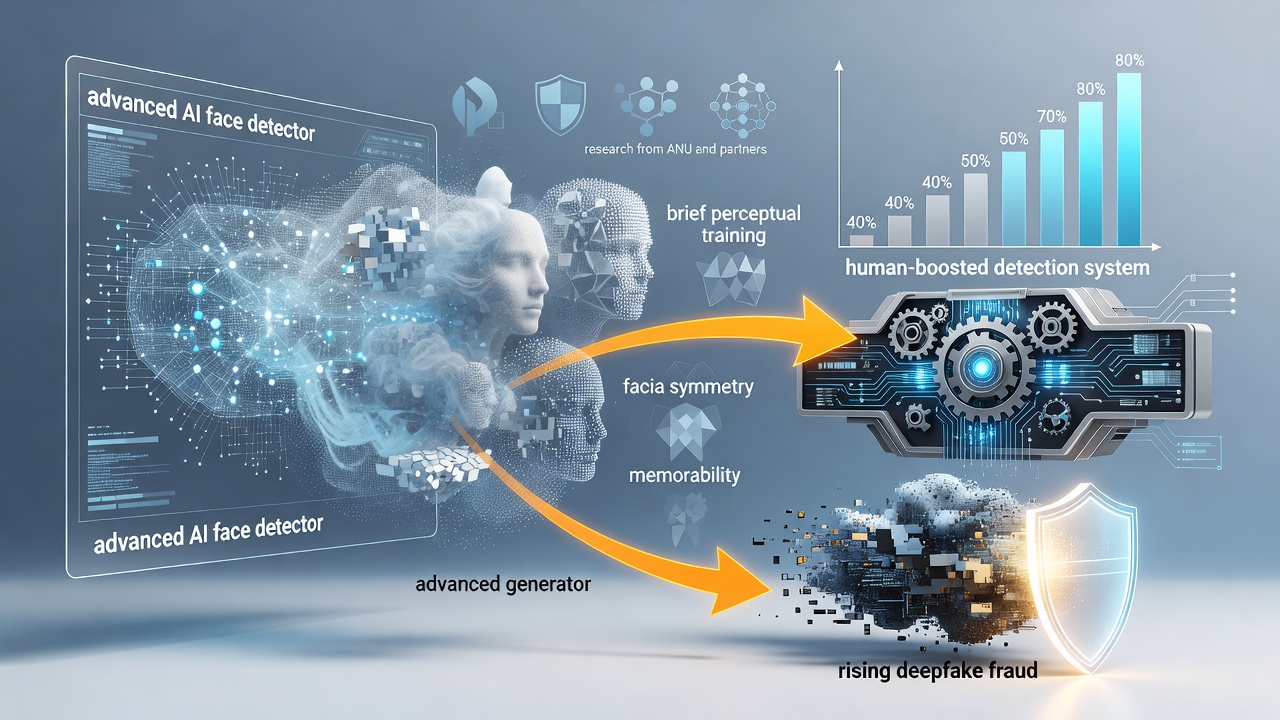
But a new wave of research offers a path forward. Humans can learn to spot these fakes. Not by chasing obvious errors. Instead, through brief, targeted practice that tunes perception to subtler cues. One study showed accuracy jumping from roughly 40% to nearly 80% after about an hour of training. Some participants neared perfect scores. The findings come from researchers at the Australian National University and partners including the University of Victoria and University of Aberdeen.
Proceedings of the National Academy of Sciences published the core paper in 2026. Lead author Associate Professor Amy Dawel of ANU explained the shift away from hunting artifacts. “Training on visual artifacts, like looking for a sixth finger or odd earrings, has had limited success, partly because the AI is getting too good, and fraudsters may avoid using pictures with obvious flaws anyway.” The team instead focused on six perceptual qualities: distinctiveness, memorability, proportionality, symmetry, attractiveness and expressiveness.
Previous attempts at education produced weak gains. Often around 10%. Sometimes none at all. They also raised false positives. People began labeling genuine faces as artificial. The Digital Trends coverage of the Aberdeen and ANU work highlighted this pivot. It stressed that modern generators powered by diffusion models and advanced GANs produce images free of classic tells. Reliance on them no longer works.
And the stakes keep rising. Deloitte has projected deepfake fraud losses in the US could hit £40 billion in a recent year, up from £12 billion earlier. One Hong Kong employee lost £25 million after a video call with what turned out to be a deepfake executive. An Associated Press report exposed an AI-created LinkedIn profile that slipped into American policy circles undetected at first. These cases show why detection matters beyond curiosity.
Yet algorithms alone won’t solve it. Many remain opaque. They break against new techniques. A February 2026 study from UNSW found humans often grow overconfident in their judgments. Most hover near chance levels. But a few “super-recognizers” perform markedly better. One paper noted these individuals reach 57% to 64% accuracy where others stay at 51%. Even they fall short for high-stakes uses like fraud prevention.
UNSW Newsroom quoted researchers hoping to dissect what makes those super-detectors tick. “Our research has revealed that some people are already sleuths at spotting AI-faces, suggesting there may be ‘super-AI-face-detectors’ out there. We want to learn more about how these people are able to spot these fake faces, what clues they are using, and see if these strategies can be taught to the rest of us.”
The ANU-led training succeeded by redirecting attention. Participants viewed batches of real and generated faces. Feedback revealed which was which. Over repetitions they built an intuitive feel. Not checklists. A gut sense of what feels off. Faces generated by current AI often appear too average. Too symmetric. Less memorable. They lack the quirks that make real people stick in memory. Training exploits those statistical differences.
Shorter sessions worked too. One experiment found five minutes of practice lifted performance noticeably. Super-recognizers started higher but both groups improved. A Royal Society Open Science paper from late 2025 tested exactly that on super-recognizers and controls. Trained groups outperformed untrained ones. The effect size held across ability levels. Yet even top performers rarely exceeded 60% without the intervention. Chance sits at 50%.
Biases in training data create extra openings. AI models generate older faces, children or non-white subjects less convincingly. Textures, lighting, skin tones betray them more often. Observers who learn these patterns gain an edge. One British Journal of Psychology study from February 2026 noted synthetic faces can seem more human than actual photos in some tests. They cluster toward the center of face space. Average in ways real faces rarely are.
But. The improvement isn’t automatic. Not every training method helps. Those focused purely on low-level artifacts often backfire. They teach people to see fakes everywhere. Or nowhere. The successful programs emphasize higher-order traits. How distinctive a face feels. How well it lingers in mind. Whether proportions and expressions match natural variation.
Recent coverage reinforces the momentum. A BBC article published just days ago described Aberdeen researchers achieving similar gains. Participants moved from 40% to 80% accuracy. They developed a calibrated confidence. Before training many guessed boldly but wrongly. Afterward their self-assessment matched reality closer. The piece tested readers with an interactive quiz. Results echoed the lab data.
So what does this mean for banks, governments and platforms? They can’t outsource judgment entirely to software. Detectors will improve. Some claim 99% accuracy on text. Faces prove harder. False positives destroy credibility. False negatives enable harm. A layered defense looks necessary. Automated flags plus trained human review.
Jim Tanaka of the University of Victoria partnered on the PNAS work. His lab’s statement captured the essence. “Our results show that AI detection can be trained up like other forms of perceptual expertise.” The brain adapts. Much as machine learning systems train on vast datasets, people refine their internal models through guided examples. Repetition. Feedback. Pattern extraction.
Critics point out limits. Five minutes or one hour won’t create experts overnight. Transfer to real-world deepfakes in motion or under poor lighting remains untested in many studies. Fraudsters adapt too. They may soon generate faces tuned to evade the new perceptual markers. Arms races rarely end cleanly.
Still the data accumulates. A 2025 Royal Society paper on super-recognizers concluded that even they rely on cues beyond obvious rendering bugs. Training helped both them and average participants reach above-chance levels. Another investigation in i-Perception found people actually recognize AI faces better in memory tasks than real ones in some setups. The synthetic versions trigger different perceptual pathways.
Financial services have taken notice. Deepfake scams targeting video calls and identity verification grow sophisticated. Training call-center staff or compliance teams could reduce successful breaches. Social media platforms might equip moderators with quick calibration exercises. Everyday users could benefit from browser tools that offer micro-training alongside detection scores.
One theme repeats across the literature. Overconfidence blinds. Many believe they spot fakes easily until tested. The UNSW team found that gap persists even among those who self-identify as skilled. Training narrows it. Participants learn when to trust their instincts and when to doubt.
AI faces aren’t going away. Generative tools grow cheaper and more accessible each quarter. Their use in advertising, entertainment and malicious impersonation will expand. Defenses must evolve in tandem. Software alone falls short. Human perception, sharpened through deliberate practice, adds a durable layer.
Researchers continue probing. They want to isolate exactly which strategies the natural super-detectors employ. Whether those tactics can scale to broader populations. How long the skills endure without refreshers. Whether training generalizes across ages, ethnicities and image qualities.
The irony sits plain. As artificial systems mimic humanity with increasing fidelity, people must train themselves in ways that echo machine learning. Exposure. Iteration. Error correction. The brain as classifier. And the early evidence says it works. Not perfectly. But well enough to matter. In a world flooded with synthetic media, that margin could prove decisive.


 WebProNews is an iEntry Publication