
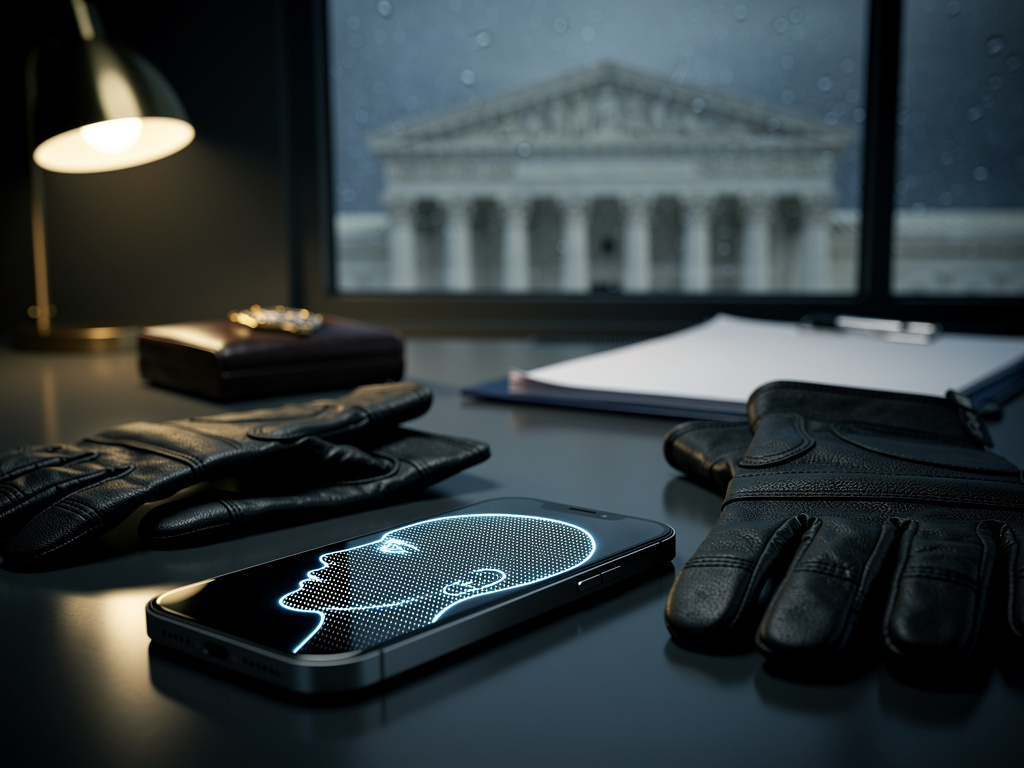
A routine morning in February 2023 turned into a constitutional crisis in miniature when FBI agents arrived at Washington Post reporter Hannah Natanson’s home with a warrant—not just for her phone, but for her face. The agents, investigating alleged leaks of classified information, didn’t simply seize Natanson’s iPhone. They compelled her to use her own biometric features to unlock it, raising profound questions about the Fifth Amendment’s protection against self-incrimination in an era when our bodies have become passwords.
According to The Intercept, the incident represents a growing trend in law enforcement’s approach to encrypted devices. While the Fourth Amendment governs whether police can search your property, the Fifth Amendment question of whether they can force you to provide the key—especially when that key is your fingerprint or face—remains murky legal territory that courts across the country are grappling with in real time.
The Natanson case illuminates a critical distinction that legal scholars have debated for years: the difference between testimonial evidence, which the Fifth Amendment protects, and physical evidence, which it does not. When police force a suspect to provide a fingerprint for comparison or a DNA sample, courts have consistently ruled this permissible. But using biometrics to unlock a phone containing potentially incriminating information occupies a gray zone that existing precedent struggles to address adequately.
The Legal Chasm Between Passcodes and Fingerprints
The constitutional framework for compelling device access has developed along two divergent paths. Courts have generally held that forcing someone to reveal a passcode violates Fifth Amendment protections because it requires the suspect to divulge the contents of their mind—testimonial evidence par excellence. This principle traces back to the Supreme Court’s decision in Doe v. United States, which established that the Fifth Amendment protects the content of a person’s thoughts, not merely their vocal cords.
Biometric unlocking, however, exists in murkier territory. In 2019, a federal judge in California issued a warrant explicitly prohibiting officers from forcing anyone present at a search location to unlock devices with biometrics, calling such compulsion a violation of Fourth and Fifth Amendment rights. Yet other courts have reached opposite conclusions, creating a patchwork of precedents that varies dramatically by jurisdiction. The Second Circuit Court of Appeals has suggested that compelled biometric unlocking might be permissible, while district courts in Illinois and Idaho have ruled it unconstitutional.
This inconsistency leaves both law enforcement and citizens in a state of uncertainty. As the Electronic Frontier Foundation has noted, the lack of clear Supreme Court guidance means that whether your constitutional rights protect you from forced biometric unlocking depends largely on geography—a troubling prospect for a fundamental constitutional question.
The Journalist Exception and Press Freedom Implications
The Natanson incident carries additional weight because of her profession. The Justice Department maintains specific guidelines limiting investigations involving journalists, recognizing that aggressive tactics against reporters can chill press freedom and the public’s right to information. These guidelines, strengthened after controversies during both the Obama and Trump administrations, generally require exhausting alternative investigative methods before seeking a journalist’s records and mandate approval from the Attorney General for such actions.
Whether federal agents followed these protocols in Natanson’s case remains unclear, but the biometric compulsion adds a new dimension to press freedom concerns. If law enforcement can force journalists to unlock their phones with their faces or fingerprints, the practical effect resembles compelling them to reveal their sources—precisely what the First Amendment and Justice Department policies aim to prevent. The Washington Post declined to comment extensively on the specifics of the case, citing ongoing legal proceedings, but media law experts have expressed alarm at the precedent.
Lucy Dalglish, dean of the Philip Merrill College of Journalism at the University of Maryland and a longtime press freedom advocate, told Columbia Journalism Review that the case represents “a technological end-run around protections that journalists have fought for decades to establish.” The ability to access a reporter’s phone potentially exposes not just sources but also story drafts, editorial discussions, and the entire journalistic process—a treasure trove of information that would have been far more difficult to obtain in the pre-smartphone era.
Technology Outpacing Legal Frameworks
The Natanson case exemplifies a broader challenge: constitutional law developed in the 18th century struggling to address 21st-century technology. When the Framers drafted the Fifth Amendment, they conceived of self-incrimination in terms of forced confessions and compelled testimony. They could not have imagined a world where people carry devices containing their entire digital lives, secured by biological features that can be deployed in seconds without conscious thought or explicit revelation of mental contents.
Biometric authentication technologies have proliferated faster than legal systems can adapt. Apple introduced Touch ID in 2013 and Face ID in 2017. Within years, these features became standard on hundreds of millions of devices worldwide. The convenience they offer—unlocking your phone with a glance rather than typing a six-digit code—comes with a constitutional trade-off that most users never consciously consider when enabling these features.
Some legal scholars argue that the distinction between passcodes and biometrics is artificial and should be collapsed. Orin Kerr, a professor at UC Berkeley School of Law and leading expert on digital privacy, has written extensively about the “foregone conclusion” doctrine, which holds that if the government already knows what it will find and can describe it with reasonable particularity, compelling someone to produce evidence may not violate the Fifth Amendment. Under this theory, if agents already know a phone belongs to a suspect and contains specific evidence, forcing biometric unlocking might be permissible—though this interpretation remains hotly contested.
Practical Implications for Digital Security
The uncertainty surrounding biometric compulsion has led security experts to recommend practical countermeasures. Both iOS and Android devices include features that temporarily disable biometric unlocking—on iPhones, rapidly pressing the side button five times activates a mode requiring the passcode. Privacy advocates recommend using this feature when encountering law enforcement, though whether doing so could be construed as obstruction remains another unsettled legal question.
The American Civil Liberties Union has published guidance suggesting that individuals concerned about forced biometric unlocking should consider disabling these features entirely, relying solely on strong passcodes. However, this advice conflicts with other security recommendations: biometric authentication, when combined with a passcode, provides stronger protection against remote hacking and unauthorized access than passcodes alone. Users face a difficult choice between security from digital threats and security from physical compulsion.
Riana Pfefferkorn, a research scholar at the Stanford Internet Observatory, noted in an interview with Wired that “we’re asking people to make constitutional law judgments when they’re setting up their phones.” The decision to enable Face ID shouldn’t require predicting how courts will interpret the Fifth Amendment, yet that’s effectively the situation users face today.
International Perspectives and Comparative Approaches
The United States isn’t alone in grappling with these issues. The United Kingdom’s Regulation of Investigatory Powers Act includes provisions compelling individuals to provide passwords or encryption keys, with refusal punishable by imprisonment—a stark contrast to American Fifth Amendment protections. In 2019, British authorities used these powers to jail a man for refusing to provide passwords to devices seized at an airport, despite no charges being filed related to the encrypted content itself.
The European Union’s approach reflects different constitutional traditions. The European Court of Human Rights has interpreted Article 8 of the European Convention on Human Rights—protecting private and family life—to provide some protections against compelled disclosure, though the doctrine remains less developed than American Fifth Amendment jurisprudence. Canada’s Charter of Rights and Freedoms includes protections against self-incrimination, but Canadian courts have generally been more permissive of biometric compulsion than some American jurisdictions.
These international variations highlight that the questions raised by the Natanson case aren’t merely technical legal puzzles but reflect fundamental choices about the balance between state power and individual privacy. Different societies, with different constitutional traditions and threat perceptions, are reaching different conclusions about where that balance should lie.
The Road Ahead for Digital Privacy Rights
Legal experts anticipate that the Supreme Court will eventually need to resolve the circuit split on biometric compulsion. The question is not if but when a case with the right procedural posture and factual circumstances will reach the nation’s highest court. The Natanson case, depending on how it proceeds through the legal system, could potentially become that vehicle, though journalist cases sometimes settle or resolve on narrower grounds to avoid setting broader precedents.
Meanwhile, Congress could intervene legislatively. Senator Ron Wyden has proposed legislation that would explicitly protect against compelled biometric unlocking, treating it equivalently to compelled passcode disclosure. However, law enforcement organizations have lobbied against such measures, arguing they would create insurmountable obstacles to legitimate investigations. The Fraternal Order of Police has testified that encryption already poses significant challenges to solving crimes, and additional restrictions on accessing locked devices would further hamper public safety efforts.
The technology industry has remained relatively quiet on the legal questions, though companies like Apple have consistently emphasized their commitment to user privacy. Apple’s refusal to create a backdoor to unlock the San Bernardino shooter’s iPhone in 2016 established the company’s stance on encryption, but biometric compulsion presents different technical and legal issues. Device manufacturers could theoretically implement features that provide additional protections—such as requiring passcode confirmation after biometric unlocking for certain sensitive apps—though no major platform has announced such plans.
Implications for Ordinary Citizens Beyond Journalists
While the Natanson case involves a journalist, the principles at stake affect every smartphone user. Approximately 90% of smartphone owners use some form of biometric authentication, according to industry surveys, meaning the vast majority of Americans have potentially made themselves vulnerable to compelled unlocking without fully understanding the constitutional implications. The convenience of biometric features has led to their near-universal adoption, but few users have considered the Fifth Amendment trade-offs.
Criminal defense attorneys report increasing instances of forced biometric unlocking, particularly in cases involving alleged drug trafficking, gang activity, and other serious crimes. Defense lawyers argue that accessing a phone’s contents can expose far more than evidence of the specific crime under investigation—text messages, photos, location data, and app usage can reveal intimate details of a person’s life, associations, and beliefs. The phone becomes not just evidence but a window into the totality of someone’s existence, raising questions about proportionality even when the initial search warrant was properly obtained.
The stakes extend beyond criminal cases. Immigration enforcement has used forced biometric unlocking at border crossings, where constitutional protections are attenuated. Civil asset forfeiture cases have involved phone searches that revealed financial information leading to property seizures. Family law cases have seen phones unlocked to gather evidence in custody disputes. The precedents set in criminal contexts inevitably spill over into these other domains, affecting millions of people who will never face criminal charges.
As the legal system slowly works toward resolution, individuals remain caught between competing security concerns and constitutional uncertainties. The Natanson case serves as a stark reminder that the most personal aspects of our lives—our faces, our fingerprints, our digital communications—now exist at the intersection of technology, law, and power. How courts ultimately resolve these tensions will shape privacy rights for generations, determining whether the Fifth Amendment’s protections extend to the biometric keys we use to lock away our digital selves, or whether the convenience of modern technology comes at the cost of constitutional rights our founders sought to protect.


 WebProNews is an iEntry Publication