
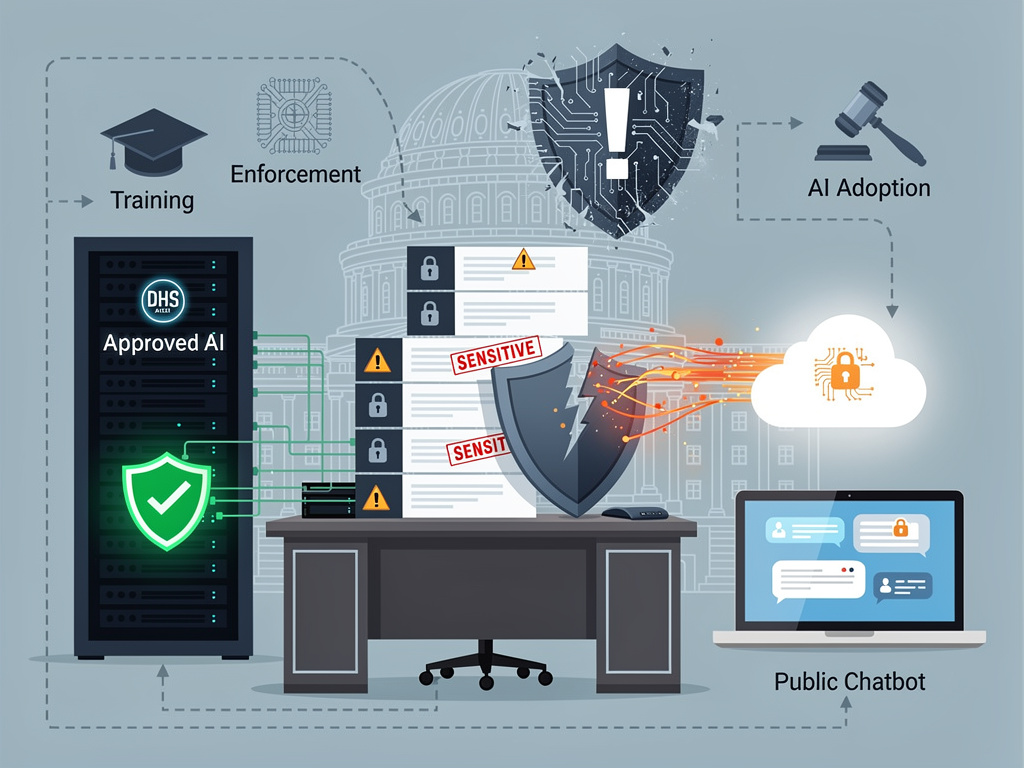
In a striking example of the gap between federal cybersecurity policy and practice, Madhu Gottumukkala, a senior official at the Cybersecurity and Infrastructure Security Agency, uploaded multiple documents marked “for official use only” to OpenAI’s public ChatGPT platform, circumventing the Department of Homeland Security’s approved artificial intelligence tools. The incident, first reported by CSO Online, raises fundamental questions about how government agencies enforce their own security protocols, particularly as they race to adopt generative AI technologies while managing the inherent risks these tools present.
The documents in question related to government contracting processes and were uploaded to the consumer version of ChatGPT, which by default uses input data to train and improve its models. This means sensitive government information could potentially be incorporated into OpenAI’s training datasets, accessible to the company’s employees, and possibly exposed through the chatbot’s responses to other users. The breach of protocol occurred despite DHS having established approved AI platforms specifically designed to prevent such data exposure, underscoring a troubling disconnect between institutional guardrails and individual compliance.
The Technical Reality of Data Persistence in AI Systems
When users upload documents to the free version of ChatGPT, those materials become part of OpenAI’s data ecosystem unless users explicitly opt out of data training—a setting many government employees may not be aware exists. Unlike enterprise versions of ChatGPT that offer data isolation guarantees, the public platform operates under terms of service that grant OpenAI broad rights to utilize input data. For government documents marked “for official use only,” this creates a chain of custody problem that violates federal information handling protocols designed to limit access to authorized personnel with appropriate clearances and need-to-know justifications.
The incident highlights the technical complexity of modern AI data flows. Once information enters a large language model’s training pipeline, extracting or guaranteeing its complete removal becomes practically impossible. The distributed nature of neural network weights means that sensitive information could influence model behavior in subtle, unpredictable ways. Security researchers have demonstrated that large language models can sometimes be prompted to reveal training data, though the likelihood varies significantly based on how the data was incorporated and the model’s architecture.
CISA’s Dual Role as Regulator and Violator
The irony of this incident cannot be overstated. CISA serves as the nation’s primary civilian cybersecurity agency, tasked with protecting federal networks and critical infrastructure from digital threats. The agency regularly issues guidance to both government entities and private sector organizations about secure AI adoption, data handling protocols, and the risks of shadow IT—the very behavior Gottumukkala’s actions exemplified. This contradiction between mission and practice undermines the agency’s credibility at a moment when federal AI governance frameworks are still taking shape.
CISA has been at the forefront of developing AI security guidelines, publishing frameworks for secure AI deployment and warning organizations about the risks of using unapproved cloud services. The agency’s own guidance emphasizes the importance of data classification, approved tool usage, and maintaining control over sensitive information. When senior officials bypass these protocols, it sends a troubling message about the enforceability and practical applicability of the very standards CISA promotes. The incident also raises questions about whether adequate training and technical controls are in place to prevent such violations.
The Broader Pattern of Government AI Adoption Challenges
This incident is not occurring in isolation but rather reflects broader tensions within federal agencies as they attempt to harness AI capabilities while maintaining security postures. Government employees increasingly face pressure to improve efficiency and leverage cutting-edge tools, yet the approved technology stack often lags behind commercial offerings. This creates incentives for workarounds and unauthorized tool usage, particularly when approved alternatives are perceived as cumbersome or less capable. The resulting shadow IT problem has plagued federal agencies for years, but generative AI has amplified both the temptation and the potential consequences.
Multiple federal agencies have struggled to balance AI innovation with security requirements. Some have banned generative AI tools entirely, while others have negotiated enterprise agreements with providers like OpenAI, Anthropic, and Google that include enhanced security provisions and data isolation guarantees. The Department of Homeland Security itself has approved specific AI platforms for employee use, making Gottumukkala’s decision to use the public ChatGPT particularly difficult to justify. The incident suggests that even when approved alternatives exist, awareness, training, and enforcement mechanisms may be insufficient to ensure compliance.
Contracting Documents and the Information Classification Dilemma
The specific nature of the uploaded documents—contracting materials marked “for official use only”—adds another dimension to this incident. While not classified at the Secret or Top Secret level, FOUO designations indicate information that could disadvantage the government if publicly released. Contracting documents often contain pricing strategies, vendor evaluation criteria, technical specifications, and procurement timelines that could provide unfair advantages to competitors or reveal vulnerabilities in government acquisition processes. The potential exposure of such information through an AI platform creates both immediate procurement risks and longer-term strategic concerns.
The FOUO designation, while less restrictive than formal classification levels, still carries legal and regulatory weight. Federal employees receive training on handling such materials, and violations can result in administrative sanctions, security clearance revocations, or in severe cases, criminal penalties. The casualness with which these documents were apparently uploaded to a consumer AI platform suggests either a significant gap in understanding of the risks or a concerning disregard for established protocols. Either explanation points to systemic problems in how agencies are preparing their workforces for the AI era.
OpenAI’s Enterprise Offerings and the Government Market
OpenAI has developed enterprise versions of ChatGPT specifically designed to address the data security and privacy concerns that make the consumer version inappropriate for sensitive applications. ChatGPT Enterprise and ChatGPT Team offer features including data encryption, administrative controls, and critically, guarantees that customer data will not be used for model training. These enterprise offerings have been adopted by numerous Fortune 500 companies and increasingly by government agencies seeking to leverage AI capabilities within their security frameworks. The existence of these alternatives makes the use of the consumer platform for government work even more problematic.
The incident underscores the importance of clear procurement pathways and user education. Even when secure alternatives exist, employees may default to familiar consumer tools if they are unaware of approved options or find them difficult to access. Government agencies must not only negotiate appropriate enterprise agreements but also ensure that employees know these tools exist, understand how to access them, and recognize why the consumer versions are prohibited for official business. This requires ongoing training, clear communication, and technical controls that make approved tools the path of least resistance.
Implications for Federal AI Governance and Policy
This incident arrives at a critical juncture for federal AI policy. The Biden administration has issued executive orders on AI safety and security, agencies are developing AI use cases across government functions, and Congress is considering legislation to establish AI governance frameworks. When senior officials at the agency responsible for cybersecurity fail to follow basic data handling protocols, it provides ammunition to AI skeptics and complicates efforts to develop balanced policies that enable innovation while managing risks. The incident may prompt calls for more restrictive approaches that could hamper legitimate AI adoption efforts.
The challenge for policymakers is to learn from this incident without overreacting in ways that stifle beneficial AI applications. The appropriate response likely involves strengthening technical controls, improving training programs, clarifying accountability mechanisms, and ensuring that approved AI tools are sufficiently capable and accessible that employees have no incentive to seek unauthorized alternatives. Simply banning AI tools drives usage underground; providing secure, approved alternatives with clear guidance offers a more sustainable path forward. The incident also highlights the need for automated data loss prevention systems that can detect and block attempts to upload sensitive information to unauthorized platforms.
Accountability and Organizational Culture in the Digital Age
As of the initial reporting, the consequences for Gottumukkala and any broader organizational response from CISA or DHS remain unclear. How agencies handle such incidents sends powerful signals about institutional priorities and the seriousness with which security protocols are regarded. A purely punitive response may discourage transparency and reporting of future incidents, while insufficient accountability could suggest that rules apply unevenly or that violations carry minimal consequences. The most effective approach likely combines individual accountability with systemic improvements that address the underlying conditions that enabled the incident.
The incident also raises questions about organizational culture and whether agencies have created environments where employees feel empowered to ask questions about appropriate tool usage before acting. In fast-moving technology domains like AI, employees will inevitably encounter situations where the right course of action is unclear. Organizations that foster cultures of security awareness, provide easily accessible guidance, and respond to questions without punitive reactions tend to experience fewer serious violations. Conversely, organizations where security is viewed as an obstacle rather than an enabler often see employees taking shortcuts that expose them to significant risks. CISA’s response to this incident will reveal much about which category the agency falls into and whether it can model the security culture it promotes to others.


 WebProNews is an iEntry Publication