
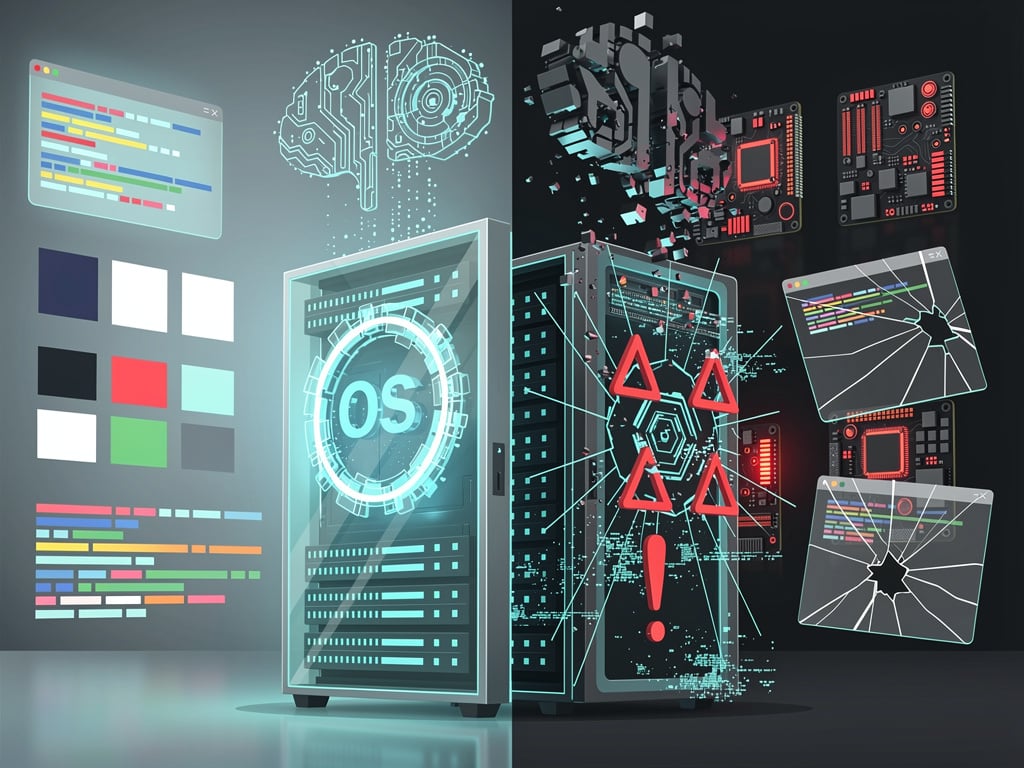
The dream of the self-writing computer program has existed almost as long as computer science itself. In recent months, that dream accelerated into a fever pitch with the release of various AI-first hardware devices. The latest entrant to this volatile market is the 01OS, an operating system developed by the team behind Open Interpreter. The project’s creator, Killian Lucas, made a bold claim that set the tech world buzzing: the entire operating system was “vibe-coded.” This term implies that rather than traditional line-by-line programming, the software was constructed by feeding natural language instructions—or “vibes”—into an artificial intelligence, which then generated the functional code. However, the resulting demonstration suggests that relying solely on AI to architect complex systems leads to a chaotic, barely functional product.
The 01OS project aims to create an open-source alternative to the proprietary AI gadgets currently struggling to find a foothold in the market. The premise is attractive: a device that interfaces with your home computer, allowing you to control applications through voice commands processed by a Large Language Model (LLM). Yet, as Futurism reported, the debut video for the 01 Light—the hardware component designed to run this software—revealed a system plaguing itself with errors, latency issues, and erratic behavior. The developer openly admitted the system was “buggy as hell,” attributing the instability directly to the fact that AI wrote the code. This admission raises serious questions about the viability of replacing human software engineers with generative models for foundational system architecture.
The Myth of Natural Language Programming
For decades, science fiction has promised an era where humans could simply speak to computers to generate complex software. The “vibe-coding” approach attempts to actualize this by using LLMs to translate intent into syntax. In the 01OS demonstration, the developer showcased how the system attempts to interpret vague commands to execute precise desktop actions. Theoretically, this democratizes coding, allowing anyone with an idea to build an operating system. In practice, the lack of precise logic resulted in a cursor that drifted aimlessly and commands that executed with agonizing slowness.
The core issue lies in the difference between probabilistic and deterministic systems. Traditional operating systems rely on deterministic code; if input A is received, action B must happen every time. AI models, conversely, are probabilistic. They predict the next likely token in a sequence. When an entire OS is built on these predictions without rigorous human oversight, the system inherits a fundamental instability. The “vibes” might be correct, but the execution logic often hallucinates, leading to the software equivalent of a structural collapse. The Futurism report highlights that even the promotional video, usually a venue for polished perfection, could not hide the system’s struggle to perform basic tasks like checking the weather or managing a calendar.
Hardware Disappointments and Market Saturation
The 01OS launch does not happen in a vacuum. It arrives amidst a wave of skepticism directed at AI hardware. High-profile failures like the Humane AI Pin and the Rabbit R1 have already soured public perception regarding standalone AI devices. These gadgets promised to liberate users from their smartphones but instead delivered slow response times, overheating batteries, and limited functionality. The 01OS attempts to pivot by positioning itself as a peripheral for your existing computer rather than a phone replacement, yet it suffers from the same fundamental flaw: the AI is not smart enough to reliably navigate a user interface designed for humans.
Critics point out that the rush to market for these devices often bypasses standard quality assurance phases. In the case of the 01OS, the “vibe-coded” label acts as both a marketing hook and a preemptive excuse for technical failures. By branding the bugs as a byproduct of an experimental coding method, the developers attempt to lower expectations while simultaneously hyping the futuristic methodology. However, users expecting a functional tool find themselves acting as unpaid beta testers for a concept that seemingly needs years of refinement before it becomes viable for daily use.
The Open Interpreter Context
To understand the 01OS, one must look at its foundation: Open Interpreter. This open-source project gained traction on GitHub by allowing LLMs to run code locally on a user’s machine. It was celebrated by developers for its transparency and flexibility, standing in contrast to closed systems like OpenAI’s ChatGPT. The 01OS was intended to be the physical manifestation of this software capability. The goal was to create a “Large Action Model” (LAM) capable of learning how to use apps just like a human does.
While the software library Open Interpreter is respected, the transition to a consumer-facing operating system exposed the limitations of the technology. Running scripts in a terminal is vastly different from managing a graphical user interface (GUI) in real-time. The demo video showed the AI struggling to identify screen elements, a task known as computer vision. When combined with the latency of processing voice commands and generating code on the fly, the user experience degrades rapidly. The friction involved in waiting for the AI to “think” and then potentially fail to click the right button makes using a mouse and keyboard significantly faster.
The Risks of Unsupervised Code Generation
Security experts have raised alarms regarding systems entirely generated by AI without strict human review. Code written by LLMs can introduce vulnerabilities that a seasoned developer would recognize and avoid. In a “vibe-coded” scenario, where the prompt is high-level and the output is accepted largely on faith, the potential for security exploits increases. If the OS misinterprets a “vibe” about file permissions, it could inadvertently expose sensitive user data.
Furthermore, maintenance becomes a nightmare. Codebases require structure, documentation, and adherence to design patterns to remain manageable. AI-generated code often resembles “spaghetti code”—a tangled mess of logic that works in isolation but breaks when integrated with other modules. If a bug arises in the 01OS, fixing it might require untangling a web of machine-generated logic that no human fully understands. The developer’s admission of the system being a disaster implies that debugging this creation is proving to be as difficult as building it, if not more so.
Community Reactions and Skepticism
The tech community’s response to the 01OS reveal has been a mixture of amusement and harsh critique. On platforms like X (formerly Twitter) and Hacker News, developers dissected the demo, noting the stark contrast between the lofty claims and the sputtering reality. Many drew parallels to the early days of the dot-com bubble, where adding a prefix like “e-” or “i-” to a product garnered investment regardless of utility. Today, claiming a product is “AI-native” or “vibe-coded” serves a similar function.
Despite the criticism, a subset of the open-source community remains optimistic. They argue that while the current iteration is flawed, the transparency of the project allows for collective improvement. Unlike the Rabbit R1, which hid its Android based architecture behind a closed interface, the 01OS invites developers to look under the hood. However, this openness also reveals the jagged edges of the technology. The consensus among pragmatic observers is that while the concept of an AI-operated computer is compelling, the current generation of LLMs lacks the reasoning capabilities required to execute it reliably.
The Future of AI in Operating Systems
The failure of the 01OS demo serves as a reality check for the industry. It suggests that the path forward is not replacing human coding entirely but augmenting it. Microsoft and Apple are integrating AI into their operating systems cautiously, using it for specific features like summarization or image editing, rather than handing over control of the mouse and keyboard. This hybrid approach maintains system stability while offering AI conveniences.
For the “vibe-coded” philosophy to succeed, AI models need to evolve beyond text prediction into genuine reasoning and planning. They require a deeper understanding of system architecture and causality. Until then, projects like 01OS remain fascinating experiments rather than viable products. They demonstrate the raw potential of generative AI while simultaneously highlighting the massive gap between a prototype and a production-grade operating system. The 01OS may eventually be remembered not as a breakthrough, but as a necessary stumble in the long march toward truly intelligent computing interfaces.


 WebProNews is an iEntry Publication