
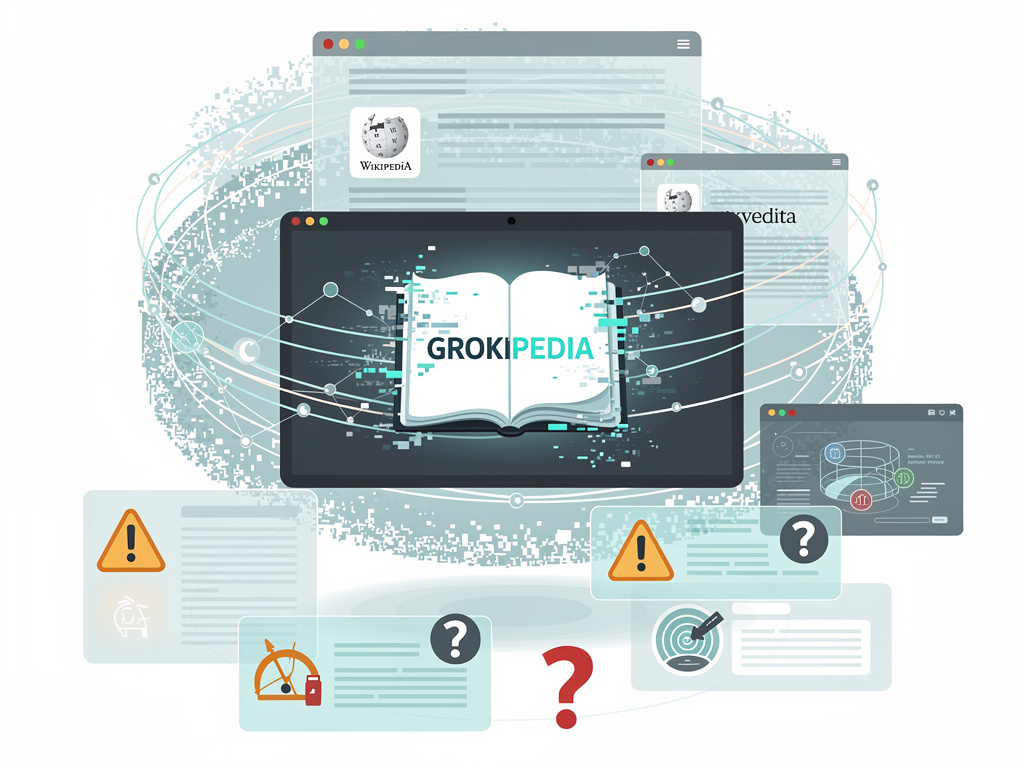
The artificial intelligence industry faces an unprecedented credibility crisis as chatbots increasingly cite fabricated sources, with Elon Musk’s xAI platform Grok emerging as a particularly troubling case study. According to The Verge, Grok has been caught referencing “Grokipedia”—a non-existent Wikipedia variant that appears to be a hallucination generated by the AI itself. This phenomenon represents more than a technical glitch; it reveals fundamental vulnerabilities in how large language models process, validate, and present information to millions of users who increasingly rely on AI for authoritative answers.
The discovery of Grokipedia citations marks a troubling evolution in AI hallucinations, moving beyond simple factual errors to the creation of entirely fictitious reference ecosystems. When users query Grok about various topics, the system sometimes provides detailed responses complete with citations to “Grokipedia,” presenting these references with the same confidence it displays when citing legitimate sources. The problem extends beyond mere confusion—it represents a recursive loop where AI-generated misinformation could eventually be ingested by other AI systems, creating a self-reinforcing cycle of synthetic falsehoods that become increasingly difficult to detect and correct.
Industry experts have long warned about the risks of “model collapse,” a phenomenon where AI systems trained on AI-generated content progressively degrade in quality and accuracy. The Grokipedia incident provides concrete evidence of this theoretical concern manifesting in real-world applications. As chatbots become more sophisticated at mimicking authoritative writing styles and citation formats, distinguishing between legitimate information and AI-generated fabrications becomes exponentially more challenging for average users who lack specialized knowledge to verify claims independently.
The Architecture of Artificial Authority
Large language models like Grok operate by predicting probable text sequences based on patterns learned from vast training datasets. When these systems generate citations, they aren’t actually consulting external databases or verifying sources in real-time. Instead, they’re producing text that statistically resembles how citations appear in their training data. This fundamental architectural limitation means that every citation a chatbot provides should be independently verified—a reality that contradicts how most users interact with these systems, treating them as search engines or reference tools rather than creative text generators.
The creation of Grokipedia as a hallucinated source represents what researchers call “confabulation”—when AI systems generate plausible-sounding but entirely fictional information to fill gaps in their knowledge. Unlike traditional search engines that retrieve and link to existing web content, generative AI creates new text on demand. When a model lacks specific information but recognizes the pattern of a user’s query requiring citation, it may fabricate a source that fits the expected format. The result is a citation that looks legitimate, complete with proper formatting and authoritative-sounding names, but points to nothing real.
The Competitive Pressure Cooker
The rush to deploy increasingly capable AI chatbots has created intense competitive pressure among technology companies, potentially at the expense of accuracy and reliability. XAI’s Grok entered a crowded market dominated by OpenAI’s ChatGPT, Google’s Gemini, Anthropic’s Claude, and Microsoft’s Copilot. Each company touts improvements in reasoning capabilities, response speed, and knowledge breadth, but the Grokipedia incident suggests that fundamental problems with hallucination and source verification remain unsolved across the industry.
Elon Musk has positioned Grok as a more truthful alternative to competitors, claiming it will provide uncensored and accurate information. The irony of Grok inventing its own Wikipedia variant undermines these claims and raises questions about whether the current generation of AI technology is ready for the widespread deployment it’s receiving. The incident also highlights how marketing narratives around AI capabilities often outpace the actual reliability of these systems, creating dangerous gaps between user expectations and technological reality.
The Wikipedia Problem and Information Ecosystems
Wikipedia itself has become a battleground in discussions about AI training data and information quality. The free encyclopedia represents one of the largest and most frequently updated knowledge repositories on the internet, making it invaluable for training language models. However, Wikipedia’s volunteer editors have grown increasingly concerned about AI-generated content infiltrating articles, potentially corrupting the very knowledge base that AI systems depend upon. The creation of “Grokipedia” as a hallucinated variant adds another layer to this complex relationship.
The recursive nature of this problem becomes apparent when considering how future AI models might be trained. If Grok’s outputs—including citations to Grokipedia—are scraped and incorporated into training datasets for next-generation models, these fictional references could propagate and multiply. Other AI systems might learn to cite Grokipedia or create their own variants, establishing a parallel universe of artificial references that exist only within the outputs of language models. This scenario isn’t hypothetical; researchers have already documented cases where AI systems trained on synthetic data exhibit degraded performance and increased hallucination rates.
User Trust and the Credibility Crisis
The broader implications for user trust cannot be overstated. Millions of people now use AI chatbots for research, fact-checking, and decision-making across personal and professional contexts. When these systems confidently cite non-existent sources, they undermine their own utility and potentially cause real harm. A student relying on Grok for research might include citations to Grokipedia in academic work, facing consequences for citing sources that don’t exist. A journalist might inadvertently incorporate fabricated information into reporting. A business professional might make decisions based on AI-provided analysis backed by fictitious references.
The problem extends beyond individual errors to systemic questions about accountability and correction. When a traditional publication makes a factual error, established processes exist for corrections, retractions, and accountability. When an AI chatbot hallucinates information and sources, the error exists in a probabilistic space rather than a specific published artifact. The same query posed to the same system at different times might produce different results, some with fabricated citations and others without, making systematic correction nearly impossible with current architectures.
Technical Solutions and Their Limitations
AI companies have implemented various strategies to reduce hallucinations and improve source reliability. Retrieval-augmented generation (RAG) systems attempt to ground AI responses in actual documents by first searching for relevant sources and then using those sources to inform generated text. This approach can reduce hallucinations but doesn’t eliminate them, and implementation quality varies significantly across different systems and use cases. The Grokipedia incident suggests that even with these safeguards, fundamental problems persist.
Another approach involves fine-tuning models specifically to refuse generating citations when uncertain or to explicitly label when information comes from training data versus external sources. However, these solutions face inherent trade-offs. Making systems more conservative about providing information reduces their usefulness for users who expect comprehensive answers. Requiring external verification for every claim would slow response times and increase computational costs. The economic incentives driving AI development favor speed and apparent capability over cautious accuracy, creating structural barriers to solving the hallucination problem.
Regulatory and Industry Responses
The Grokipedia incident arrives as regulators worldwide grapple with how to govern AI systems. The European Union’s AI Act includes provisions for transparency and accuracy in AI systems, particularly those deployed in high-risk contexts. However, enforcement mechanisms remain unclear, and the global nature of AI deployment complicates jurisdictional questions. When a chatbot accessible worldwide hallucinates sources, which regulatory body has authority to require corrections or impose penalties?
Industry self-regulation efforts have produced mixed results. Major AI companies have signed voluntary commitments to develop safe and trustworthy systems, but these agreements lack enforcement mechanisms and often contain vague language about accuracy and reliability. The competitive dynamics driving AI development create perverse incentives where companies face pressure to deploy systems quickly rather than ensuring comprehensive reliability. Until market forces or regulatory requirements change these incentives, hallucination problems like Grokipedia citations will likely persist.
The Path Forward for AI Credibility
Addressing the Grokipedia problem and broader hallucination issues requires acknowledging fundamental limitations in current AI architectures. Large language models excel at pattern matching and text generation but lack genuine understanding or fact-verification capabilities. Positioning these systems as authoritative information sources rather than sophisticated text generators creates false expectations and inevitable disappointment. A more honest framing would present AI chatbots as tools that require verification rather than replacements for traditional research methods.
Education represents another crucial component of addressing this challenge. Users need to understand how AI systems actually work—that they generate plausible-sounding text based on statistical patterns rather than consulting authoritative sources or verifying facts. This understanding would promote appropriate skepticism and verification behaviors. However, the user experience design of most chatbot interfaces actively works against this understanding, presenting generated text with confidence and authority that exceeds the systems’ actual reliability.
The Grokipedia incident serves as a valuable case study in the gap between AI marketing narratives and technological reality. As these systems become more deeply integrated into information ecosystems, research workflows, and decision-making processes, the industry faces a choice: continue prioritizing capability demonstrations and market share over reliability, or invest in fundamental architectural improvements that might reduce apparent capabilities but increase trustworthiness. The citations to non-existent sources aren’t merely bugs to be fixed—they’re symptoms of deeper issues that require rethinking how AI systems are designed, deployed, and positioned in society. Until the industry addresses these foundational questions, users should treat every AI-generated citation with the same skepticism they would apply to any unverified source, regardless of how authoritative it appears.


 WebProNews is an iEntry Publication