
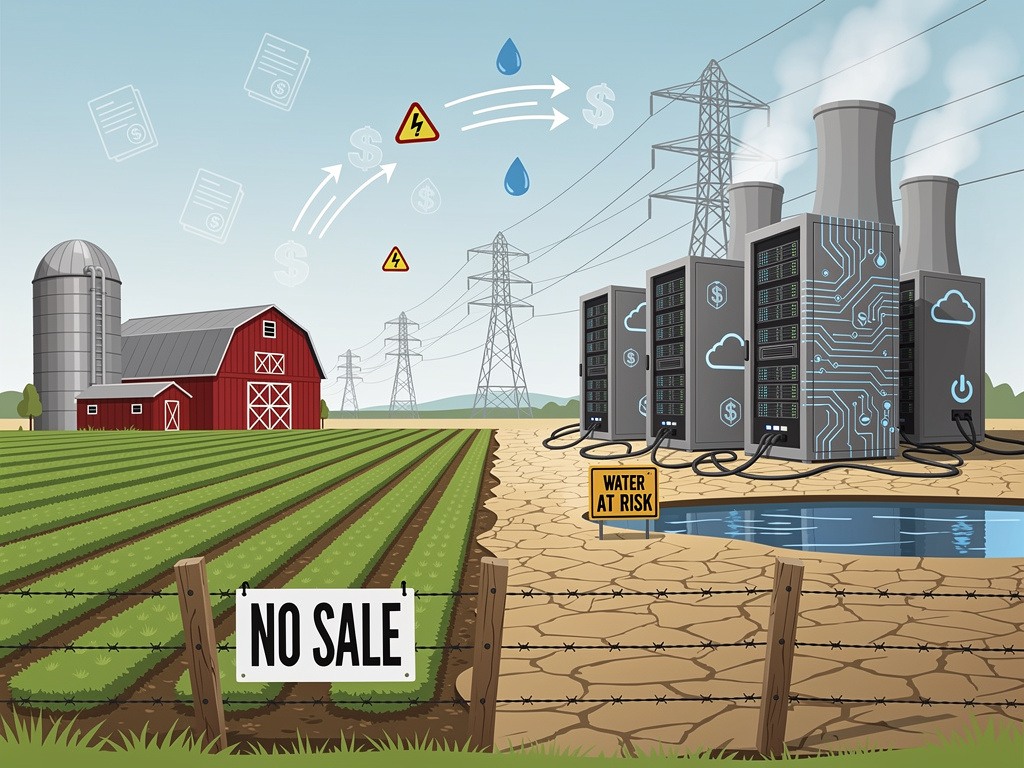
Across the American heartland, a quiet but consequential standoff is unfolding between two of the nation’s most powerful economic forces: agriculture and Big Tech. Farmers who have tended their land for generations are increasingly rejecting multimillion-dollar offers from technology companies eager to convert fertile acreage into sprawling data center campuses. The refusals, often made in the face of life-changing sums, reveal a deep tension between the insatiable demand for computing infrastructure and the values that have long defined rural America.
As reported by Slashdot, the phenomenon has accelerated in recent months as artificial intelligence workloads drive an unprecedented surge in data center construction. Companies including Microsoft, Amazon Web Services, and Meta have dispatched land agents across rural counties in Virginia, Ohio, Indiana, Iowa, and other states, dangling offers that can reach $50 million or more for parcels of several hundred acres. Yet a surprising number of landowners are saying no.
The AI Boom Fueling an Insatiable Appetite for Land
The arithmetic behind the land rush is straightforward. Training and running large language models and other AI systems requires enormous computing power, which in turn requires physical space, reliable electricity, and abundant water for cooling. Rural farmland often checks all three boxes. Proximity to high-voltage transmission lines, relatively cheap power from regional utilities, and flat terrain suitable for massive single-story buildings make agricultural parcels especially attractive to data center developers.
According to industry tracking firm CBRE, data center construction in the United States reached record levels in 2024 and has continued to climb in early 2025. Northern Virginia’s “Data Center Alley” in Loudoun County — already the world’s largest concentration of data centers — is running low on available power and land, pushing developers to scout adjacent counties and entirely new states. The same pressure is being felt in central Ohio, where Intel’s chip fabrication campus has attracted a constellation of supporting data infrastructure, and in Indiana, where agricultural land is being eyed for hyperscale facilities.
Generational Ties That Money Can’t Buy
For many farmers, the decision to reject a windfall offer is rooted in identity as much as economics. Families who have worked the same soil for a century or more view their land not merely as a financial asset but as a legacy — a physical connection to ancestors who cleared it, irrigated it, and passed it down. Selling to a data center developer would sever that link permanently, since the construction of a hyperscale facility typically involves grading the land, pouring vast concrete foundations, and installing infrastructure that renders the property unsuitable for future agricultural use.
“This land has been in my family since 1887,” one Indiana farmer told local media, explaining his refusal of an eight-figure offer. “No amount of money replaces what it means to us.” That sentiment is echoed across multiple states. In Ohio’s Licking County, where multiple data center proposals have drawn public scrutiny, farmers and longtime residents have organized opposition groups, arguing that the facilities would consume water resources, strain electrical grids, and fundamentally alter the character of their communities.
Water, Power, and the Infrastructure Squeeze
The concerns extend well beyond sentimentality. Data centers are voracious consumers of water and electricity, and rural communities are increasingly questioning whether their infrastructure can handle the load. A single large data center campus can consume millions of gallons of water per day for cooling — water that might otherwise irrigate crops or supply households. In drought-prone regions, the competition for water has become a flashpoint.
Electricity demand is equally contentious. The surge in data center construction has prompted utilities across the Midwest and Southeast to reconsider plans to retire coal-fired power plants, raising uncomfortable questions about the environmental cost of AI-driven computing. In Georgia, as reported by multiple outlets, local officials have debated whether the tax revenue from data centers justifies the strain on the grid. In Virginia, Dominion Energy has warned that the pace of data center growth is outstripping its ability to build new generation and transmission capacity, a bottleneck that has only intensified as AI workloads expand.
The Tax Revenue Temptation — and Its Limits
Local governments, for their part, are often enthusiastic about data center development. The facilities generate substantial property tax revenue and, during construction, create temporary employment. Some counties have offered generous tax incentives to lure developers, viewing data centers as an economic lifeline for communities that have watched manufacturing and agricultural employment decline for decades.
But the long-term employment picture is less rosy than it might appear. Once built, a data center employing several hundred construction workers may require only 30 to 50 full-time technicians to operate. The jobs are well-paying, but they are few, and they often require specialized skills that local residents may not possess. This has led some community leaders to question whether trading productive farmland for a handful of jobs and a tax payment is truly a favorable bargain, especially when the loss of agricultural output, rural character, and environmental resources is factored in.
Zoning Battles and Political Pushback
The friction has spilled into zoning hearings and county board meetings across the country. In several Virginia counties, residents have packed public forums to oppose rezoning requests for data center projects, citing noise from industrial cooling systems, light pollution, and the visual impact of massive windowless buildings on pastoral settings. In some cases, county supervisors have sided with residents, denying or delaying permits despite the promise of significant tax revenue.
In Ohio, state legislators have introduced bills that would give local communities more authority to regulate data center siting, responding to constituent complaints that developers have exploited permissive zoning codes designed for agricultural and light industrial use. Similar legislative efforts are underway in Indiana and Iowa. The political dynamics are complex: Republican-leaning rural districts that typically champion property rights and economic development are finding themselves at odds with the corporate interests that often align with their party’s pro-business agenda.
Developers Adjust Their Playbook
Faced with resistance, some data center developers are adjusting their strategies. A few have begun targeting brownfield sites — former industrial properties, retired power plants, or defunct shopping centers — that carry less emotional and agricultural significance. Others are exploring partnerships with farmers that would allow data centers to coexist with agricultural operations, though the feasibility of such arrangements remains unproven at scale.
Microsoft, for instance, has publicly committed to sustainability goals that include reducing water consumption at its data centers and investing in renewable energy to offset grid strain. Amazon Web Services has similarly pledged to match its electricity consumption with renewable sources. Whether these commitments are sufficient to assuage rural concerns is another matter. Critics point out that corporate sustainability pledges often operate on long timelines and rely on carbon credits or offsite renewable projects that do little to address the immediate, local impact of a new facility.
A Broader Reckoning Over Land Use in the AI Era
The standoff between farmers and data center developers is, at its core, a question about how America allocates its finite land resources in an era of surging demand for digital infrastructure. The United States loses roughly two million acres of farmland per year to development of all kinds, according to the American Farmland Trust. Data centers represent a small but rapidly growing share of that conversion, and the trend shows no sign of slowing as AI investment accelerates.
Some agricultural economists warn that the long-term consequences of converting prime farmland could be severe. With global food demand projected to rise significantly by mid-century, every acre of productive soil matters. The irony is not lost on observers: the same AI systems that promise to optimize crop yields and improve agricultural efficiency are, through their physical infrastructure requirements, consuming the very land on which food is grown.
For now, the farmers who are saying no to Big Tech’s millions are making a bet of their own — that the value of their land, measured not in dollars but in bushels, heritage, and community, will endure long after the servers have been decommissioned. Whether the market and the political system will continue to respect that bet remains an open question, one that will shape the American countryside for decades to come.


 WebProNews is an iEntry Publication