
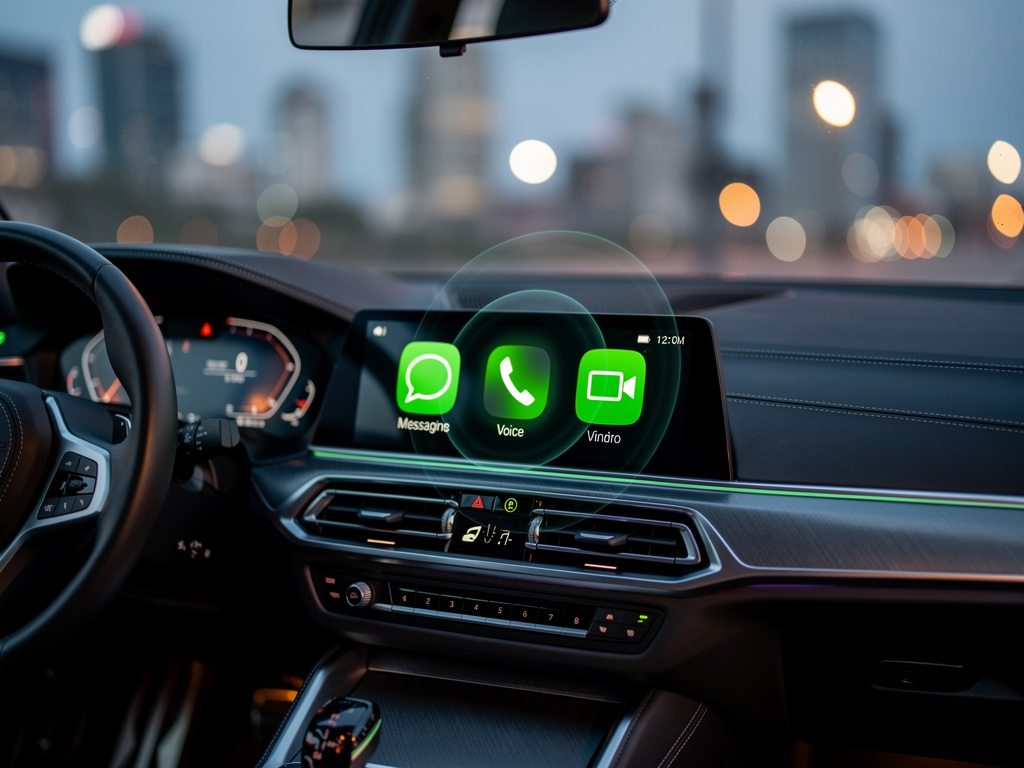
For years, the world’s most popular messaging app was conspicuously absent from the dashboard of every Apple CarPlay–equipped vehicle. That absence ends now.
WhatsApp has officially launched a native CarPlay application, giving its more than two billion users the ability to make and receive voice and video calls directly through their car’s infotainment system. The update, first spotted in WhatsApp beta builds and now rolling out broadly, represents one of the most requested features in the app’s history — and one that Meta took a remarkably long time to deliver.
As MacRumors reported, the new CarPlay integration allows WhatsApp users to initiate calls, receive incoming calls, and access their recent call history and favorite contacts — all from the vehicle’s built-in display. The interface mirrors the clean, simplified design language Apple requires of CarPlay apps, with large touch targets and minimal distraction. Voice messages can be played back through the car’s speakers. Siri integration means users can dictate and send text messages hands-free.
No video playback while driving, obviously. Apple’s CarPlay framework prohibits it.
The timing is notable. Apple has been steadily expanding what third-party developers can do inside CarPlay, particularly since announcing the next-generation CarPlay platform that promises deeper vehicle integration. WhatsApp’s arrival suggests Meta is positioning itself to be a first-class citizen on that platform as it matures. And it comes at a moment when competition among messaging apps for in-car presence is intensifying — Telegram launched its own CarPlay calling feature late last year, and Google Messages has long worked with Android Auto.
Meta had tested WhatsApp CarPlay functionality in limited beta releases over the past several months, according to MacRumors. Beta testers reported that the app was stable but initially lacked support for group calls, a limitation that appears to have been resolved in the public release. Group voice calls with up to 32 participants now work through CarPlay, though the interface simplifies the experience to show only the active speaker’s name.
The feature requires WhatsApp version 25.8 or later on an iPhone running iOS 18 or newer. It works with any CarPlay-compatible vehicle, whether using a wired USB connection or wireless CarPlay. Setup is automatic — once WhatsApp is updated, the app icon appears on the CarPlay home screen without any additional configuration.
This matters more than it might seem at first glance. WhatsApp isn’t just another messaging app. In vast swaths of Europe, Latin America, Africa, and South Asia, it is the primary communications tool — often replacing traditional phone calls entirely. Families coordinate through it. Businesses run on it. In countries like Brazil, India, and Germany, WhatsApp is effectively the phone network. The fact that these users couldn’t access their primary calling app through their car’s dashboard was a genuine daily friction point.
Consider the numbers. Apple says CarPlay is available in more than 98% of new cars sold in the United States. Globally, hundreds of millions of vehicles support it. The overlap between WhatsApp’s user base and CarPlay-equipped vehicles is enormous, particularly in European markets where both Apple’s market share and WhatsApp’s dominance are strong.
So why did it take so long?
Part of the answer is technical. Apple’s CarPlay API for messaging and calling apps has evolved significantly over the past few years. Earlier versions of the framework were restrictive, essentially limiting third-party apps to audio playback and navigation. Apple gradually opened up calling capabilities to VoIP apps through its CallKit framework, but the integration required careful work to meet Apple’s strict safety and user interface guidelines. WhatsApp’s end-to-end encryption added another layer of complexity — the app had to ensure that call audio routed through the vehicle’s Bluetooth system without compromising its encryption protocols.
But part of the delay was also strategic. Meta has historically been slow to adopt Apple platform features, a reflection of the deep tension between the two companies. Mark Zuckerberg and Tim Cook have publicly clashed over privacy, app store economics, and the future of computing. Meta’s apps on iOS have sometimes lagged behind in adopting new Apple technologies — whether widgets, App Clips, or Live Activities — in ways that feel deliberate. The CarPlay gap fits that pattern.
Whatever the reason for the wait, the execution appears solid. Early user reports on social media describe the CarPlay app as responsive and intuitive. The call quality matches what users experience when holding the phone directly, which makes sense — the audio is simply being routed through the car’s speakers and microphone via Bluetooth or USB, with WhatsApp handling the connection on the backend.
There are limitations. You can’t browse chat conversations through CarPlay. You can’t view photos, documents, or location shares. The app is strictly a calling interface with message dictation bolted on. Apple’s CarPlay guidelines demand this level of restraint, and WhatsApp has complied. For users who want the full messaging experience, the phone still needs to come out — though ideally not while driving.
The launch also raises questions about what comes next for WhatsApp on Apple’s platforms. The app still lacks a native Apple Watch application, a gap that competitors like Telegram have filled. There’s no WhatsApp widget for the iPhone lock screen or home screen that shows unread message counts in real time. And WhatsApp’s iPad app, while finally available after years of requests, remains limited compared to the iPhone version. CarPlay support is a step forward, but Meta’s iOS feature parity story remains incomplete.
For Apple, WhatsApp’s arrival on CarPlay is straightforwardly good news. It makes CarPlay more useful for a massive global user base and strengthens the case for CarPlay over competing systems. Apple has been fighting to maintain CarPlay’s dominance as automakers — particularly General Motors — have explored dropping CarPlay support in favor of their own built-in software. Every major app that commits to CarPlay makes that calculation harder for automakers to justify.
And for drivers? It’s simple. The app they use most for calls now works where they spend hours every day. No workarounds. No Bluetooth workarounds routing through the regular phone dialer. Just WhatsApp, on the screen, working the way it should have years ago.
The update is available now on the App Store worldwide.


 WebProNews is an iEntry Publication