
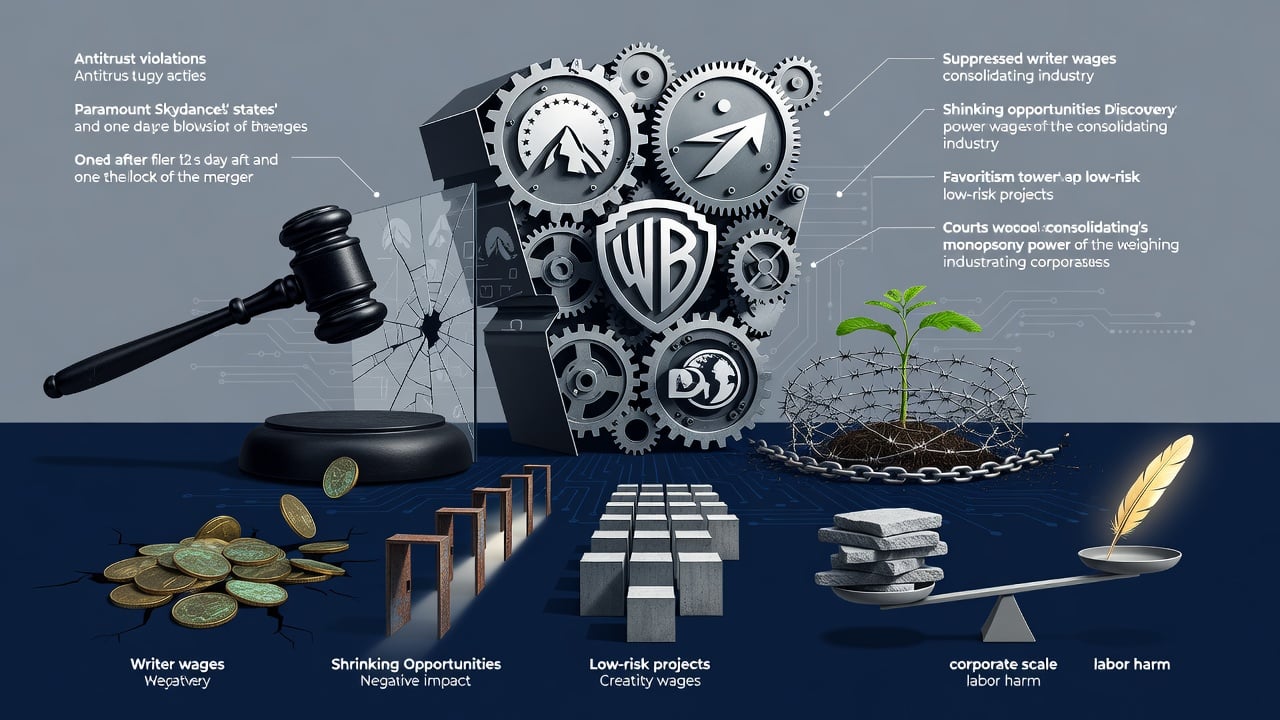
The Writers Guild of America has filed suit to block Paramount Skydance’s proposed $111 billion takeover of Warner Bros. Discovery. The complaint, lodged in federal court in Northern California, argues the deal violates antitrust statutes. It would hand one buyer outsized control over script purchases. And that power, the union says, would squeeze writers’ pay while shrinking job prospects across film, episodic TV and streaming.
Short and sharp. The merged company becomes the dominant purchaser of original programming in the United States. Fewer rivals mean stronger incentive to cut costs. Studios converge on safe bets. Original voices lose out. That dynamic already played out after earlier consolidations. The 2022 Warner Bros.-Discovery tie-up and the 2025 Paramount-Skydance combination each triggered layoffs and tighter budgets. Writers saw the pattern coming.
“With fewer competitors, the merged Paramount-Warner Bros. entity would have both the incentive and the ability to lower costs by suppressing writers’ wages and reducing output,” the complaint states, according to Variety. “Writers will be paid less and have fewer employment opportunities.” The language appears almost verbatim across coverage from Deadline and The Hollywood Reporter. Michele Mulroney, president of WGA West, put it plainly: the merger threatens livelihoods and creative diversity in an already consolidated industry. Chris Fontana, WGA East president, echoed the concern, warning that the new giant would suppress wages and opportunities especially for emerging writers.
But why now? The suit landed one day after 12 state attorneys general filed their own antitrust challenge. Those officials sought a temporary restraining order to pause the transaction. They focused on theatrical distribution and basic cable markets where the combined entity would wield anticompetitive power. The WGA coordinated with those offices and federal lawmakers for months. It praised the states’ action yet chose to file separately. Labor impacts demanded their own spotlight. The union hired Shinder Cantor Lerner, Cuneo Gilbert & LaDuca, and Platkin to press the case.
Paramount pushed back. Executives called the state suit a misunderstanding of antitrust precedent. They insisted the true market includes Amazon, Apple and Netflix, not just legacy studios. The deal, they argued, would strengthen the company. More slates. More greenlights. Better outcomes for creators. David Ellison, who would lead the enlarged operation, met with House members on federal film tax incentives hours after the states sued. The timing underscored the stakes.
Yet the numbers tell a different story for writers. The merged firm would control roughly one-third of U.S. entertainment media, per estimates cited in Engadget. It would stand as the single largest employer of screenwriters. That concentration gives the buyer leverage to dictate terms. Lower minimums. Shorter overall deals. Reduced volume of original series and films. Studios favor franchises over risky originals. The creative pipeline narrows. Pay stagnates. Opportunities vanish for mid-level and junior writers who once cycled through multiple buyers.
Industry watchers have seen this movie before. The 2000 AOL-Time Warner deal promised synergy but delivered years of contraction. The 2019 Disney-Fox transaction concentrated content ownership and squeezed suppliers. Each wave of consolidation left fewer doors open. Writers, still recovering from the 2023 strike that centered on residuals and AI protections, view this merger as the next threat. They aren’t alone. Actor Mark Ruffalo joined a petition against the deal that gathered more than 5,000 signatures. Cinema United, a coalition of industry groups, backed the states’ lawsuit and called the combination dangerous.
So far the Justice Department has approved the transaction. Paramount fought off a partial bid from Netflix earlier this year and sealed the Warner Bros. Discovery pact in June. But court challenges can still derail or delay it. Paramount owes Warner shareholders $650 million for every 90 days the deal slips. That pressure may force a quicker resolution. Or it may embolden opponents to dig in.
The WGA’s filing marks a rare direct intervention by a labor union in a corporate merger. It frames the deal not just as an antitrust issue but as an existential threat to the craft of screenwriting. If the courts agree, the ruling could reshape how future media deals are scrutinized. Pay, output, creative risk. All hang in the balance.
Recent coverage adds urgency. On the same day as the WGA suit, New York Post reported the union joined a growing chorus of challengers. X posts from industry accounts amplified the complaint’s core warning: consolidation looks efficient on spreadsheets until the labor pool realizes it has become redundant. One analyst noted the merged entity could decide who gets paid to write the next blockbuster or streaming hit. Another highlighted that the WGA’s focus on monopsony power, a single dominant buyer, distinguishes its argument from the states’ broader market claims.
Legal experts following the case say the union must prove not only reduced competition but concrete harm to writers as a class. The complaint cites internal studio documents and post-merger behavior from prior deals to build that record. Whether judges accept that evidence will shape the outcome. For now the battle lines are drawn. Writers, states and a handful of high-profile artists stand against one of the largest media combinations in history. The coming months will test whether antitrust law still protects the creative workforce or bends to scale.


 WebProNews is an iEntry Publication