
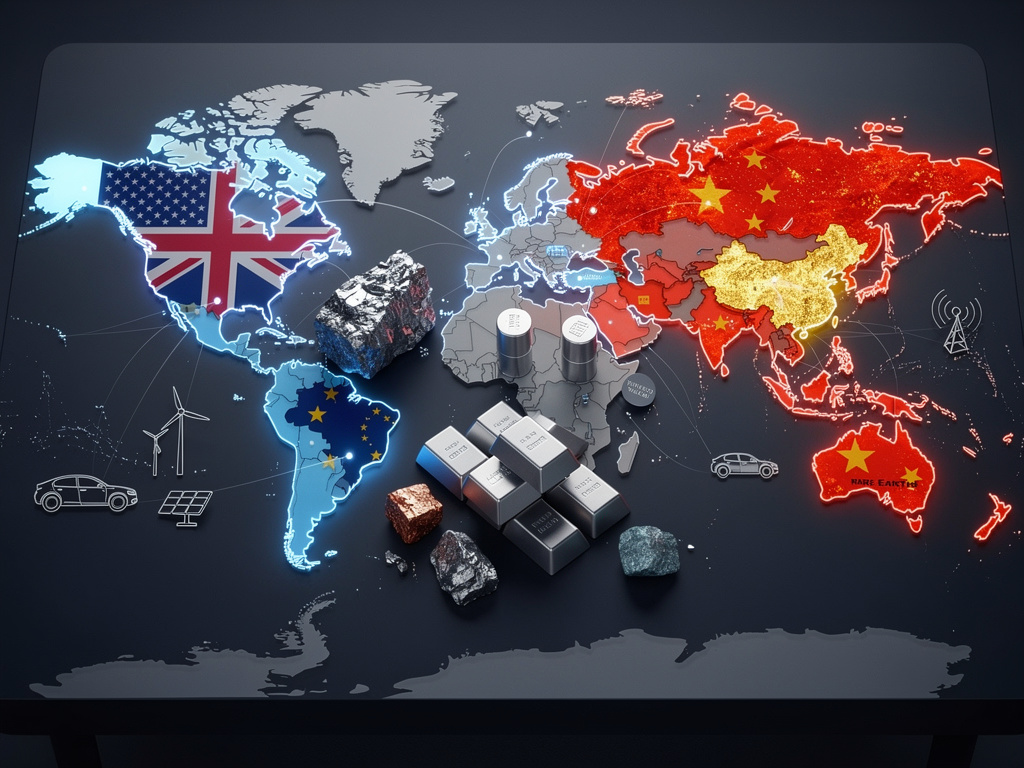
In an unprecedented coordinated effort to reshape global commodity markets, the United States, United Kingdom, European Union, and Australia are advancing plans to establish minimum price guarantees for critical minerals and rare earth elements. This strategic intervention, which represents the most significant Western challenge to China’s market dominance in decades, signals a fundamental shift in how democratic nations approach resource security in an era of intensifying geopolitical competition.
The proposed mechanism would guarantee producers of lithium, cobalt, nickel, and rare earth elements a floor price for their output, effectively creating a safety net that encourages investment in mining and processing facilities outside China’s sphere of influence. According to The Guardian, discussions among G7 finance officials have accelerated in recent months, with technical working groups now drafting implementation frameworks that could be operational within eighteen months. The initiative draws inspiration from agricultural price support programs but applies them to materials essential for electric vehicles, renewable energy systems, and advanced defense technologies.
China currently controls approximately 60 percent of global rare earth mining and processes nearly 90 percent of these materials into usable forms for manufacturing. This asymmetric dominance has created vulnerabilities that Western policymakers increasingly view as untenable. Beijing’s willingness to weaponize resource access—demonstrated through export restrictions on gallium and germanium in 2023—has transformed critical minerals from mere economic considerations into matters of national security. The proposed price floor mechanism aims to counteract China’s ability to flood markets with subsidized materials, a tactic that has historically bankrupted Western competitors and consolidated Beijing’s control.
Architectural Design of the Price Support System
The contemplated structure would establish reference prices for key minerals based on production costs in democratic nations, adjusted for reasonable profit margins and environmental compliance expenses. When market prices fall below these thresholds, participating governments would compensate producers for the difference through direct payments or tradable certificates. This approach differs fundamentally from tariffs or quotas by supporting domestic production without explicitly restricting imports, potentially avoiding World Trade Organization conflicts that have plagued previous industrial policy initiatives.
Treasury officials from participating nations have emphasized that the mechanism would incorporate strict environmental and labor standards, effectively creating a “premium tier” of responsibly sourced materials. Mining operations would need to demonstrate compliance with emissions targets, water management protocols, and worker safety requirements to qualify for price support. This dual-purpose design addresses both supply chain security and the growing corporate demand for materials with verified sustainability credentials, potentially creating market differentiation that justifies higher costs to end users.
Economic Implications and Market Dynamics
Financial modeling conducted by policy advisors suggests the program could require annual commitments ranging from $15 billion to $40 billion across participating nations, depending on commodity price volatility and production volumes. While substantial, proponents argue these figures pale in comparison to the economic and security costs of continued dependence on potentially hostile suppliers. The European Commission has reportedly allocated preliminary budget authority for its share, viewing the expenditure as insurance against supply disruptions that could paralyze the continent’s automotive and renewable energy sectors.
Market analysts have expressed skepticism about whether artificial price floors can overcome China’s structural advantages in processing infrastructure and integrated supply chains. Chinese facilities benefit from decades of accumulated expertise, proximity to manufacturing clusters, and regulatory environments that prioritize production volume over environmental concerns. Even with price supports, Western operations face challenges in attracting skilled workers, navigating permitting processes that can extend beyond a decade, and competing against established relationships between Chinese suppliers and global manufacturers.
Geopolitical Calculations and Strategic Rivalry
The initiative represents a calculated escalation in the economic dimension of great power competition, acknowledging that technology leadership increasingly depends on access to specific geological resources. Pentagon strategists have identified critical mineral dependency as a potential Achilles heel in conflict scenarios, where Chinese control over materials essential for missile guidance systems, radar components, and communications equipment could provide decisive leverage. The price floor mechanism aims to catalyze investment in alternative supply chains before such vulnerabilities can be exploited.
Beijing has already signaled its displeasure with the proposal, with state media characterizing it as a protectionist scheme that violates free market principles—an ironic stance given China’s own extensive industrial subsidies. Chinese officials have hinted at potential countermeasures, including preferential access arrangements with developing nations and accelerated efforts to secure long-term supply contracts with African and Latin American producers. This dynamic threatens to bifurcate global commodity markets into competing spheres of influence, with suppliers forced to choose alignment with either Chinese or Western purchasing blocs.
Industry Response and Corporate Strategy
Mining executives have offered cautious support for the initiative while emphasizing that price guarantees alone cannot overcome all barriers to Western production expansion. Capital intensity remains a fundamental challenge, with modern rare earth processing facilities requiring investments exceeding $1 billion and construction timelines spanning five to seven years. Companies need assurance that political commitment will outlast electoral cycles and that support mechanisms won’t be abandoned once immediate supply concerns ease, leaving investors stranded with stranded assets.
Automotive manufacturers and battery producers have expressed concern about potential cost implications, warning that artificially elevated mineral prices could undermine electric vehicle adoption rates and climate transition timelines. Industry groups are lobbying for the price floor to be set at levels that ensure supply security without creating windfall profits for mining companies or unsustainable cost burdens for downstream users. This tension between security objectives and economic efficiency will likely require ongoing calibration as the program matures.
Technical Implementation Challenges
Establishing credible reference prices presents significant methodological challenges, as production costs vary dramatically based on ore grades, extraction methods, and geographic factors. Policymakers must develop transparent formulas that resist political manipulation while remaining responsive to legitimate cost fluctuations. The system will also need mechanisms to prevent fraud, ensuring that supported production actually reaches intended markets rather than being diverted or sold to ineligible buyers at subsidized rates.
Coordination among participating nations adds another layer of complexity, as each jurisdiction operates under different budgetary constraints, regulatory frameworks, and political pressures. The United States might prioritize lithium for battery production, while European nations focus on rare earths for wind turbines, and Australia emphasizes its comparative advantages in hard rock mining. Harmonizing these priorities while maintaining a unified front against Chinese market power will require sustained diplomatic effort and compromise on national preferences.
Environmental and Social Dimensions
Environmental organizations have offered qualified support for the initiative, recognizing that Western production standards generally surpass those in China, where rare earth processing has generated extensive soil and water contamination. However, advocacy groups emphasize that price supports must not become blank checks for environmentally destructive practices, insisting on rigorous oversight and community consent requirements for new mining projects. The tension between rapid supply chain development and environmental protection will test policymakers’ ability to balance competing imperatives.
Indigenous communities in Australia and North America, whose territories contain significant mineral deposits, are demanding meaningful participation in project governance and benefit-sharing arrangements. Previous mining booms have left legacies of environmental degradation and social disruption without corresponding economic gains for affected populations. The price floor initiative offers an opportunity to establish new models of resource development that respect indigenous rights and deliver equitable outcomes, though achieving this will require genuine commitment rather than perfunctory consultation.
Long-Term Strategic Outlook
The success of this initiative will ultimately be measured not in tons of minerals produced but in whether it achieves genuine supply chain resilience and reduces coercive leverage in the international system. If the price floor mechanism catalyzes sufficient Western production to create viable alternatives to Chinese suppliers, it could represent a turning point in the deglobalization of strategic industries. Conversely, if it proves economically unsustainable or politically contentious, it may simply accelerate China’s efforts to lock in long-term supply arrangements with non-aligned nations.
The program also raises fundamental questions about the future of market-based resource allocation in an era of renewed strategic competition. By explicitly subordinating market efficiency to security considerations, Western democracies are acknowledging that pure economic logic cannot address all challenges posed by authoritarian state capitalism. Whether this represents a temporary aberration or a permanent shift toward more managed international economic relations will profoundly shape the global trading system for decades to come. As these nations move from planning to implementation, the critical minerals initiative will serve as a test case for whether democratic governments can match the strategic coherence and long-term commitment that characterize China’s approach to economic statecraft.


 WebProNews is an iEntry Publication